Ludwig Katharina, Huppertz Tilman, Radsak Markus, Gouveris Haralampos
Sleep Medicine Center, Department of Otorhinolaryngology, Medical Center of the Johannes Gutenberg-University of Mainz, Mainz, Germany.
IIIrd Department of Medicine, Medical Center of the Johannes Gutenberg-University of Mainz, Mainz, Germany.
Front Surg. 2022 Jul 6;9:890377. doi: 10.3389/fsurg.2022.890377. eCollection 2022.
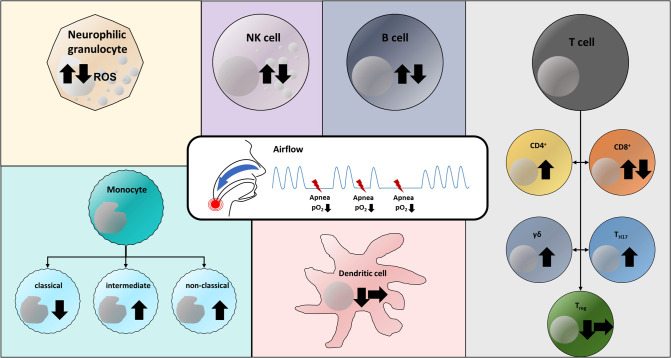
Obstructive sleep apnea (OSA) is the most common sleep-related breathing disorder. Repetitive pauses in breathing during sleep cause a brief but recurrent decrease in oxygen saturation in organs and tissues (chronic intermittent tissue hypoxia). Many studies have proven a pro-inflammatory status in OSA patients. However, few reports are available on the effects of OSA on the cellular immune system, mostly focusing on single immune cell types and their subtypes. The aim of this Mini-Review is to summarize these reports, as OSA is associated with a high prevalence and comorbidities such as atherosclerosis, which are known to involve the cellular immune system.
阻塞性睡眠呼吸暂停(OSA)是最常见的与睡眠相关的呼吸障碍。睡眠期间呼吸反复暂停会导致器官和组织中的氧饱和度出现短暂但反复的下降(慢性间歇性组织缺氧)。许多研究已证实OSA患者存在促炎状态。然而,关于OSA对细胞免疫系统影响的报道较少,大多集中在单一免疫细胞类型及其亚型上。本综述的目的是总结这些报道,因为OSA的患病率较高,且伴有动脉粥样硬化等合并症,而这些疾病已知与细胞免疫系统有关。