Clinical Research Service Center, Affiliated Hospital of Guangdong Medical University, Zhanjiang, China.
Guangdong Engineering Research Center of Collaborative Innovation Technology of Clinical Medical Big Data Cloud Service in Medical Consortium of West Guangdong Province, Affiliated Hospital of Guangdong Medical University, Zhanjiang, China.
Front Public Health. 2022 Jul 8;10:938770. doi: 10.3389/fpubh.2022.938770. eCollection 2022.
Multiple myeloma (MM) imposes a heavy burden in China. Understanding the secular trend of MM burden and projecting its future trend could facilitate appropriate public health planning and improve the management of MM.
Sex-specific incidence and mortality rates of MM in China from 1990 to 2019 were collected from the Global Burden of Disease 2019 study. The secular trend of MM burden was analyzed by joinpoint regression. Age-period-cohort model was used to analyze the effects of age, period, and birth cohort on MM burden and project future trends up to 2044.
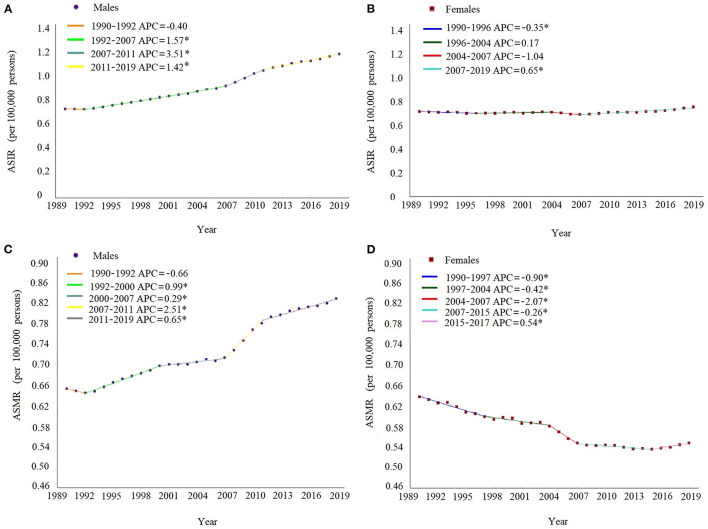
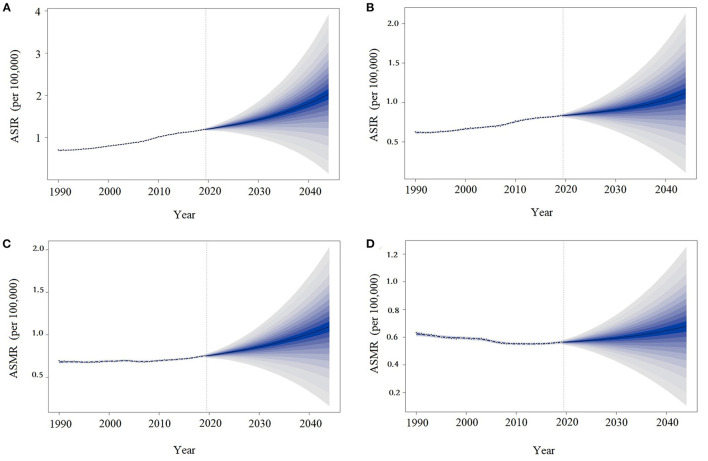
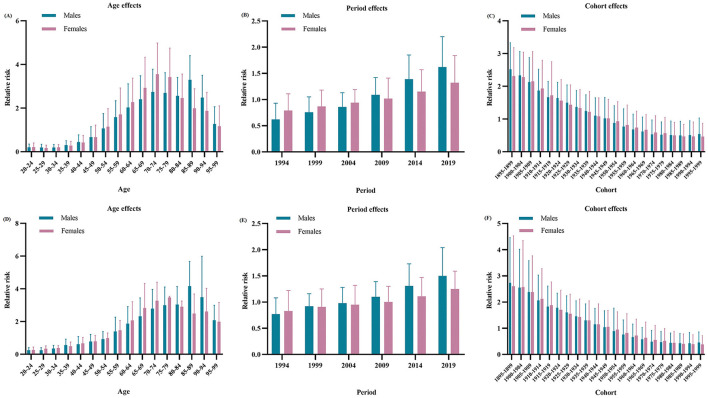
From 1990 to 2019, the age-standardized incidence and mortality rates of MM continued to increase in males. For females, the age-standardized rates were stable in MM incidence and decreased in MM mortality. Males had a higher disease burden of MM than females. Age effects were the most significant risk factor for MM incidence and mortality. Moreover, the risk of MM incidence and mortality increased with increasing time period but decreased with birth cohort in males and females. The age-standardized incidence and mortality rates of MM in China is predicted to be continuously increasing over the next 25 years.
The burden of MM in China is expected to continue to increase in the future, with significant sex difference. A comprehensive understanding of the risk characteristics and disease pattern of MM could help develop timely intervention measures to effectively reduce its burden.
多发性骨髓瘤(MM)在中国造成了沉重的负担。了解 MM 负担的长期趋势并预测其未来趋势,有助于进行适当的公共卫生规划并改善 MM 的管理。
本研究收集了 1990 年至 2019 年全球疾病负担研究中中国 MM 的性别特异性发病率和死亡率数据。采用 Joinpoint 回归分析 MM 负担的长期趋势。采用年龄-时期-队列模型分析年龄、时期和出生队列对 MM 负担的影响,并预测至 2044 年的未来趋势。
1990 年至 2019 年,男性 MM 的年龄标准化发病率和死亡率持续上升。对于女性,MM 的年龄标准化发病率保持稳定,而死亡率则下降。男性 MM 的疾病负担高于女性。年龄因素是 MM 发病率和死亡率的最重要危险因素。此外,男性和女性的 MM 发病率和死亡率均随时期增加而增加,但随出生队列增加而降低。中国 MM 的年龄标准化发病率和死亡率预计在未来 25 年内将持续上升。
未来中国 MM 的负担预计将继续增加,且存在显著的性别差异。全面了解 MM 的风险特征和疾病模式有助于制定及时的干预措施,有效降低其负担。