Institute of Animal Husbandry and Veterinary Medicine, Shanghai Academy of Agricultural Sciences, Shanghai 201106, China.
Shanghai Key Laboratory of Agricultural Genetic Breeding, Shanghai 201106, China.
Viruses. 2022 Jun 24;14(7):1383. doi: 10.3390/v14071383.
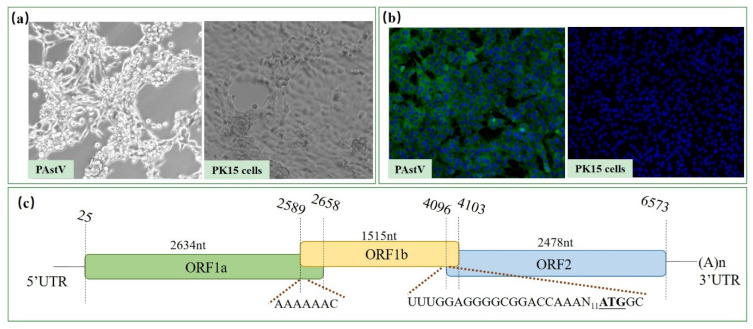
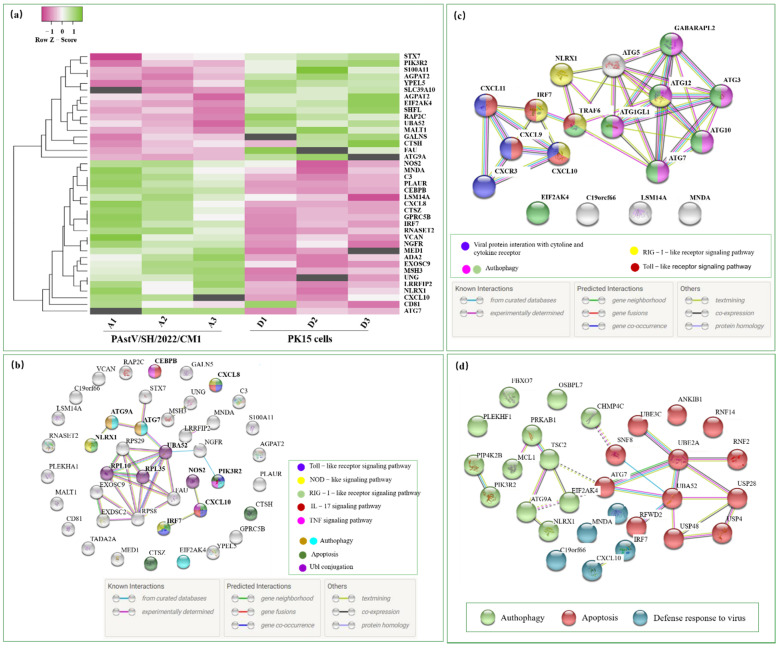
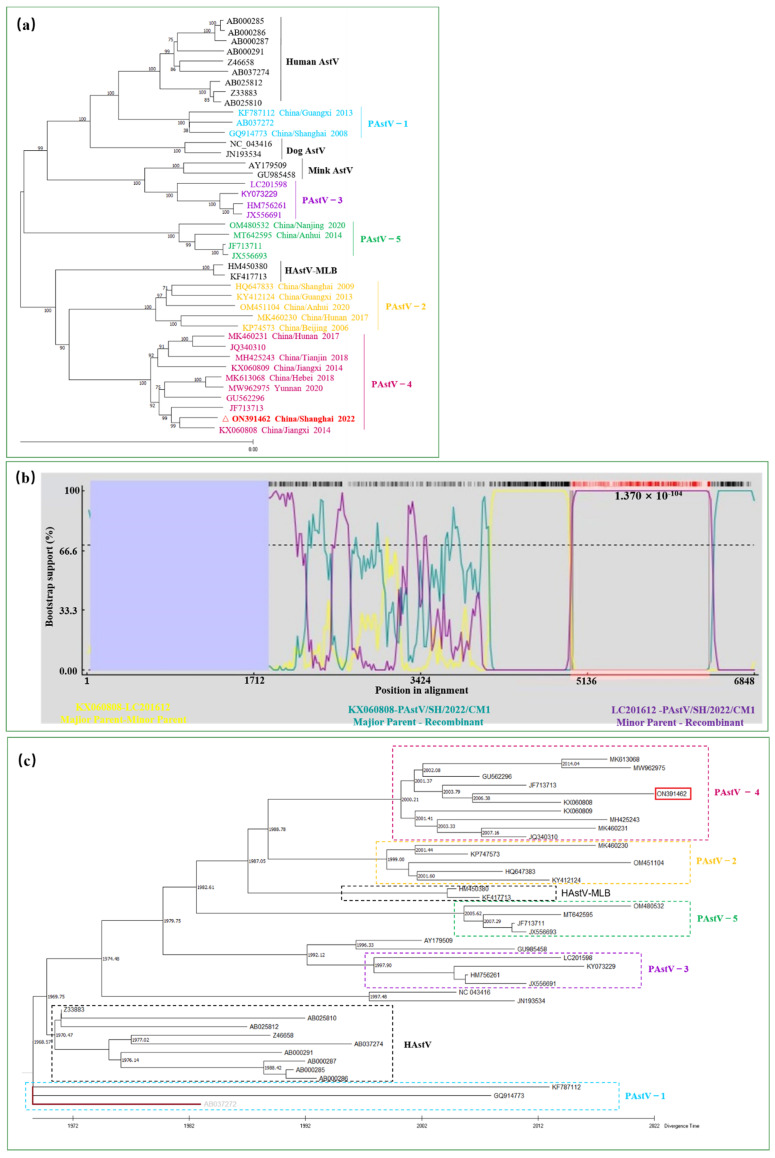
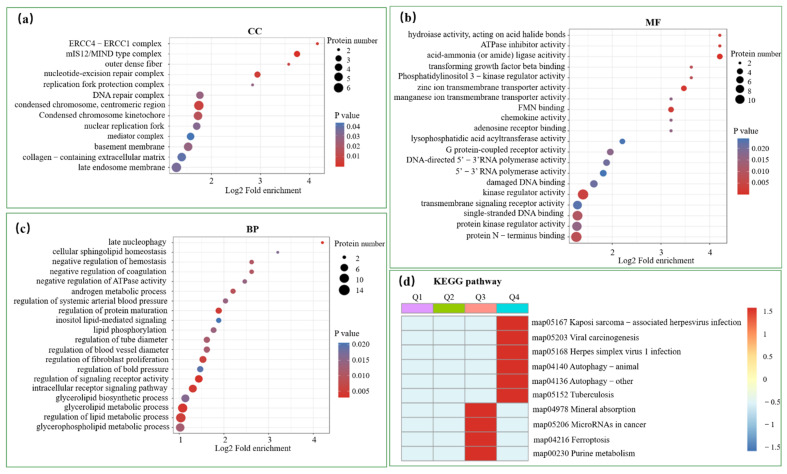
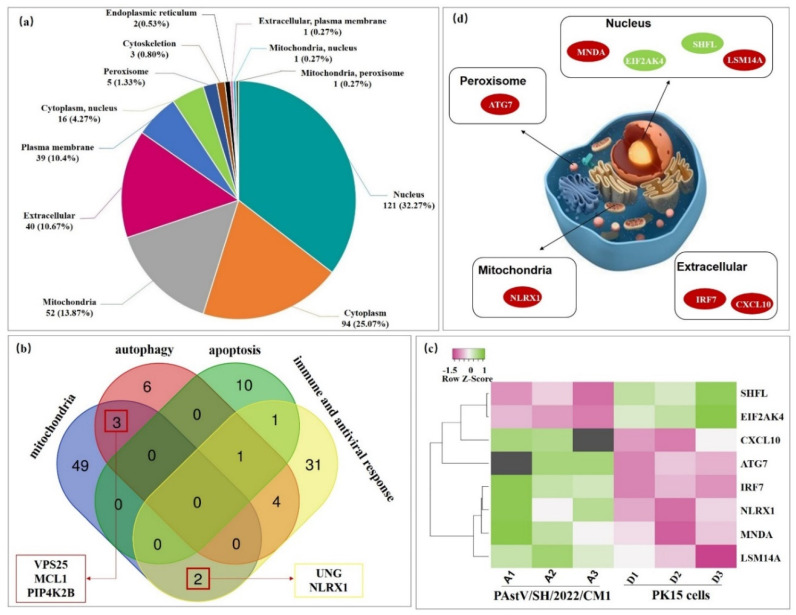
Porcine astrovirus (PAstV) has been identified as an important diarrheic pathogen with a broad global distribution. The PAstV is a potential pathogen to human beings and plays a role in public health. Until now, the divergence characteristics and pathogenesis of the PAstV are still not well known. In this study, the PAstV-4 strain PAstV/CH/2022/CM1 was isolated from the diarrheal feces of a piglet in Shanghai, which was identified to be a recombination of PAstV4/JPN (LC201612) and PAstV4/CHN (JX060808). A time tree based on the ORF2 protein of the astrovirus demonstrated that type 2-5 PAstV (PAstV-2 to 5) diverged from type 1 PAstV (PAstV-1) at a point from 1992 to 2000. To better understand the molecular basis of the virus, we sought to explore the host cell response to the PAstV/CH/2022/CM1 infection using proteomics. The results demonstrate that viral infection elicits global protein changes, and that the mitochondria seems to be a primary and an important target in viral infection. Importantly, there was crosstalk between autophagy and apoptosis, in which ATG7 might be the key mediator. In addition, the NOD-like receptor X1 (NLRX1) in the mitochondria was activated and participated in several important antiviral signaling pathways after the PAstV/CH/2022/CM1 infection, which was closely related to mitophagy. The NLRX1 may be a crucial protein for antagonizing a viral infection through autophagy, but this has yet to be validated. In conclusion, the data in this study provides more information for understanding the virus genomic characterization and the potential antiviral targets in a PAstV infection.
猪星状病毒(PAstV)已被确定为一种具有广泛全球分布的重要腹泻病原体。PAstV 是人类的潜在病原体,对公共卫生具有重要意义。迄今为止,PAstV 的分化特征和发病机制尚不清楚。在本研究中,从上海一头仔猪的腹泻粪便中分离出一株 PAstV-4 株 PAstV/CH/2022/CM1,鉴定为 PAstV4/JPN(LC201612)和 PAstV4/CHN(JX060808)的重组病毒。基于星状病毒 ORF2 蛋白的时间树表明,2-5 型 PAstV(PAstV-2 至 5)于 1992 年至 2000 年之间从 1 型 PAstV(PAstV-1)分化而来。为了更好地了解病毒的分子基础,我们试图通过蛋白质组学探索宿主细胞对 PAstV/CH/2022/CM1 感染的反应。结果表明,病毒感染引起了全局蛋白变化,线粒体似乎是病毒感染的主要和重要靶标。重要的是,自噬和细胞凋亡之间存在串扰,其中 ATG7 可能是关键的介质。此外,线粒体中的 NOD 样受体 X1(NLRX1)在 PAstV/CH/2022/CM1 感染后被激活并参与了几个重要的抗病毒信号通路,这与线粒体自噬密切相关。NLRX1 可能是通过自噬拮抗病毒感染的关键蛋白,但这还有待验证。总之,本研究的数据为理解 PAstV 感染的病毒基因组特征和潜在抗病毒靶点提供了更多信息。