Nikoloudaki Myrto, Repa Argyro, Pitsigavdaki Sofia, Molla Ismail Sali Ainour, Sidiropoulos Prodromos, Lionis Christos, Bertsias George
Department of Rheumatology and Clinical Immunology, University Hospital of Heraklion and Medical School, University of Crete, 71110 Heraklion, Greece.
Institute of Molecular Biology and Biotechnology-FORTH, 71110 Heraklion, Greece.
J Clin Med. 2022 Jul 25;11(15):4316. doi: 10.3390/jcm11154316.
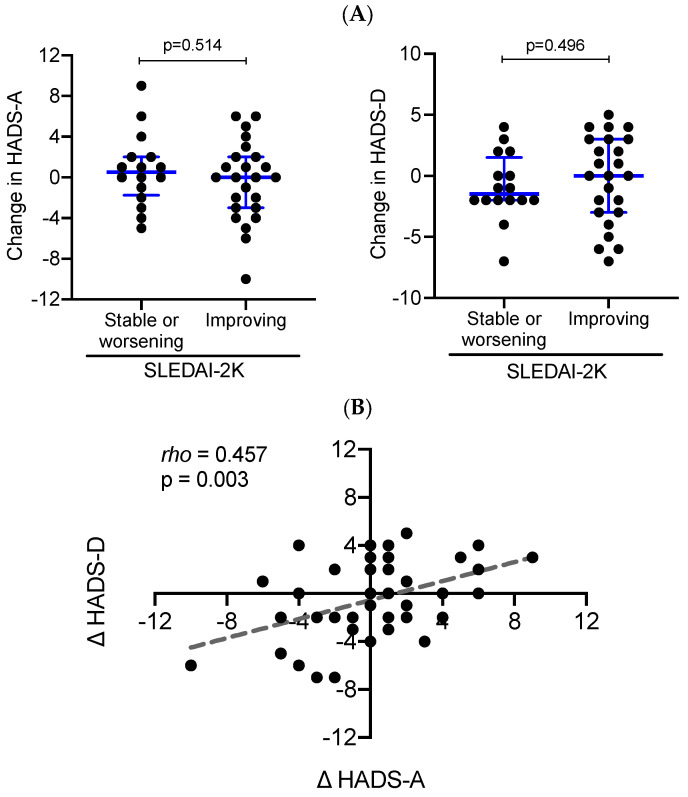
Mental disorders such as anxiety and depression are prevalent in systemic lupus erythematosus (SLE) patients, yet their association with the underlying disease activity remains uncertain and has been mostly evaluated at a cross-sectional level. To examine longitudinal trends in anxiety, depression, and lupus activity, a prospective observational study was performed on 40 adult SLE outpatients with active disease (SLE Disease Activity Index [SLEDAI]-2K ≥ 3 [excluding serology]) who received standard-of-care. Anxiety and depression were determined at baseline and 6 months by the Hospital Anxiety and Depression Scale. Treatment adherence was assessed with the Morisky Medication Adherence Scale-4. Increased anxiety (median [interquartile range] HADS-A: 11.0 [7.8]) and depression (HADS-D: 8.0 [4.8]) were found at inclusion, which remained stable and non-improving during follow-up (difference: 0.0 [4.8] and −0.5 [4.0], respectively) despite reduced SLEDAI-2K by 2.0 (4.0) (p < 0.001). Among possible baseline predictors, paid employment—but not disease activity—correlated with reduced HADS-A and HADS-D with corresponding standardized beta-coefficients of −0.35 (p = 0.017) and −0.27 (p = 0.093). Higher anxiety and depression correlated with lower treatment adherence (p = 0.041 and p = 0.088, respectively). These results indicate a high-mental disease burden in active SLE that persists despite disease control and emphasize the need to consider socioeconomic factors as part of comprehensive patient assessment.
焦虑和抑郁等精神障碍在系统性红斑狼疮(SLE)患者中很普遍,但其与潜在疾病活动的关联仍不确定,且大多是在横断面水平上进行评估。为了研究焦虑、抑郁和狼疮活动的纵向趋势,对40名患有活动性疾病(SLE疾病活动指数[SLEDAI]-2K≥3[不包括血清学指标])并接受标准治疗的成年SLE门诊患者进行了一项前瞻性观察研究。通过医院焦虑抑郁量表在基线和6个月时测定焦虑和抑郁情况。使用Morisky药物依从性量表-4评估治疗依从性。纳入时发现焦虑(中位数[四分位间距]HADS-A:11.0[7.8])和抑郁(HADS-D:8.0[4.8])增加,尽管SLEDAI-2K降低了2.0(4.0)(p<0.001),但在随访期间这些情况仍保持稳定且无改善(差异分别为0.0[4.8]和-0.5[4.0])。在可能的基线预测因素中,有薪工作——而非疾病活动——与HADS-A和HADS-D降低相关,相应的标准化β系数分别为-0.35(p=0.017)和-0.27(p=0.093)。较高的焦虑和抑郁与较低的治疗依从性相关(分别为p=0.041和p=0.088)。这些结果表明,尽管疾病得到控制,但活动性SLE患者的精神疾病负担仍然很高,并强调需要将社会经济因素作为全面患者评估的一部分加以考虑。