• 文献检索
  • 文档翻译
  • 深度研究
  • 学术资讯
  • Suppr Zotero 插件Zotero 插件
  • 邀请有礼
  • 套餐&价格
  • 历史记录
应用&插件
Suppr Zotero 插件Zotero 插件浏览器插件Mac 客户端Windows 客户端微信小程序
定价
高级版会员购买积分包购买API积分包
服务
文献检索文档翻译深度研究API 文档MCP 服务
关于我们
关于 Suppr公司介绍联系我们用户协议隐私条款
关注我们

Suppr 超能文献

核心技术专利:CN118964589B侵权必究
粤ICP备2023148730 号-1Suppr @ 2026

文献检索

告别复杂PubMed语法,用中文像聊天一样搜索,搜遍4000万医学文献。AI智能推荐,让科研检索更轻松。

立即免费搜索

文件翻译

保留排版,准确专业,支持PDF/Word/PPT等文件格式,支持 12+语言互译。

免费翻译文档

深度研究

AI帮你快速写综述,25分钟生成高质量综述,智能提取关键信息,辅助科研写作。

立即免费体验

2014 年至 2019 年巴西登革热、寨卡和基孔肯雅热病毒传播和住院率:一项生态学研究。

Dengue, Zika, and Chikungunya viral circulation and hospitalization rates in Brazil from 2014 to 2019: An ecological study.

机构信息

Faculty of Epidemiology and Population Health, London School of Hygiene & Tropical Medicine, London, United Kingdom.

Centro de Integração de Dados e Conhecimento para a Saúde(CIDACS), Gonçalo Moniz Institute, Fundação Oswaldo Cruz, Salvador, Bahia, Brazil.

出版信息

PLoS Negl Trop Dis. 2022 Jul 27;16(7):e0010602. doi: 10.1371/journal.pntd.0010602. eCollection 2022 Jul.

DOI:10.1371/journal.pntd.0010602
PMID:35895718
原文链接:https://pmc.ncbi.nlm.nih.gov/articles/PMC9359537/
Abstract

BACKGROUND

In addition to their direct pathogenic effects, arthropod-borne (arboviruses) have been hypothesized to indirectly contribute to hospitalizations and death through decompensation of pre-existing comorbidities. Using nationwide data routinely collected from 1 January 2014 to 31 December 2019 in Brazil, we investigated whether local increases in arbovirus notifications were associated with excess hospitalization.

METHODS

We estimated the relative risks for the association between municipality- and state-level increases in arboviral case notifications and age-standardized hospitalization rates (i.e., classified as direct or indirect based on ICD-10 codes) using Bayesian multilevel models with random effects accounting for temporal and geographic correlations. For municipality-level analyses, we excluded municipalities with <200 notifications of a given arbovirus and further adjusted the models for the local Gini Index, Human Development Index, and Family Healthcare Strategy (Estratégia de Saúde da Família) coverage. Models for dengue, Zika, and chikungunya were performed separately.

RESULTS

From 2014 to 2019, Brazil registered 7,566,330 confirmed dengue cases, 159,029 confirmed ZIKV cases, and 433,887 confirmed CHIKV cases. Dengue notifications have an endemic and seasonal pattern, with cases present in 5334 of the 5570 (95.8%) Brazilian municipalities and most (69.5%) registered between February and May. Chikungunya notifications followed a similar seasonal pattern to DENV but with a smaller incidence and were restricted to 4390 (78.8%) municipalities. ZIKV was only notified in 2581 (46.3%) municipalities. Increases in dengue and chikungunya notifications were associated with small increases in age-standardized arbovirus-related hospitalizations, but no consistent association was found with all-cause or other specific indirect causes of hospitalization. Zika was associated to increases in hospitalizations by neurological diseases.

CONCLUSIONS

Although we found no clear association between increased incidence of the three arboviruses and excess risks of all-cause or indirect hospitalizations at the municipality- and state-levels, follow-up investigations at the individual-level are warranted to define any potential role of acute arbovirus infection in exacerbating risks of hospitalization from underlying conditions.

摘要

背景

除了直接的致病作用外,虫媒病毒(arboviruses)还被假设通过加重先前存在的合并症而间接导致住院和死亡。本研究使用巴西从 2014 年 1 月 1 日至 2019 年 12 月 31 日期间常规收集的全国性数据,调查了地方虫媒病毒通知的增加是否与超额住院有关。

方法

我们使用贝叶斯多层次模型估计了市县级和州级虫媒病毒病例通知增加与年龄标准化住院率(即根据 ICD-10 代码分类为直接或间接)之间的关联的相对风险,该模型具有随机效应,可考虑时间和地理相关性。对于市县级分析,我们排除了通知少于 200 例特定虫媒病毒的市,并且还进一步调整了模型以考虑当地基尼指数、人类发展指数和家庭医疗保健策略(Estratégia de Saúde da Família)覆盖率。单独进行了登革热、寨卡病毒和基孔肯雅热的模型分析。

结果

2014 年至 2019 年,巴西共登记了 7566330 例确诊登革热病例、159029 例确诊寨卡病毒病例和 433887 例确诊基孔肯雅热病例。登革热通知具有地方性和季节性模式,5570 个巴西市中有 5334 个(95.8%)有病例,大多数(69.5%)病例发生在 2 月至 5 月之间。基孔肯雅热通知与 DENV 相似,具有季节性模式,但发病率较低,仅限于 4390 个(78.8%)市。寨卡病毒仅在 2581 个(46.3%)市有通知。登革热和基孔肯雅热通知的增加与年龄标准化 arbovirus 相关住院率的小幅度增加有关,但与全因或其他特定间接住院原因无一致关联。寨卡病毒与神经疾病引起的住院增加有关。

结论

尽管我们没有发现这三种 arboviruses 发病率增加与市县级和州级全因或间接住院的超额风险之间存在明确关联,但需要进行个体水平的后续调查,以确定急性 arbovirus 感染在加重潜在疾病住院风险方面的任何潜在作用。
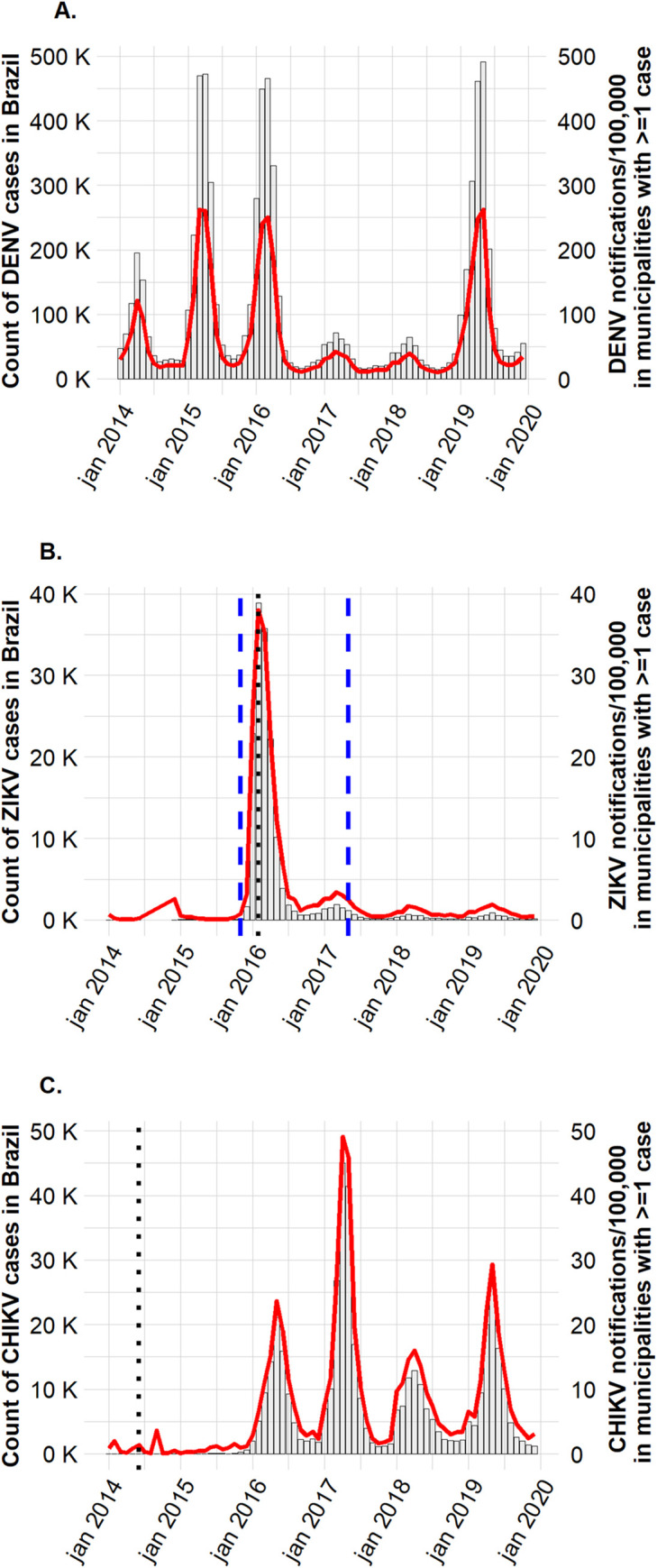
https://cdn.ncbi.nlm.nih.gov/pmc/blobs/6e6d/9359537/97f0dfcf45b4/pntd.0010602.g001.jpg

相似文献

1
Dengue, Zika, and Chikungunya viral circulation and hospitalization rates in Brazil from 2014 to 2019: An ecological study.2014 年至 2019 年巴西登革热、寨卡和基孔肯雅热病毒传播和住院率:一项生态学研究。
PLoS Negl Trop Dis. 2022 Jul 27;16(7):e0010602. doi: 10.1371/journal.pntd.0010602. eCollection 2022 Jul.
2
Epidemiological profile of arboviruses in two different scenarios: dengue circulation vs. dengue, chikungunya and Zika co-circulation.虫媒病毒在两种不同情况下的流行病学特征:登革热传播与登革热、基孔肯雅热和寨卡病毒共同传播。
BMC Infect Dis. 2023 Mar 22;23(1):177. doi: 10.1186/s12879-023-08139-6.
3
Positivity of dengue, chikungunya, and Zika infections in women in Northeast Brazil post-Zika epidemic.巴西东北部寨卡疫情后登革热、基孔肯雅热和寨卡病毒感染妇女的阳性率。
Pathog Glob Health. 2023 Jul;117(5):485-492. doi: 10.1080/20477724.2022.2142187. Epub 2022 Oct 31.
4
Arbovirus investigation in patients from Mato Grosso during Zika and Chikungunya virus introdution in Brazil, 2015-2016.2015 - 2016年巴西寨卡病毒和基孔肯雅病毒传入期间,对来自马托格罗索州患者的虫媒病毒调查。
Acta Trop. 2019 Feb;190:395-402. doi: 10.1016/j.actatropica.2018.12.019. Epub 2018 Dec 12.
5
Spatio-Temporal Cluster Detection of Dengue, Chikungunya, and Zika Viruses' Infection in Rio de Janeiro State from 2010 to 2019.2010 年至 2019 年里约热内卢州登革热、基孔肯雅热和寨卡病毒感染的时空聚集性检测。
Viruses. 2023 Jul 1;15(7):1496. doi: 10.3390/v15071496.
6
Zika, dengue and chikungunya population prevalence in Rio de Janeiro city, Brazil, and the importance of seroprevalence studies to estimate the real number of infected individuals.巴西里约热内卢市的寨卡、登革热和基孔肯雅热流行情况,以及血清流行率研究对估计实际感染人数的重要性。
PLoS One. 2020 Dec 17;15(12):e0243239. doi: 10.1371/journal.pone.0243239. eCollection 2020.
7
Serological and molecular epidemiology of the Dengue, Zika and Chikungunya viruses in a risk area in Brazil.巴西一个危险地区登革热、寨卡病毒和基孔肯雅病毒的血清学和分子流行病学
BMC Infect Dis. 2021 Jul 24;21(1):704. doi: 10.1186/s12879-021-06401-3.
8
Emergence of chikungunya and Zika in a municipality endemic to dengue, Santa Luzia, MG, Brazil, 2015-2017.2015 - 2017年,在巴西米纳斯吉拉斯州圣卢西亚市(登革热地方病流行区)基孔肯雅热和寨卡病毒病的出现情况。
Rev Soc Bras Med Trop. 2019 Jan 14;52:e20180347. doi: 10.1590/0037-8682-0347-2018.
9
Detection of coinfection with Primate Erythroparvovirus 1 and arboviruses (DENV, CHIKV and ZIKV) in individuals with acute febrile illness in the state of Rio Grande do Norte in 2016.检测 2016 年在里约热内卢格兰德州急性发热疾病患者中感染灵长类细小病毒 1 与虫媒病毒(登革热病毒、基孔肯雅热病毒和 Zika 病毒)的合并感染情况。
PLoS Negl Trop Dis. 2023 Nov 2;17(11):e0011701. doi: 10.1371/journal.pntd.0011701. eCollection 2023 Nov.
10
Urban arbovirus exposure in blood donations from an endemic area of Brazil.巴西流行地区献血者中的城市虫媒病毒暴露。
Vox Sang. 2024 Sep;119(9):1006-1011. doi: 10.1111/vox.13707. Epub 2024 Jul 5.

引用本文的文献

1
Sex-specific public health data: analyzing the arboviral impact on women in Brazil.特定性别的公共卫生数据:分析虫媒病毒对巴西女性的影响。
Rev Saude Publica. 2025 Jun 30;59:e17. doi: 10.11606/s1518-8787.2025059006235. eCollection 2025.
2
Bussuquara Virus: A Neglected Orthoflavivirus with Broad Distribution Across Central and South America and the Caribbean.布苏夸拉病毒:一种被忽视的正黄病毒,广泛分布于中美洲、南美洲和加勒比地区。
Viruses. 2025 Jan 27;17(2):183. doi: 10.3390/v17020183.
3
[Dengue lethality and inequalities in the Region of the Americas between 2014 and 2023Letalidade da dengue e desigualdades na Região das Américas entre 2014 e 2023].

本文引用的文献

1
Mortality among Hospitalized Dengue Patients with Comorbidities in Mexico, Brazil, and Colombia.墨西哥、巴西和哥伦比亚合并症住院登革热患者的死亡率。
Am J Trop Med Hyg. 2021 May 10;105(1):102-109. doi: 10.4269/ajtmh.20-1163.
2
The worldwide seroprevalence of DENV, CHIKV and ZIKV infection: A systematic review and meta-analysis.登革热病毒、基孔肯雅热病毒和 Zika 病毒在全球的血清流行率:系统评价和荟萃分析。
PLoS Negl Trop Dis. 2021 Apr 28;15(4):e0009337. doi: 10.1371/journal.pntd.0009337. eCollection 2021 Apr.
3
Risk predictors of progression to severe disease during the febrile phase of dengue: a systematic review and meta-analysis.
2014年至2023年美洲地区登革热致死率及不平等情况[2014年至2023年美洲地区登革热致死率及不平等情况]
Rev Panam Salud Publica. 2024 Dec 18;48:e139. doi: 10.26633/RPSP.2024.139. eCollection 2024.
4
The risk and risk factors of chikungunya virus infection and rheumatological sequelae in a cohort of U.S. Military Health System beneficiaries: Implications for the vaccine era.在美国医疗保健系统受益人群中,基孔肯雅病毒感染和风湿学后遗症的风险和风险因素:对疫苗时代的影响。
PLoS Negl Trop Dis. 2024 Aug 5;18(8):e0011810. doi: 10.1371/journal.pntd.0011810. eCollection 2024 Aug.
5
Long chikungunya? An overview to immunopathology of persistent arthralgia.长期基孔肯雅热?持续性关节痛免疫病理学概述。
World J Virol. 2024 Jun 25;13(2):89985. doi: 10.5501/wjv.v13.i2.89985.
6
Risk of adverse pregnancy and infant outcomes associated with prenatal Zika virus infection: a post-epidemic cohort in Central-West Brazil.与产前寨卡病毒感染相关的不良妊娠和婴儿结局风险:巴西中西部的一个后疫情时期队列研究。
Sci Rep. 2023 May 5;13(1):7335. doi: 10.1038/s41598-023-33334-5.
7
Democratizing Public Health: Participatory Policymaking Institutions, Mosquito Control, and Zika in the Americas.公共卫生的民主化:美洲的参与式政策制定机构、蚊虫控制与寨卡病毒
Trop Med Infect Dis. 2023 Jan 5;8(1):38. doi: 10.3390/tropicalmed8010038.
登革热发热期进展为重症疾病的风险预测因素:系统评价和荟萃分析。
Lancet Infect Dis. 2021 Jul;21(7):1014-1026. doi: 10.1016/S1473-3099(20)30601-0. Epub 2021 Feb 25.
4
Emerging arboviruses in the urbanized Amazon rainforest.城市化亚马逊雨林中的新兴虫媒病毒。
BMJ. 2020 Nov 13;371:m4385. doi: 10.1136/bmj.m4385.
5
Spatiotemporal dynamics, risk areas and social determinants of dengue in Northeastern Brazil, 2014-2017: an ecological study.2014-2017 年巴西东北部登革热的时空动态、风险区域和社会决定因素:一项生态学研究。
Infect Dis Poverty. 2020 Nov 3;9(1):153. doi: 10.1186/s40249-020-00772-6.
6
Postnatal symptomatic Zika virus infections in children and adolescents: A systematic review.儿童和青少年产后有症状的寨卡病毒感染:系统评价。
PLoS Negl Trop Dis. 2020 Oct 2;14(10):e0008612. doi: 10.1371/journal.pntd.0008612. eCollection 2020 Oct.
7
Neurological disease in adults with Zika and chikungunya virus infection in Northeast Brazil: a prospective observational study.巴西东北部寨卡和基孔肯雅病毒成人感染相关神经疾病:一项前瞻性观察研究。
Lancet Neurol. 2020 Oct;19(10):826-839. doi: 10.1016/S1474-4422(20)30232-5. Epub 2020 Sep 16.
8
Zika virus infection enhances future risk of severe dengue disease.寨卡病毒感染增加了未来患严重登革热疾病的风险。
Science. 2020 Aug 28;369(6507):1123-1128. doi: 10.1126/science.abb6143.
9
The Endless Challenges of Arboviral Diseases in Brazil.巴西虫媒病毒疾病面临的无尽挑战。
Trop Med Infect Dis. 2020 May 9;5(2):75. doi: 10.3390/tropicalmed5020075.
10
The frequency and clinical presentation of Zika virus coinfections: a systematic review.寨卡病毒合并感染的频率和临床表现:系统评价。
BMJ Glob Health. 2020 May;5(5). doi: 10.1136/bmjgh-2020-002350.