Oltean Teodora, Lippens Lien, Lemeire Kelly, De Tender Caroline, Vuylsteke Marnik, Denys Hannelore, Vandecasteele Katrien, Vandenabeele Peter, Adjemian Sandy
Cell Death and Inflammation Unit, Vlaams Instituut voor Biotechnologie (VIB)-UGent Center for Inflammation Research (IRC), Ghent, Belgium.
Department of Biomedical Molecular Biology (DBMB), Ghent University, Ghent, Belgium.
Front Oncol. 2022 Jul 12;12:892813. doi: 10.3389/fonc.2022.892813. eCollection 2022.
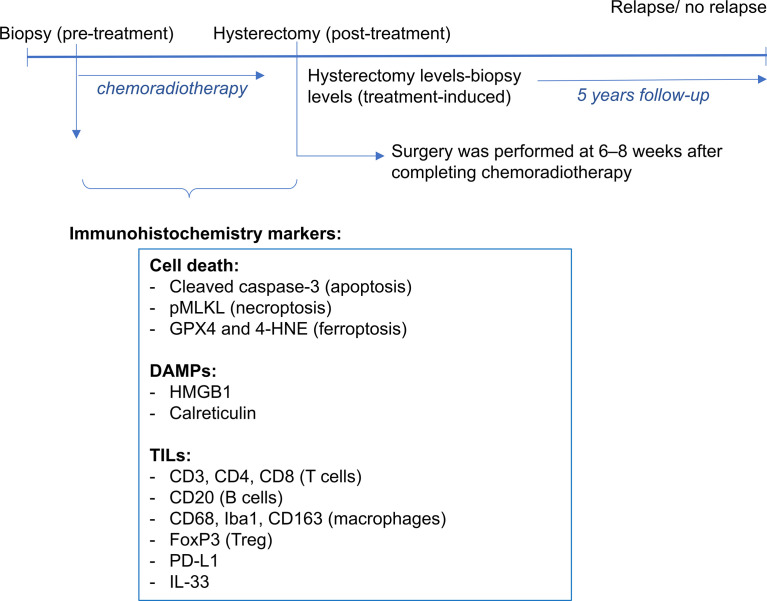
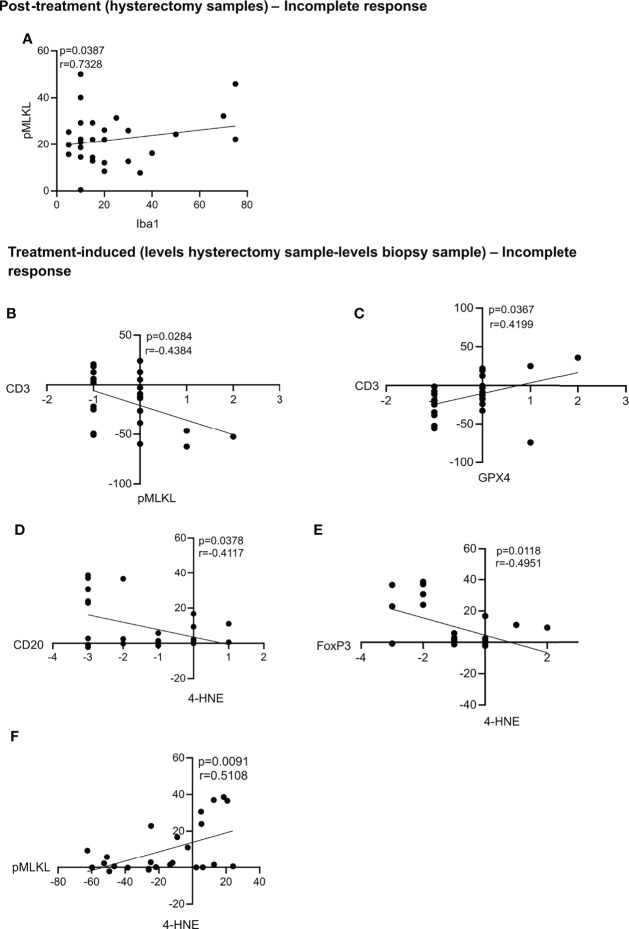
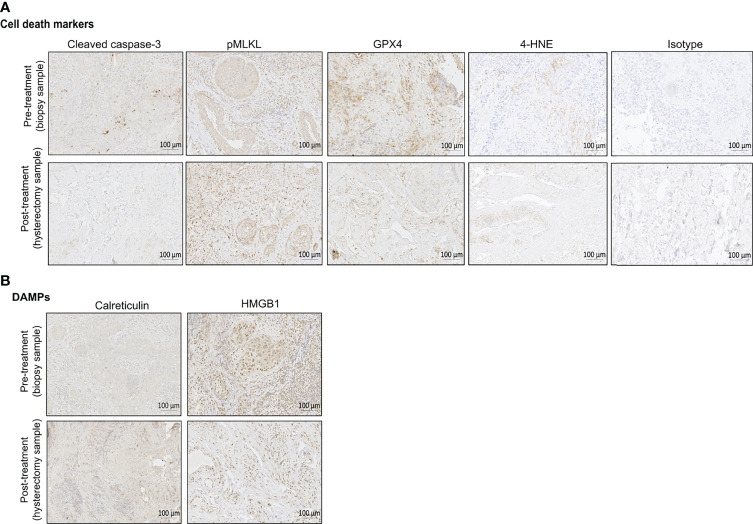
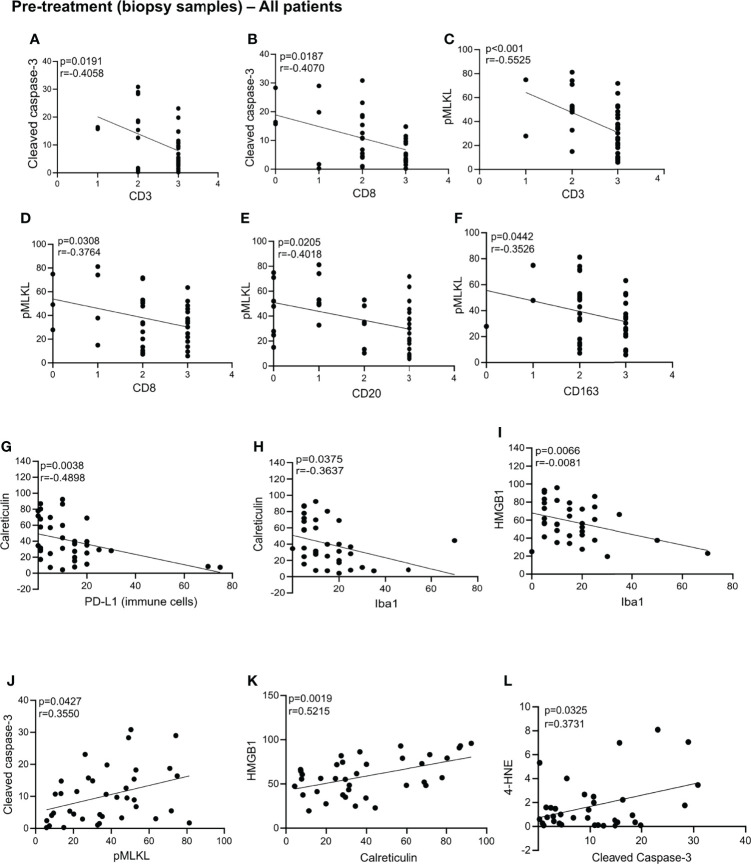
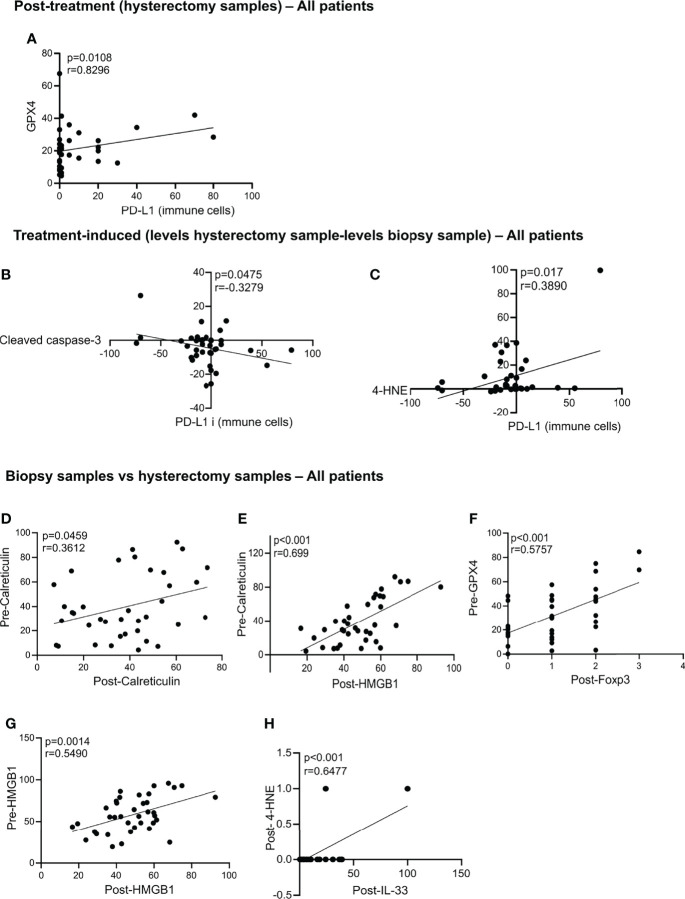
Irradiation induces distinct cellular responses such as apoptosis, necroptosis, iron-dependent cell death (a feature of ferroptosis), senescence, and mitotic catastrophe. Several of these outcomes are immunostimulatory and may represent a potential for immunogenic type of cell death (ICD) induced by radiotherapy triggering abscopal effects. The purpose of this study is to determine whether intra-tumoral ICD markers can serve as biomarkers for the prediction of patient's outcomes defined as the metastasis status and survival over a 5-year period. Thirty-eight patients with locally advanced cervical cancer, treated with neoadjuvant chemoradiotherapy using cisplatin were included in this study. Pre-treatment tumor biopsy and post-treatment hysterectomy samples were stained for cell death markers and danger associated molecular patterns (DAMPs): cleaved caspase-3 (apoptosis), phosphorylated mixed lineage kinase domain like pseudokinase (pMLKL; necroptosis), glutathione peroxidase 4 (GPX4; ferroptosis) and 4-hydroxy-2-noneal (4-HNE; ferroptosis), high mobility group box 1 (HMGB1) and calreticulin. Although these markers could not predict the patient's outcome in terms of relapse or survival, many significantly correlated with immune cell infiltration. For instance, inducing ferroptosis post-treatment seems to negatively impact immune cell recruitment. Measuring ICD markers could reflect the impact of treatment on the tumor microenvironment with regard to immune cell recruitment and infiltration.
Cell death readouts during neoadjuvant chemoradiation in cervical cancer.
辐射可诱导不同的细胞反应,如凋亡、坏死性凋亡、铁依赖性细胞死亡(铁死亡的一个特征)、衰老和有丝分裂灾难。这些结果中的几种具有免疫刺激作用,可能代表放疗诱导的免疫原性细胞死亡(ICD)引发远隔效应的潜力。本研究的目的是确定肿瘤内ICD标志物是否可作为预测患者结局的生物标志物,患者结局定义为转移状态和5年生存期。本研究纳入了38例接受顺铂新辅助放化疗的局部晚期宫颈癌患者。对治疗前肿瘤活检和治疗后子宫切除样本进行细胞死亡标志物和危险相关分子模式(DAMPs)染色:裂解的半胱天冬酶-3(凋亡)、磷酸化混合谱系激酶结构域样假激酶(pMLKL;坏死性凋亡)、谷胱甘肽过氧化物酶4(GPX4;铁死亡)和4-羟基壬烯醛(4-HNE;铁死亡)、高迁移率族蛋白B1(HMGB1)和钙网蛋白。尽管这些标志物不能预测患者的复发或生存结局,但许多标志物与免疫细胞浸润显著相关。例如,治疗后诱导铁死亡似乎对免疫细胞募集有负面影响。检测ICD标志物可以反映治疗对肿瘤微环境中免疫细胞募集和浸润的影响。
宫颈癌新辅助放化疗期间的细胞死亡读数。