Department of Social and Administrative Pharmacy, School of Pharmaceutical Sciences, Universiti Sains Malaysia, Pulau Pinang, Malaysia.
Department of Mathematics, COMSATS Institute of Information Technology, Lahore, Pakistan.
PLoS One. 2022 Jul 29;17(7):e0271587. doi: 10.1371/journal.pone.0271587. eCollection 2022.
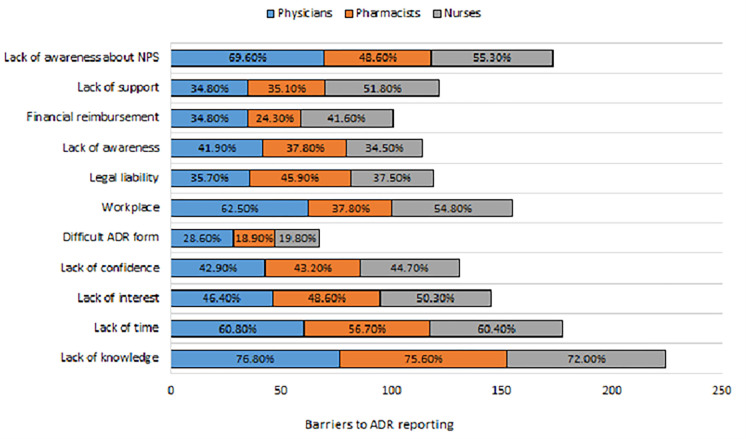
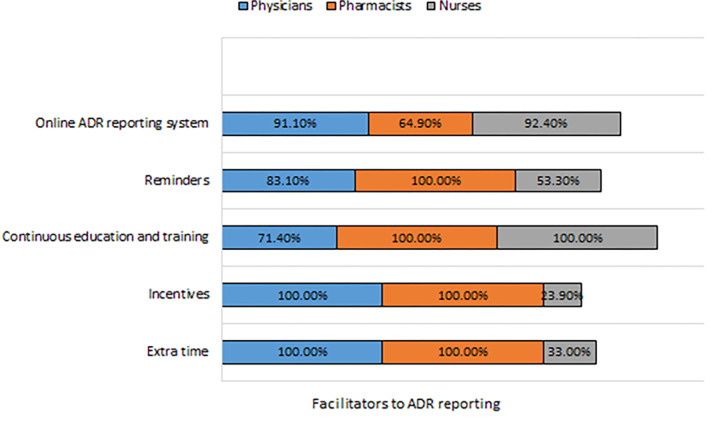
The timely reporting of adverse drug reactions (ADRs) could improve pharmacovigilance (PV) in a healthcare system. However, in almost all healthcare systems barriers exist that lead to the underreporting of ADRs. The objective of this study was to identify the barriers and facilitators regarding PV activities from the point of view of healthcare professionals (HCPs) in Lahore, Pakistan. A cross-sectional questionnaire-based survey was conducted between September 2018 to January 2019. The data was collected through convenience sampling of physicians, pharmacists, and nurses at tertiary care public hospitals in Lahore. A total of 384 questionnaires were distributed, and 346 HCPs responded to the survey. Over 62% percent of physicians and 54.8% of nurses agreed that they did not know how to report an ADR in their workplace. About 43.2% of pharmacists and 40.1% of nurses disagreed that they were not aware of the need for ADR reporting. Furthermore, 41.6% of nurses identified a lack of financial reimbursement and 51.8% highlighted a lack of support from a colleague as a reason that could lead to the underreporting of ADR. The majority of participants, including 69.6% physicians, 48.6% pharmacists, and 55.3% nurses identified the lack of knowledge about the existence of a national PV centre. Extra time for ADR reporting, incentives, continuous medical education, reminders, and availability of an online ADR reporting system was classed as the facilitators and were agreed upon by the majority of HCPs.
及时报告药物不良反应(ADR)可以改善医疗保健系统中的药物警戒(PV)。然而,在几乎所有的医疗保健系统中,都存在导致 ADR 报告不足的障碍。本研究的目的是从巴基斯坦拉合尔的医疗保健专业人员(HCP)的角度确定与 PV 活动相关的障碍和促进因素。这是一项横断面问卷调查研究,于 2018 年 9 月至 2019 年 1 月进行。通过便利抽样的方法,在拉合尔的三级公立医院收集了医生、药剂师和护士的数据。共发放了 384 份问卷,346 名 HCP 对调查做出了回应。超过 62%的医生和 54.8%的护士同意他们不知道如何在工作场所报告 ADR。约 43.2%的药剂师和 40.1%的护士不同意他们不知道需要报告 ADR。此外,41.6%的护士认为缺乏经济补偿,51.8%的护士强调缺乏同事的支持,这可能导致 ADR 报告不足。大多数参与者,包括 69.6%的医生、48.6%的药剂师和 55.3%的护士认为缺乏对国家 PV 中心存在的认识。大多数 HCP 认为,额外的 ADR 报告时间、奖励、持续的医学教育、提醒和可获得在线 ADR 报告系统被认为是促进因素。