Aarnoutse Romy, Ziemons Janine, Hillege Lars E, de Vos-Geelen Judith, de Boer Maaike, Bisschop Saskia M P, Vriens Birgit E P J, Vincent Jeroen, van de Wouw Agnes J, Le Giang N, Venema Koen, Rensen Sander S, Penders John, Smidt Marjolein L
GROW - School for Oncology and Developmental Biology, Maastricht University, Maastricht, the Netherlands.
Department of Surgery, Maastricht University Medical Centre, Maastricht, the Netherlands.
NPJ Breast Cancer. 2022 Jul 29;8(1):89. doi: 10.1038/s41523-022-00455-5.
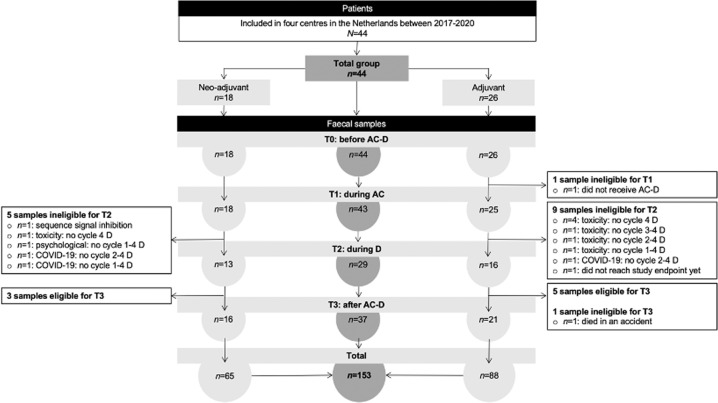
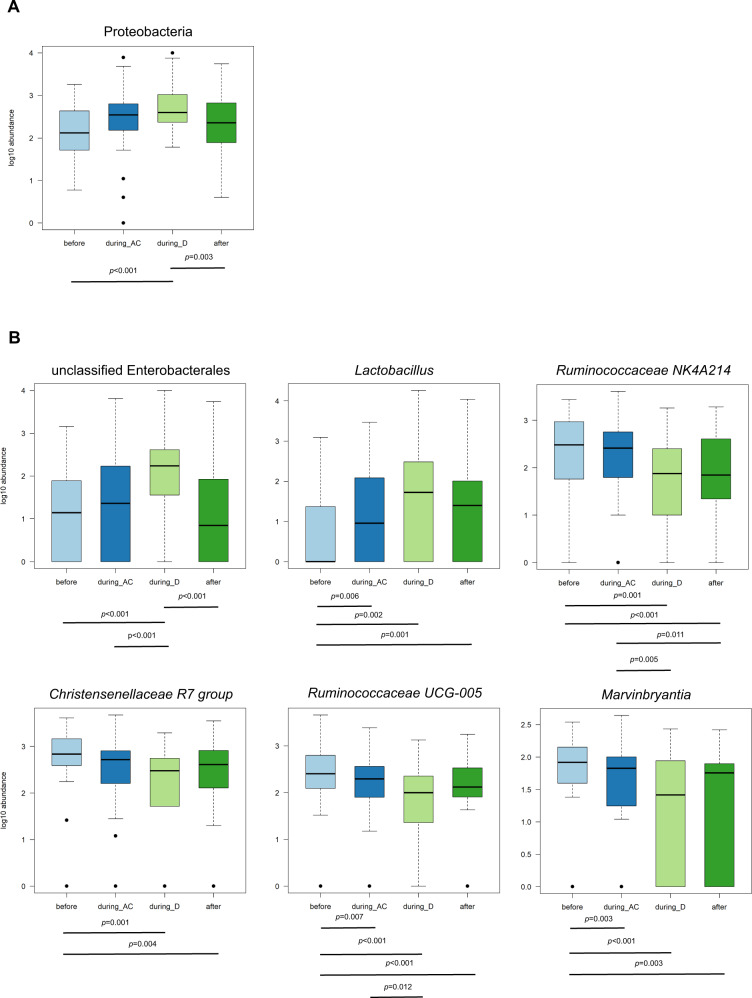
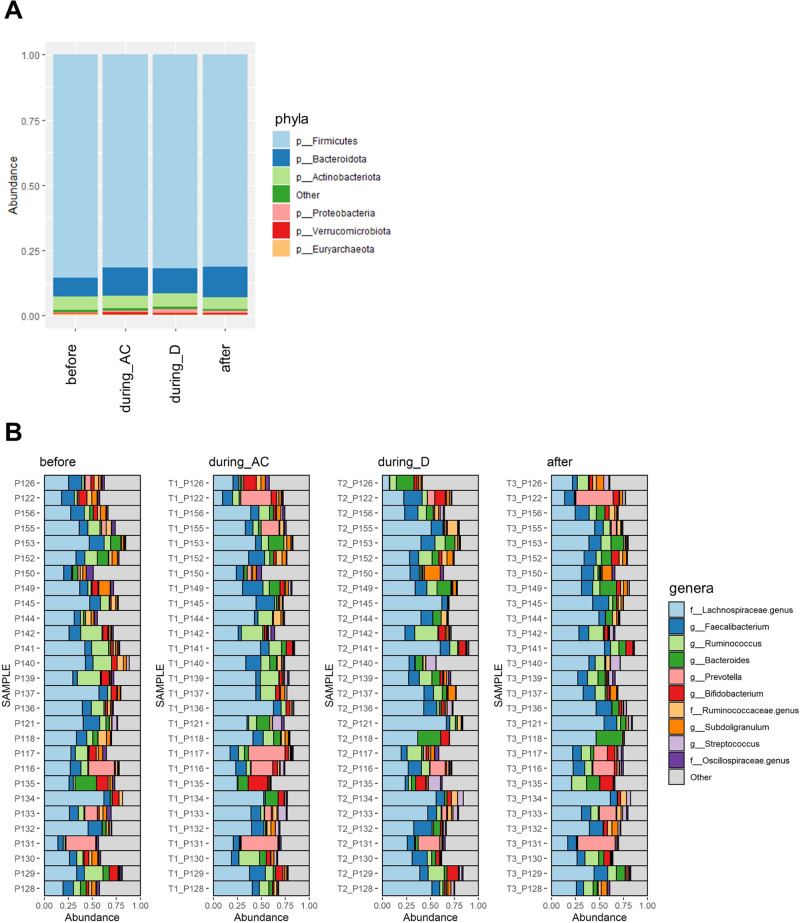
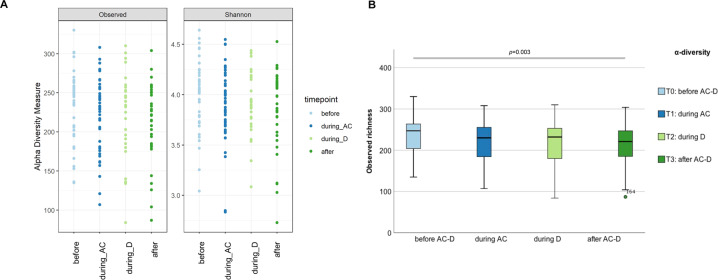
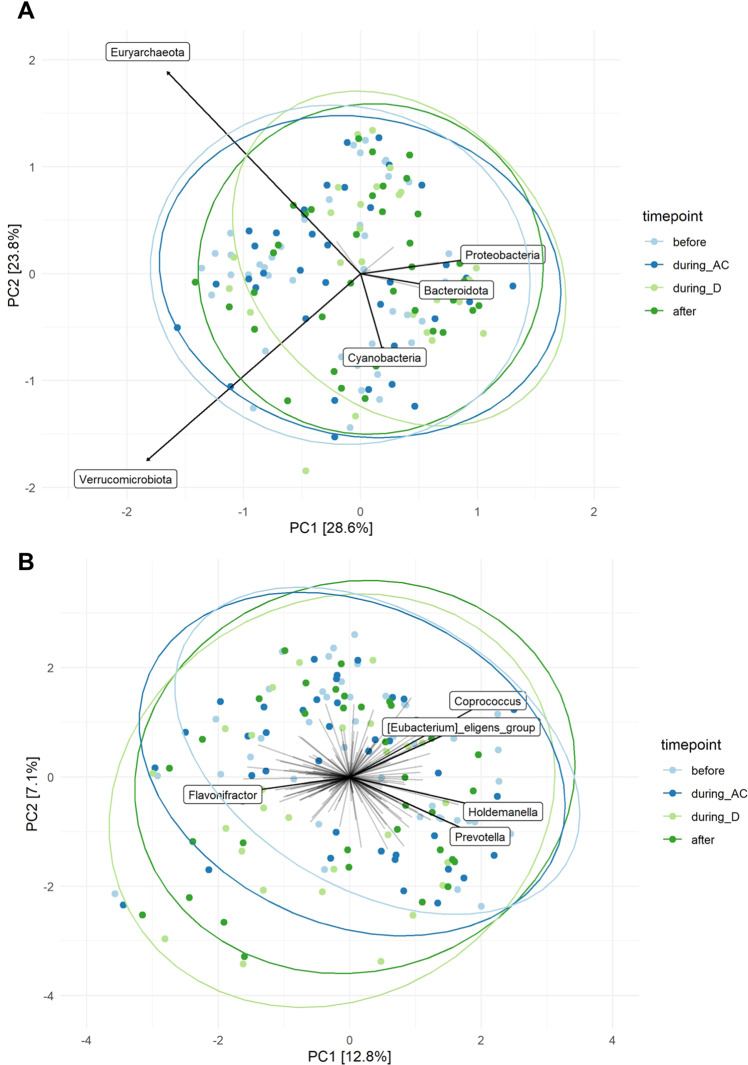
This clinical study explored the associations between the intestinal microbiota, chemotherapy toxicity, and treatment response in postmenopausal oestrogen receptor positive breast cancer patients.Oestrogen receptor positive postmenopausal breast cancer patients were prospectively enroled in a multicentre cohort study and treated with 4 cycles of (neo)adjuvant adriamycin, cyclophosphamide (AC) followed by 4 cycles of docetaxel (D). Patients collected a faecal sample and completed a questionnaire before treatment, during AC, during D, and after completing AC-D. Chemotherapy toxicity and tumour response were determined. Intestinal microbiota was analysed by amplicon sequencing of the 16 S rRNA V4 gene-region. In total, 44 patients, including 18 neoadjuvant patients, were included, and 153 faecal samples were collected before AC-D (n = 44), during AC (n = 43), during D (n = 29), and after AC-D treatment (n = 37), 28 participants provided all four samples. In the whole group, observed species richness reduced during treatment (p = 0.042). The abundance of Proteobacteria, unclassified Enterobacterales, Lactobacillus, Ruminococcaceae NK4A214 group, Marvinbryantia, Christensenellaceae R7 group, and Ruminococcaceae UCG-005 changed significantly over time. Patients with any grade diarrhoea during docetaxel treatment had a significantly lower observed species richness compared to patients without diarrhoea. In the small group neoadjuvant treated patients, pathologic response was unrelated to baseline intestinal microbiota richness, diversity and composition. While the baseline microbiota was not predictive for pathologic response in a rather small group of neoadjuvant treated patients in our study, subsequent shifts in microbial richness, as well as the abundance of specific bacterial taxa, were observed during AC-D treatment in the whole group and the neoadjuvant group.
这项临床研究探讨了绝经后雌激素受体阳性乳腺癌患者肠道微生物群、化疗毒性和治疗反应之间的关联。雌激素受体阳性绝经后乳腺癌患者被前瞻性纳入一项多中心队列研究,并接受4个周期的(新)辅助阿霉素、环磷酰胺(AC)治疗,随后接受4个周期的多西他赛(D)治疗。患者在治疗前、AC治疗期间、D治疗期间以及完成AC-D治疗后收集粪便样本并填写问卷。测定化疗毒性和肿瘤反应。通过对16S rRNA V4基因区域进行扩增子测序分析肠道微生物群。总共纳入了44例患者,其中包括18例新辅助治疗患者,在AC-D治疗前(n = 44)、AC治疗期间(n = 43)、D治疗期间(n = 29)以及AC-D治疗后(n = 37)共收集了153份粪便样本,28名参与者提供了全部4份样本。在整个研究组中,观察到的物种丰富度在治疗期间降低(p = 0.042)。变形菌门、未分类肠杆菌科、乳杆菌属、瘤胃球菌科NK4A214组、马文氏菌属、克里斯滕森菌科R7组和瘤胃球菌科UCG-005的丰度随时间发生显著变化。与未发生腹泻的患者相比,多西他赛治疗期间出现任何级别的腹泻的患者观察到的物种丰富度显著降低。在接受新辅助治疗的小部分患者中,病理反应与基线肠道微生物群的丰富度、多样性和组成无关。虽然在我们研究中一小部分接受新辅助治疗的患者中,基线微生物群不能预测病理反应,但在整个研究组和新辅助治疗组的AC-D治疗期间均观察到微生物丰富度以及特定细菌类群丰度的后续变化。