Division of Infection Control and Environmental Health, Norwegian Institute of Public Health, Postboks 222, Skøyen N-0213, Oslo, Norway.
BMC Public Health. 2022 Jul 30;22(1):1454. doi: 10.1186/s12889-022-13868-5.
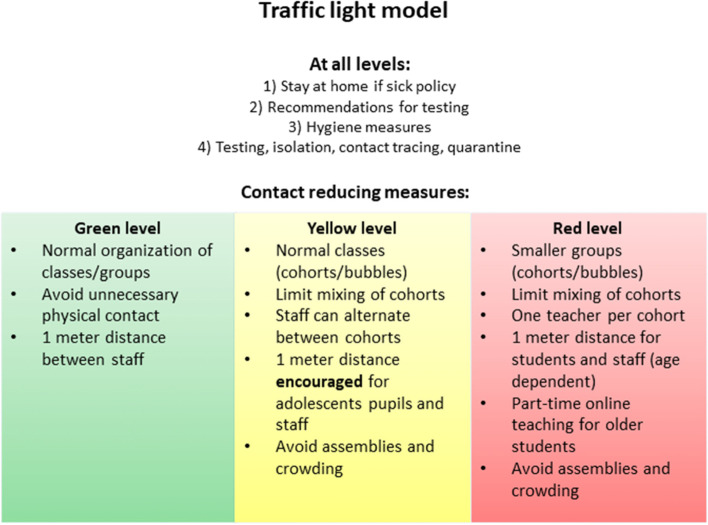
Schools and preschools have largely remained open in Norway throughout the pandemic, with flexible mitigation measures in place. This contrasts with many other high-income countries that closed schools for long periods of time. Here we describe cases and outbreaks of COVID-19 in schools and preschools during the academic year 2020/2021, to evaluate the strategy of keeping these open with infection prevention control measures in place.
In this descriptive study, the Norwegian Institute of Public Health initiated systematic surveillance for COVID-19 cases and outbreaks in schools and preschools in October 2020. Data was compiled from the national outbreak alert system VESUV, municipality websites, and media scanning combined with the national emergency preparedness register Beredt C-19. An outbreak was defined as ≥ 2 cases among pupils or staff within 14 days at the same educational setting. Settings were categorized as preschool (1-5-years), primary school (6-12-years), lower secondary school (13-15-years) and upper secondary school (16-18- years). We reported the incidence rate among preschool and school-aged pupils and gave a descriptive overview of outbreaks and included cases per educational setting.
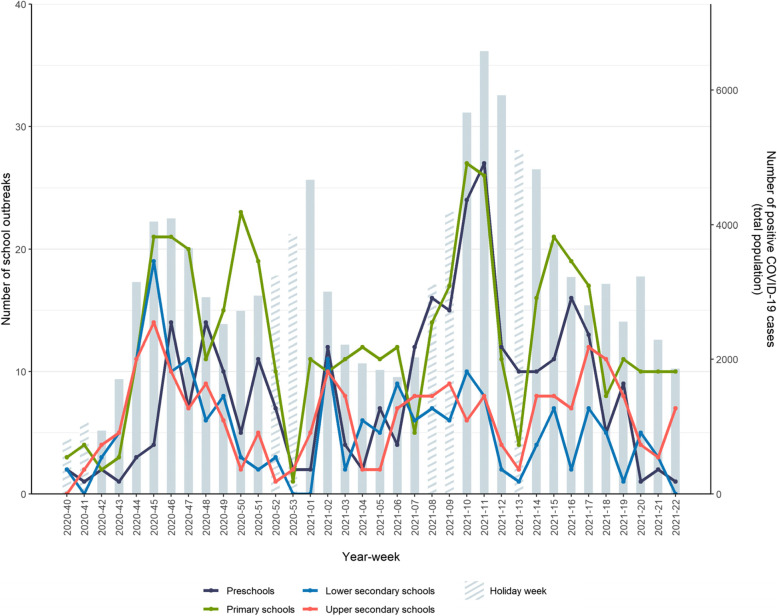
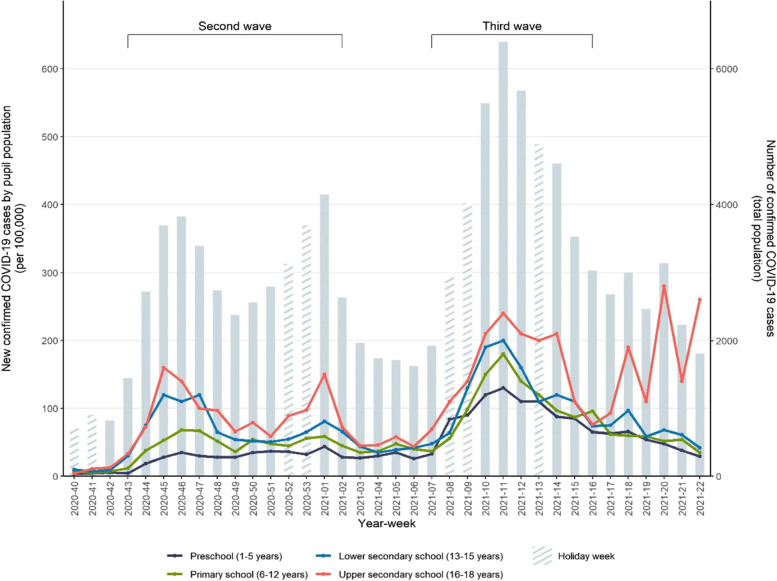
During the whole academic year, a total of 1203 outbreaks in preschools and school settings were identified, out of a total of 8311 preschools and schools nationwide. The incidence of COVID-19 in preschool- and school-aged children and the rates of outbreaks in these settings largely followed the community trend. Most of the outbreaks occurred in primary schools (40%) and preschools (25%). Outbreaks across all settings were mostly small (median 3 cases, range 2 to 72), however, 40 outbreaks (3% of total) included 20 or more cases. The larger outbreaks were predominantly seen in primary schools (43%).
We observed few large outbreaks in open schools and preschools in Norway during the academic year of 2020/2021, also when the Alpha variant was predominant. This illustrates that it is possible to keep schools and preschools open even during periods of high community transmission of COVID-19. Adherence to targeted IPC measures adaptable to the local situation has been essential to keep educational settings open, and thus reduce the total burden on children and adolescents.
在整个疫情期间,挪威的学校和幼儿园基本保持开放,同时采取了灵活的缓解措施。这与许多其他高收入国家形成鲜明对比,这些国家曾长时间关闭学校。在这里,我们描述了 2020/2021 学年期间学校和幼儿园发生的 COVID-19 病例和疫情,以评估在采取感染预防和控制措施的情况下保持这些场所开放的策略。
在这项描述性研究中,挪威公共卫生研究所于 2020 年 10 月开始对学校和幼儿园的 COVID-19 病例和疫情进行系统监测。数据来自国家疫情警报系统 VESUV、市网站和媒体扫描,结合国家应急准备登记册 Beredt C-19 收集。疫情定义为同一教育场所 14 天内 2 名或以上学生或工作人员的病例。场所分为幼儿园(1-5 岁)、小学(6-12 岁)、初中(13-15 岁)和高中(16-18 岁)。我们报告了幼儿园和学龄儿童的发病率,并对疫情进行了描述性概述,包括每个教育场所的病例。
整个学年,全国共发现 1203 起幼儿园和学校疫情,涉及全国 8311 所幼儿园和学校。幼儿园和学龄儿童 COVID-19 的发病率以及这些场所疫情的发生率基本符合社区趋势。大多数疫情发生在小学(40%)和幼儿园(25%)。所有场所的疫情大多规模较小(中位数为 3 例,范围为 2 至 72 例),但有 40 起疫情(占总数的 3%)包括 20 例或更多病例。较大的疫情主要发生在小学(43%)。
在 2020/2021 学年期间,我们观察到挪威开放学校和幼儿园的疫情很少,即使是在 Alpha 变异株占主导地位的时候。这表明,即使在 COVID-19 社区传播率较高的时期,也有可能保持学校和幼儿园开放。坚持针对特定 IPC 措施并使其适应当地情况对于保持教育环境开放从而减少儿童和青少年的整体负担至关重要。