Chen Changjun, Zhao Xin, Luo Yue, Li Bohua, Li Qianhao, Zhao Chengcheng, Huang Yan, Kang Pengde
Department of Orthopedics, West China Hospital, Sichuan University, Chengdu, People's Republic of China.
Department of Orthopedics, Shandong Provincial Hospital Affiliated to Shandong First Medical University, Jinan, People's Republic of China.
J Inflamm Res. 2022 Jul 22;15:4159-4169. doi: 10.2147/JIR.S367214. eCollection 2022.
Osteonecrosis of the femoral head (ONFH) is a complex disease resulting in degeneration of the hip joint. The pathogenesis of ONFH is largely unknown, but alterations in immunological factors have been proposed to play a role.
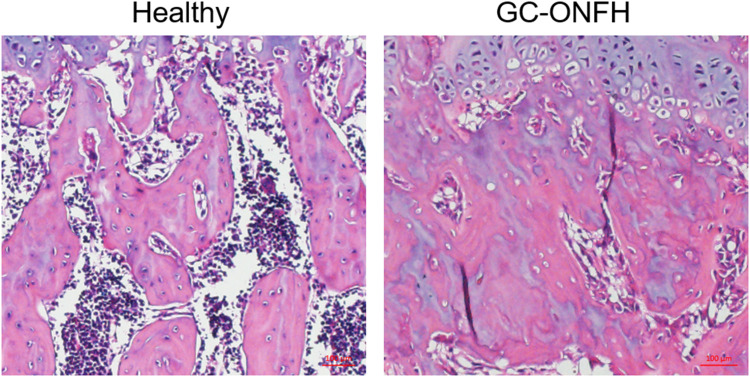
We included 109 patients with ONFH and 109 age-, sex-, and body mass index-matched healthy controls in this study. The percentage of circulating CD3, CD4, and CD8 lymphocytes among the total lymphocytes was identified by flow cytometry and compared between the cases and controls. Subgroup analysis within each etiological group and correlation analysis of T-cell subset levels with disease duration were performed. Furthermore, we compared the expression patterns of CD4, RANKL, and FoxP3 in the femoral head of healthy and glucocorticoid (GC)-treated ONFH rats.
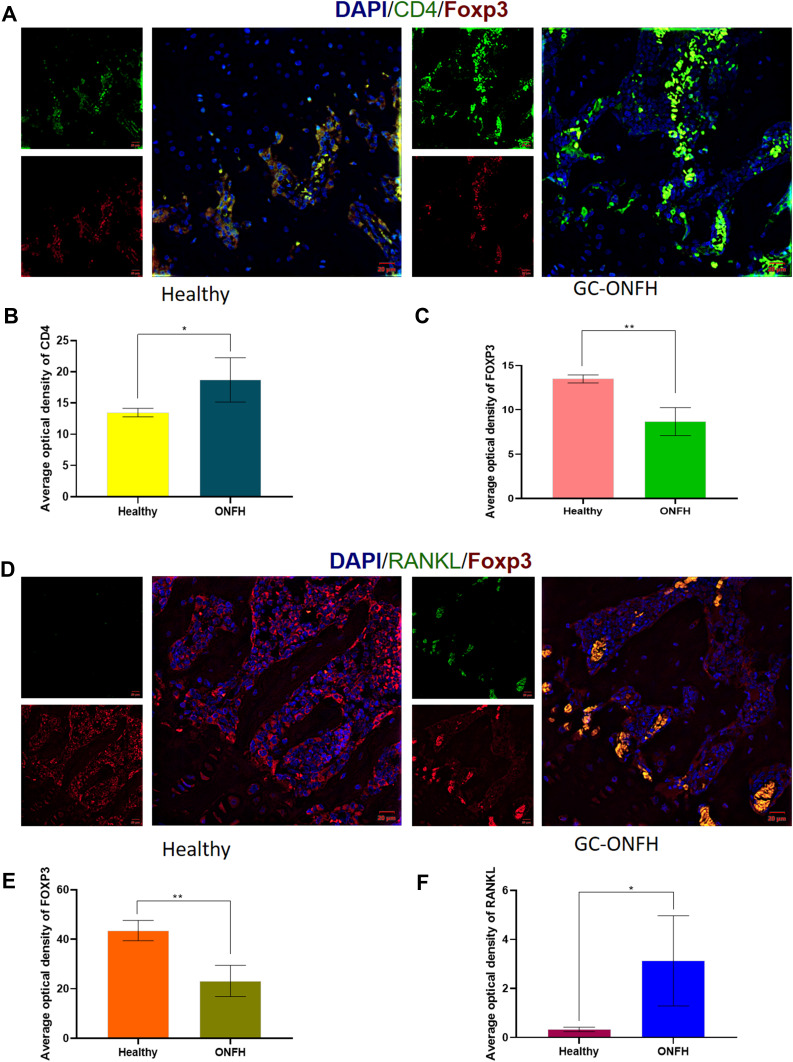
The results showed that CD3 and CD4 T-cell counts and the CD4/CD8 ratio were significantly higher in patients with ONFH and that CD3 lymphocyte levels were negatively correlated with disease duration. The CD4 T-cell levels and CD4/CD8 ratios in the GC-ONFH etiological group were lower than those in the idiopathic-, traumatic-, and alcoholic-ONFH groups, while the CD8 T-cell levels were higher. Furthermore, the CD3, CD4, and CD8 T-cell counts and the CD4/CD8 ratio were higher in the GC-ONFH group than in the control group. Finally, we observed diminished levels of FoxP3/CD4 double-positive T regulatory cells and increased RANKL T-cell levels in the bone marrow of the femoral head in GC-ONFH rats.
The imbalance of T-cell subsets might be involved in the pathophysiological process of ONFH, and diminished CD4/FoxP3 T regulatory cells may be associated with increased RANKL T cells in the bone marrow of the femoral head in GC-ONFH, which may facilitate bone resorption and collapse of the femoral head.
This study was registered in the Chinese Clinical Trial Registry (Registration number: ChiCTR2100042642).
股骨头坏死(ONFH)是一种导致髋关节退变的复杂疾病。ONFH的发病机制尚不清楚,但有研究认为免疫因素的改变在其中发挥作用。
本研究纳入109例ONFH患者和109例年龄、性别及体重指数相匹配的健康对照。通过流式细胞术检测总淋巴细胞中循环CD3、CD4和CD8淋巴细胞的百分比,并在病例组和对照组之间进行比较。对每个病因组进行亚组分析,并对T细胞亚群水平与病程进行相关性分析。此外,我们比较了健康大鼠和糖皮质激素(GC)诱导的ONFH大鼠股骨头中CD4、RANKL和FoxP3的表达模式。
结果显示,ONFH患者的CD3和CD4 T细胞计数以及CD4/CD8比值显著升高,且CD3淋巴细胞水平与病程呈负相关。GC-ONFH病因组的CD4 T细胞水平和CD4/CD8比值低于特发性、创伤性和酒精性ONFH组,而CD8 T细胞水平较高。此外,GC-ONFH组的CD3、CD4和CD8 T细胞计数以及CD4/CD8比值高于对照组。最后,我们观察到GC-ONFH大鼠股骨头骨髓中FoxP3/CD4双阳性调节性T细胞水平降低,RANKL T细胞水平升高。
T细胞亚群失衡可能参与ONFH的病理生理过程,GC-ONFH患者股骨头骨髓中CD4/FoxP3调节性T细胞减少可能与RANKL T细胞增加有关,这可能促进股骨头的骨吸收和塌陷。
本研究已在中国临床试验注册中心注册(注册号:ChiCTR2100042642)。