Aklilu Lemma Institute of Pathobiology, Addis Ababa University, Addis Ababa, Ethiopia.
College of Medicine and Health Sciences, Bahir Dar University, Bahir Dar, Ethiopia.
Malar J. 2022 Aug 1;21(1):230. doi: 10.1186/s12936-022-04250-2.
The increase in detections of Plasmodium vivax infection in Duffy-negative individuals in Africa has challenged the dogma establishing the unique P. vivax Duffy Binding Protein-Duffy antigen receptor for chemokines (PvDBP-DARC) pathway used by P. vivax merozoites to invade reticulocytes. Information on the impact of Duffy antigen polymorphisms on the epidemiology of P. vivax malaria remains elusive. The objective of this study was to determine the distribution of asexual parasitaemia of P. vivax according to the Duffy antigen polymorphisms in Ethiopia.
DNA was extracted from dried blood spots (DBS) collected from prospectively recruited 138 P. vivax-infected patients from health centres. The identification and estimation of P. vivax asexual parasitaemia were performed by microscopic examination and quantitative real-time polymerase chain reaction (PCR). Duffy genotyping was conducted by DNA sequencing in a total of 138 P.vivax infected samples.
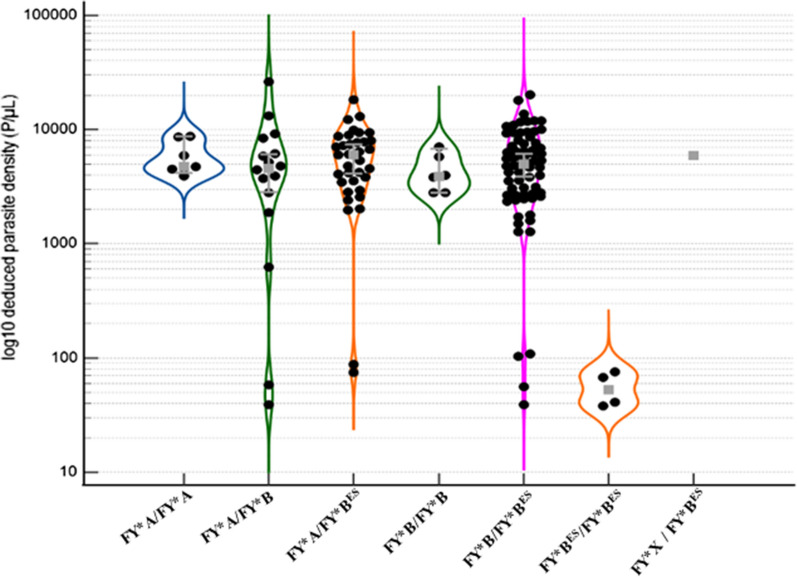
The proportion of Duffy-negatives (FYB/FYB) in P. vivax infected patients was 2.9% (4/138). Duffy genotype FYB/FYB (48.6%) was the most common, followed by FYA/FYB genotype (25.4%). In one patient, the FY02 W.01/FY02 N.01 genotype conferring a weak expression of the Fy antigen was observed. All P.vivax infected Duffy-negative patients showed low asexual parasitaemia (≤ 110 parasites/µL). The median P. vivax parasitaemia in Duffy-negative patients (53 parasites/µL) was significantly lower than those found in homozygous and heterozygous individuals (P < 0.0001).
Plasmodium vivax in Duffy-negative patients shows invariably low asexual parasitaemia. This finding suggests that the pathway used by P. vivax to invade Duffy-negative reticulocytes is much less efficient than that used in Duffy-positives. Moreover, the low asexual parasitaemia observed in Duffy-negative individuals could constitute an 'undetected silent reservoir', thus likely delaying the elimination of vivax malaria in Ethiopia.
在非洲,检测到越来越多的对达菲阴性个体的间日疟原虫感染,这对间日疟原虫裂殖子入侵网织红细胞所使用的独特达菲结合蛋白-达菲抗原受体趋化因子(PvDBP-DARC)途径的定论提出了挑战。关于达菲抗原多态性对间日疟疟疾流行病学的影响的信息仍然难以捉摸。本研究的目的是确定根据埃塞俄比亚的达菲抗原多态性,间日疟原虫无性体寄生虫血症的分布。
从前瞻性招募的来自卫生中心的 138 例间日疟原虫感染患者的干燥血斑(DBS)中提取 DNA。通过显微镜检查和定量实时聚合酶链反应(PCR)来鉴定和估计间日疟原虫无性体寄生虫血症。在总共 138 例感染了 P.vivax 的样本中,通过 DNA 测序进行达菲基因分型。
在感染间日疟原虫的患者中,达菲阴性(FYB/FYB)的比例为 2.9%(4/138)。最常见的达菲基因型为 FYB/FYB(48.6%),其次是 FYA/FYB 基因型(25.4%)。在一名患者中,观察到 FY02 W.01/FY02 N.01 基因型赋予 Fy 抗原的弱表达。所有感染间日疟原虫的达菲阴性患者均表现出低无性体寄生虫血症(≤110 个寄生虫/μL)。达菲阴性患者的中位间日疟原虫寄生虫血症(53 个寄生虫/μL)明显低于纯合子和杂合子个体(P<0.0001)。
达菲阴性患者的间日疟原虫始终表现出低无性体寄生虫血症。这一发现表明,间日疟原虫入侵达菲阴性网织红细胞的途径效率远低于达菲阳性个体。此外,在达菲阴性个体中观察到的低无性体寄生虫血症可能构成一个“未被发现的沉默储库”,从而可能延迟在埃塞俄比亚消除间日疟。