Precision Health Department, Luxembourg Institute of Health, Strassen, Luxembourg.
Business Development Office, Luxembourg Institute of Health, Strassen, Luxembourg.
BMC Endocr Disord. 2022 Aug 2;22(1):195. doi: 10.1186/s12902-022-01111-6.
Bioelectrical impedance analysis (BIA) is a widely used method to assess total body fat (TBF) depots characterising obesity. Automated BIA devices provide an inexpensive and easy assessment of TBF, making them widely available to the general public and healthcare providers without specific qualification to assess body composition. The equations included in the automated BIA devices have been developed in very few specific populations, which means that they are not suitable to assess TBF for everyone and need to be validated before use in other populations. The aim of the present work is to evaluate the accuracy of the automated BIA device Tanita® BC-532 in youth of White European ethnicity, compared with the dual-energy x-ray absorptiometry (DEXA), gold standard measurement of TBF.
Total body fat percentage (TBF%) was measured with the BIA device Tanita® BC-532 and DEXA (Hologic® QDR4500W) in 197 youth of White European ethnicity (N = 104 girls), 7-17 years old, and visiting the Diabetes & Endocrinology Care Paediatrics Clinic, Centre Hospitalier de Luxembourg, for overweight or obesity management.
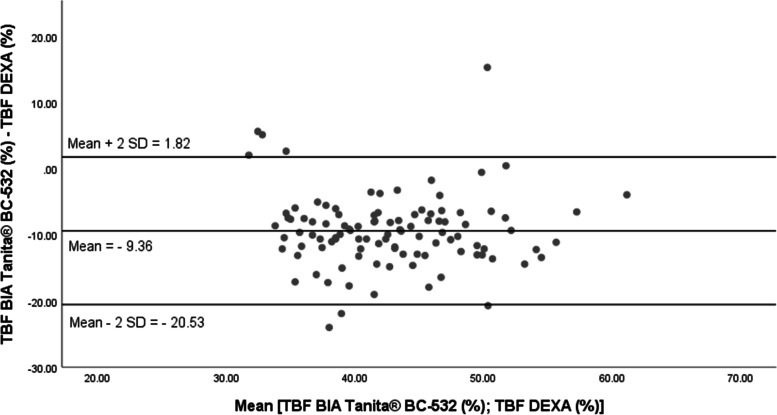
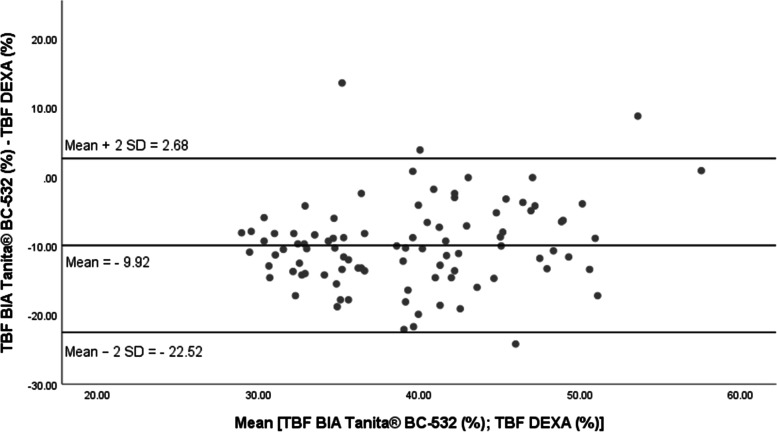
TBF% evaluated with BIA was significantly correlated with TBF% measured with DEXA in both boys (r = 0.617) and girls (r = 0.648) (p < 10). However, the residual mean between the assessment of TBF% by BIA and by DEXA [TBF (%)-TBF (%)] is extremely high (mean ± standard deviation = 10.52% ± 5.22% in boys, respectively 9.96% ± 4.40% in girls). The maximal absolute residual value is also very high, about 24% in both genders.
The automated BIA device Tanita® BC-532 appears to be not accurate to assess total body fat in youth with overweight or obesity. There is a need to calibrate the BIA device before its use in the populations where it was not previously validated.
生物电阻抗分析(BIA)是一种广泛用于评估肥胖症特征的总体体脂肪(TBF)的方法。自动化 BIA 设备提供了一种廉价且易于评估 TBF 的方法,使它们广泛提供给没有特定资格评估身体成分的普通公众和医疗保健提供者。自动化 BIA 设备中包含的方程是在极少数特定人群中开发的,这意味着它们不适合所有人评估 TBF,并且需要在其他人群中使用之前进行验证。本研究的目的是评估白种欧洲人青少年中自动化 BIA 设备 Tanita® BC-532 的准确性,该设备与双能 X 射线吸收法(DEXA),即 TBF 的金标准测量方法进行比较。
共纳入 197 名白种欧洲人青少年(N=104 名女孩),年龄为 7-17 岁,他们因超重或肥胖就诊于卢森堡中心医院糖尿病和内分泌儿科诊所,接受超重或肥胖管理,使用 BIA 设备 Tanita® BC-532 和 DEXA(Hologic® QDR4500W)测量全身脂肪百分比(TBF%)。
在男孩(r=0.617)和女孩(r=0.648)中,通过 BIA 评估的 TBF%与通过 DEXA 测量的 TBF%显著相关(p<0.001)。然而,BIA 和 DEXA 评估 TBF%之间的平均残余值[TBF(%)-TBF(%)]非常高(男孩分别为 10.52%±5.22%,女孩分别为 9.96%±4.40%)。最大绝对残余值也非常高,约为 24%,在两性中均如此。
自动化 BIA 设备 Tanita® BC-532 似乎无法准确评估超重或肥胖青少年的总体体脂肪。在将 BIA 设备用于未经其先前验证的人群之前,需要对其进行校准。