Marchandot Benjamin, Curtiaud Anais, Matsushita Kensuke, Trimaille Antonin, Host Aline, Faller Emilie, Garbin Olivier, Akladios Chérif, Jesel Laurence, Morel Olivier
Division of Cardiovascular Medicine, Nouvel Hopital Civil, Strasbourg University Hospital, 1 place de l'Hôpital, 67000 Strasbourg, France.
INSERM (French National Institute of Health and Medical Research), UMR 1260, Regenerative Nanomedicine, FMTS, Strasbourg, France.
Eur Heart J Open. 2022 Feb 2;2(1):oeac001. doi: 10.1093/ehjopen/oeac001. eCollection 2022 Jan.
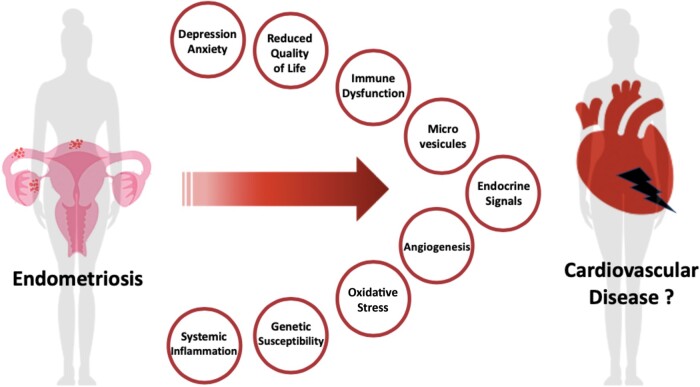
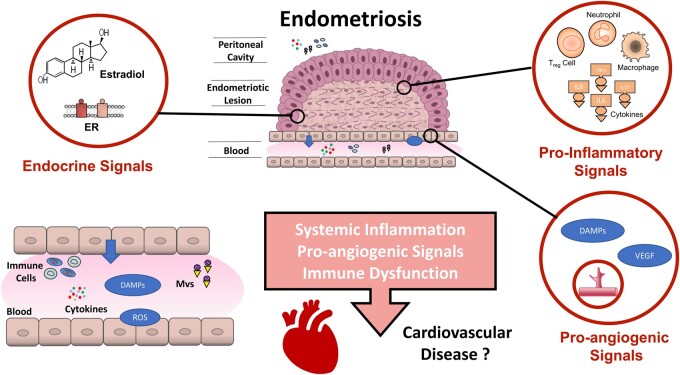
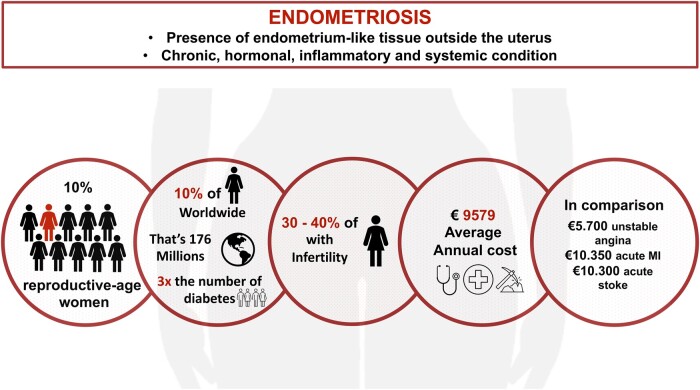
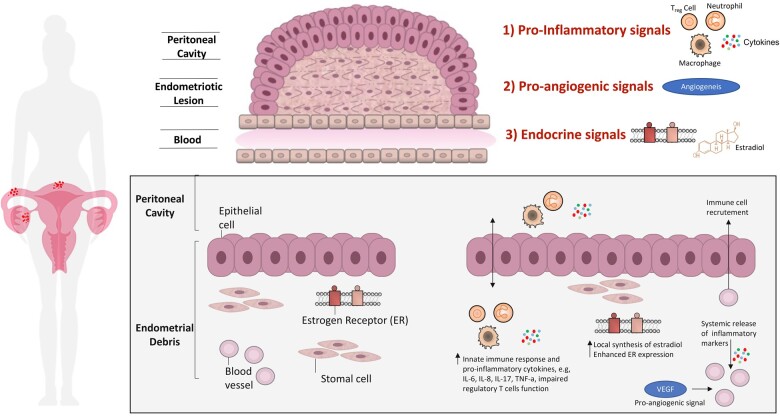
Endometriosis is a chronic gynaecological disease affecting 1 in 10 reproductive-age women. It is defined as the presence of endometrium-like tissue outside the uterus. Beyond this placid anatomical definition, endometriosis is a complex, hormonal, inflammatory, and systemic condition that poses significant familial, psychological, and economic burden. The interaction between the cardiovascular system and endometriosis has become a field of interest as the underlying mutual mechanisms become better understood. On the basis of accumulating fundamental and clinical evidence, it is likely that there exists a close relationship between endometriosis and the cardiovascular system. Therefore, investigating the endometriosis-cardiovascular interaction is highly clinically significant. In this review, we highlight our current understanding of the pathophysiology of endometriosis with systemic hormonal, pro-inflammatory, pro-angiogenic, immunologic, and genetic processes beyond the peritoneal microenvironment. Additionally, we provide current clinical evidence about how endometriosis interacts with cardiovascular risk factors and cardiovascular disease (CVD). To date, only small associations between endometriosis and CVD have been reported in observational studies, inherently limited by the potential influence of unmeasured confounding. Cardiovascular disease in women with endometriosis remains understudied, under-recognized, and underdiagnosed. More detailed study of the cardiovascular-endometriosis interaction is needed to fully understand its clinical relevance, underlying pathophysiology, possible means of early diagnosis and prevention.
子宫内膜异位症是一种慢性妇科疾病,影响着十分之一的育龄女性。它被定义为子宫外存在类似子宫内膜的组织。除了这一平静的解剖学定义外,子宫内膜异位症是一种复杂的、与激素相关的、炎症性的全身性疾病,会带来重大的家庭、心理和经济负担。随着心血管系统与子宫内膜异位症之间潜在的共同机制得到更好的理解,它们之间的相互作用已成为一个备受关注的领域。基于越来越多的基础和临床证据,子宫内膜异位症与心血管系统之间可能存在密切关系。因此,研究子宫内膜异位症与心血管系统的相互作用具有高度的临床意义。在这篇综述中,我们重点介绍了目前对子宫内膜异位症病理生理学的理解,涉及全身激素、促炎、促血管生成、免疫和遗传过程,这些过程超出了腹膜微环境的范畴。此外,我们提供了目前关于子宫内膜异位症如何与心血管危险因素及心血管疾病(CVD)相互作用的临床证据。迄今为止,观察性研究仅报道了子宫内膜异位症与心血管疾病之间的小关联,这些研究本身受到未测量混杂因素潜在影响的限制。患有子宫内膜异位症的女性的心血管疾病仍未得到充分研究、认识和诊断。需要对心血管系统与子宫内膜异位症的相互作用进行更详细的研究,以充分了解其临床相关性、潜在病理生理学、早期诊断和预防的可能方法。