• 文献检索
  • 文档翻译
  • 深度研究
  • 学术资讯
  • Suppr Zotero 插件Zotero 插件
  • 邀请有礼
  • 套餐&价格
  • 历史记录
应用&插件
Suppr Zotero 插件Zotero 插件浏览器插件Mac 客户端Windows 客户端微信小程序
定价
高级版会员购买积分包购买API积分包
服务
文献检索文档翻译深度研究API 文档MCP 服务
关于我们
关于 Suppr公司介绍联系我们用户协议隐私条款
关注我们

Suppr 超能文献

核心技术专利:CN118964589B侵权必究
粤ICP备2023148730 号-1Suppr @ 2026

文献检索

告别复杂PubMed语法,用中文像聊天一样搜索,搜遍4000万医学文献。AI智能推荐,让科研检索更轻松。

立即免费搜索

文件翻译

保留排版,准确专业,支持PDF/Word/PPT等文件格式,支持 12+语言互译。

免费翻译文档

深度研究

AI帮你快速写综述,25分钟生成高质量综述,智能提取关键信息,辅助科研写作。

立即免费体验

个体和家庭水平特征变化对印度青少年男女性贫血患病率的影响。

Effect of change in individual and household level characteristics on anemia prevalence among adolescent boys and girls in India.

机构信息

Department of Survey Research & Data Analytics, International Institute for Population Sciences, Mumbai, Maharashtra, India.

Department of Public Health & Mortality Studies, International Institute for Population Sciences, Mumbai, Maharashtra, 400088, India.

出版信息

BMC Public Health. 2022 Aug 3;22(1):1478. doi: 10.1186/s12889-022-13863-w.

DOI:10.1186/s12889-022-13863-w
PMID:35922790
原文链接:https://pmc.ncbi.nlm.nih.gov/articles/PMC9351076/
Abstract

BACKGROUND

Anemia is a significant public health challenge that affects the population of all nations. Anemia among adolescents emerged as an alarming public health issue as it harms an individual's physical capacity and cognitive and work performance. The study aims to determine the effect of changes in individual and household level factors on the prevalence of anemia among adolescent boys and girls.

METHOD

The study utilized data from two waves of the "Understanding the lives of adolescent and young adults" (UDAYA) survey, conducted in Bihar and Uttar Pradesh during 2015-16 (wave-1) and 2018-19 (wave-2). The sample size for the present study was 4216 and 5974 unmarried adolescent boys and girls aged 10-19 years in both waves. We performed descriptive analysis to observe the characteristics of adolescents during 2015-16. Further, changes in selected independent variables from wave-1 to wave-2 were examined using the proportion test. Moreover, random-effect regression models were employed to examine the association of changes in individual and household level factors with anemia prevalence among adolescents.

RESULTS

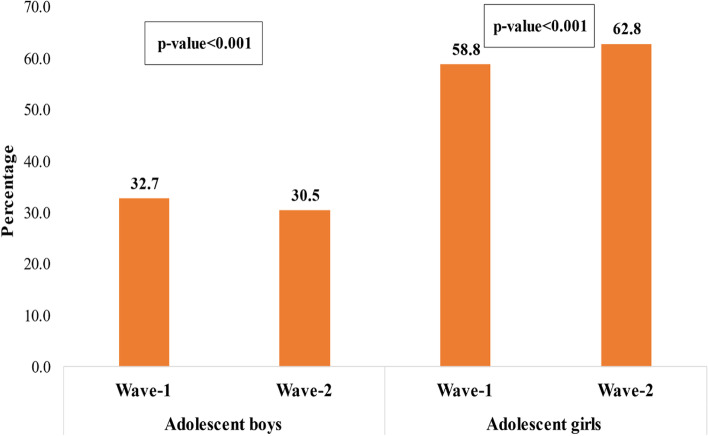
The prevalence of anemia decreased over time among adolescent boys (33 to 30%), whereas it increased among adolescent girls (59 to 63%). The results from the random-effect model show that adolescent boys who used shared toilets were more anemic than those who used a private restroom [β:0.05, 95% CI:(0.01, 0.08)]. Moreover, underweight [β:0.05, CI:(0.01, 0.09)] and thin [β:0.04, CI:(0.00, 0.07)] adolescent boys were more likely to be anemic compared to their normal counterparts. Additionally, boys who belonged to the poorest [β:0.08, CI:(0.02, 0.14)] households had a higher risk of anemia than the richest household.

CONCLUSION

The anemia prevalence was higher among adolescents aged 10-19 years in Uttar Pradesh and Bihar. This study has filled an information gap by providing state-level representative estimates indicating underweight status and thinness as the common factors behind the anemia prevalence among adolescent boys than in girls. Iron deficiency anemia is the most prevalent in certain age groups in India. Hence, Anemia prevention efforts and iron-folic acid (IFA) supplementation programs are currently being strengthened in India, targeting the high-risk population.

摘要

背景

贫血是一个严重的公共卫生挑战,影响着所有国家的人口。青少年贫血已经成为一个令人震惊的公共卫生问题,因为它会损害个人的身体能力以及认知和工作表现。本研究旨在确定个体和家庭层面因素的变化对青少年男女贫血患病率的影响。

方法

本研究使用了 2015-16 年(第 1 波)和 2018-19 年(第 2 波)在比哈尔邦和北方邦进行的“了解青少年和年轻人生活”(UDAYA)调查的两波数据。本研究的样本量为 4216 名和 5974 名 10-19 岁的未婚青少年男孩和女孩。我们进行描述性分析,以观察 2015-16 年青少年的特征。此外,使用比例检验检查第 1 波到第 2 波之间选定的自变量的变化。此外,采用随机效应回归模型检验个体和家庭层面因素的变化与青少年贫血患病率的关联。

结果

青少年男孩的贫血患病率随时间呈下降趋势(从 33%降至 30%),而少女的贫血患病率则呈上升趋势(从 59%升至 63%)。随机效应模型的结果表明,使用公共厕所的青少年男孩比使用私人厕所的男孩更容易贫血[β:0.05,95%置信区间:(0.01,0.08)]。此外,体重不足[β:0.05,CI:(0.01,0.09)]和消瘦[β:0.04,CI:(0.00,0.07)]的青少年男孩比正常体重的男孩更容易贫血。此外,来自最贫困家庭的男孩[β:0.08,CI:(0.02,0.14)]患贫血的风险高于最富裕家庭的男孩。

结论

在北方邦和比哈尔邦,10-19 岁青少年的贫血患病率较高。本研究通过提供州级代表性估计数填补了信息空白,这些估计数表明,体重不足和消瘦是男孩贫血患病率高于女孩的共同因素。缺铁性贫血是印度某些年龄段最常见的贫血类型。因此,印度目前正在加强贫血预防工作和铁叶酸(IFA)补充计划,针对高危人群。
https://cdn.ncbi.nlm.nih.gov/pmc/blobs/edee/9351076/90d50803fc56/12889_2022_13863_Fig1_HTML.jpg

相似文献

1
Effect of change in individual and household level characteristics on anemia prevalence among adolescent boys and girls in India.个体和家庭水平特征变化对印度青少年男女性贫血患病率的影响。
BMC Public Health. 2022 Aug 3;22(1):1478. doi: 10.1186/s12889-022-13863-w.
2
Associated factors and socio-economic inequality in the prevalence of thinness and stunting among adolescent boys and girls in Uttar Pradesh and Bihar, India.印度北方邦和比哈尔邦青少年男女性别消瘦和发育迟缓的相关因素和社会经济不平等。
PLoS One. 2021 Feb 24;16(2):e0247526. doi: 10.1371/journal.pone.0247526. eCollection 2021.
3
Prevalence and predictors of anaemia among adolescents in Bihar and Uttar Pradesh, India.印度比哈尔邦和北方邦青少年贫血症的患病率及其预测因素。
Sci Rep. 2022 May 17;12(1):8197. doi: 10.1038/s41598-022-12258-6.
4
A study of awareness on HIV/AIDS among adolescents: A Longitudinal Study on UDAYA data.青少年对艾滋病认知的研究:UDAYA 数据的纵向研究。
Sci Rep. 2021 Nov 24;11(1):22841. doi: 10.1038/s41598-021-02090-9.
5
Changes in anemia and anthropometry during adolescence predict learning outcomes: findings from a 3-year longitudinal study in India.青少年时期贫血和人体测量学的变化可预测学习成绩:来自印度一项为期 3 年的纵向研究的结果。
Am J Clin Nutr. 2022 Jun 7;115(6):1549-1558. doi: 10.1093/ajcn/nqac028.
6
Iron-and-folic-acid supplementation among adolescents (aged 10-19 years) in two North Indian States, 2015-2016: a sex-stratified analysis.2015-2016 年在印度北部两个邦对青少年(10-19 岁)进行的铁和叶酸补充剂:一项按性别分层的分析。
Public Health Nutr. 2022 Mar;25(3):617-622. doi: 10.1017/S136898002000508X. Epub 2020 Dec 14.
7
Determinants of School dropouts among adolescents: Evidence from a longitudinal study in India.青少年辍学的决定因素:来自印度一项纵向研究的证据。
PLoS One. 2023 Mar 2;18(3):e0282468. doi: 10.1371/journal.pone.0282468. eCollection 2023.
8
Association of iron supplementation and dietary diversity with nutritional status and learning outcomes among adolescents: Results from a longitudinal study in Uttar Pradesh and Bihar, India.铁补充剂和饮食多样性与青少年营养状况和学习成果的关联:来自印度北方邦和比哈尔邦的一项纵向研究结果。
J Glob Health. 2021 Jul 24;11:04037. doi: 10.7189/jogh.11.04037. eCollection 2021.
9
What shapes gender attitudes among adolescent girls and boys? Evidence from the UDAYA Longitudinal Study in India.什么塑造了青少年女孩和男孩的性别态度?来自印度 UDAYA 纵向研究的证据。
PLoS One. 2021 Mar 18;16(3):e0248766. doi: 10.1371/journal.pone.0248766. eCollection 2021.
10
Banned by the law, practiced by the society: The study of factors associated with dowry payments among adolescent girls in Uttar Pradesh and Bihar, India.被法律禁止,被社会实践:印度北方邦和比哈尔邦少女支付嫁妆相关因素的研究。
PLoS One. 2021 Oct 15;16(10):e0258656. doi: 10.1371/journal.pone.0258656. eCollection 2021.

引用本文的文献

1
Anemia: Etiology, Pathophysiology, Impact, and Prevention: A Review.贫血:病因、病理生理学、影响及预防:综述
Iran J Public Health. 2025 Mar;54(3):509-520. doi: 10.18502/ijph.v54i3.18244.
2
Prevalence of anemia in India: a systematic review, meta-analysis and geospatial analysis.印度贫血症患病率:系统评价、荟萃分析和地理空间分析
BMC Public Health. 2025 Apr 4;25(1):1270. doi: 10.1186/s12889-025-22439-3.
3
Anemia Across Lifespans in Rural South India: A Comprehensive Study of Age and Gender Dynamics From the Field Practice Area of Centre for Rural Health (CRHA), Nutakki, Andhra Pradesh.

本文引用的文献

1
Prevalence and correlates of Helicobacter pylori infection among under-five children, adolescent and non-pregnant women in Nepal: Further analysis of Nepal national micronutrient status survey 2016.尼泊尔五岁以下儿童、青少年和非孕妇人群中幽门螺杆菌感染的流行情况及其相关因素:2016 年尼泊尔国家微量营养素状况调查的进一步分析。
PLoS Negl Trop Dis. 2021 Jun 21;15(6):e0009510. doi: 10.1371/journal.pntd.0009510. eCollection 2021 Jun.
2
Does socio-economic inequality exist in micro-nutrients supplementation among children aged 6-59 months in India? Evidence from National Family Health Survey 2005-06 and 2015-16.印度 6-59 个月儿童微营养素补充是否存在社会经济不平等?来自 2005-06 年和 2015-16 年全国家庭健康调查的证据。
BMC Public Health. 2021 Mar 19;21(1):545. doi: 10.1186/s12889-021-10601-6.
3
印度南部农村地区全生命周期贫血情况:来自安得拉邦努塔基农村卫生中心(CRHA)实地实践区的年龄与性别动态综合研究
Cureus. 2025 Jan 25;17(1):e77963. doi: 10.7759/cureus.77963. eCollection 2025 Jan.
4
Anaemia among lactating adolescents (15-19 years) in India: a repeated cross-sectional analysis of the NFHS data (2005-2021).印度哺乳期青少年(15-19 岁)贫血:NFHS 数据(2005-2021)的重复横断面分析。
BMC Public Health. 2024 Oct 29;24(1):2993. doi: 10.1186/s12889-024-20187-4.
5
Prevalence of anemia and its associated factors among school-going adolescent girls in schools of Dhankuta municipality, Nepal.尼泊尔丹库塔市学校中在校青春期女孩贫血患病率及其相关因素
PLOS Glob Public Health. 2024 Sep 17;4(9):e0003684. doi: 10.1371/journal.pgph.0003684. eCollection 2024.
6
Anthropometry Indices and Body Composition in Adolescent Girls with Anemia: A Scoping Review.贫血青春期女孩的人体测量指数与身体成分:一项范围综述
J Multidiscip Healthc. 2024 Aug 26;17:4131-4141. doi: 10.2147/JMDH.S481134. eCollection 2024.
7
Identification and validation of ferroptosis related markers in erythrocyte differentiation of umbilical cord blood-derived CD34 cell by bioinformatic analysis.通过生物信息学分析鉴定和验证脐带血来源的CD34细胞红细胞分化中铁死亡相关标志物
Front Genet. 2024 Jul 30;15:1365232. doi: 10.3389/fgene.2024.1365232. eCollection 2024.
8
Dietary Patterns and Association with Anemia in Children Aged 9-16 Years in Guangzhou, China: A Cross-Sectional Study.膳食模式与中国广州 9-16 岁儿童贫血的关系:一项横断面研究。
Nutrients. 2023 Sep 25;15(19):4133. doi: 10.3390/nu15194133.
9
Spatial variation and attributable risk factors of anaemia among young children in Uganda: Evidence from a nationally representative survey.乌干达幼儿贫血的空间变异及归因风险因素:来自全国代表性调查的证据
PLOS Glob Public Health. 2023 May 17;3(5):e0001899. doi: 10.1371/journal.pgph.0001899. eCollection 2023.
Associated factors and socio-economic inequality in the prevalence of thinness and stunting among adolescent boys and girls in Uttar Pradesh and Bihar, India.印度北方邦和比哈尔邦青少年男女性别消瘦和发育迟缓的相关因素和社会经济不平等。
PLoS One. 2021 Feb 24;16(2):e0247526. doi: 10.1371/journal.pone.0247526. eCollection 2021.
4
Inequality in child undernutrition among urban population in India: a decomposition analysis.印度城市人口中儿童营养不足的不平等现象:分解分析。
BMC Public Health. 2020 Dec 3;20(1):1852. doi: 10.1186/s12889-020-09864-2.
5
Prevalence of Anemia and Associated Factors among Secondary School Adolescent Girls in Jimma Town, Oromia Regional State, Southwest Ethiopia.埃塞俄比亚西南部奥罗米亚州吉马镇中学青春期女孩贫血患病率及相关因素
Anemia. 2020 Sep 22;2020:5043646. doi: 10.1155/2020/5043646. eCollection 2020.
6
Correction: Nutritional status of Indian adolescents (15-19 years) from National Family Health Surveys 3 and 4: Revised estimates using WHO 2007 Growth reference.更正:来自第三次和第四次全国家庭健康调查的印度青少年(15 - 19岁)的营养状况:使用世界卫生组织2007年生长参考标准的修订估计数。
PLoS One. 2020 Sep 24;15(9):e0239923. doi: 10.1371/journal.pone.0239923. eCollection 2020.
7
Random effects models for complex designs.复杂设计的随机效应模型。
Stat Methods Med Res. 2020 Dec;29(12):3695-3706. doi: 10.1177/0962280220938418. Epub 2020 Jul 16.
8
Characterisation of the types of anaemia prevalent among children and adolescents aged 1-19 years in India: a population-based study.印度 1-19 岁儿童和青少年常见贫血类型的特征:一项基于人群的研究。
Lancet Child Adolesc Health. 2020 Jul;4(7):515-525. doi: 10.1016/S2352-4642(20)30094-8.
9
Moving beyond individual barriers and identifying multi-level strategies to reduce anemia in Odisha India.超越个体障碍,确定多层次策略,减少印度奥里萨邦的贫血。
BMC Public Health. 2020 Apr 6;20(1):457. doi: 10.1186/s12889-020-08574-z.
10
Prevalence of Anemia Among Adolescent Girls in a Rural Area of Tamil Nadu, India.印度泰米尔纳德邦农村地区青春期女孩的贫血患病率
J Family Med Prim Care. 2019 Apr;8(4):1414-1417. doi: 10.4103/jfmpc.jfmpc_140_19.