Harms Floor A, Ubbink Rinse, de Wijs Calvin J, Ligtenberg Max P, Ter Horst Maarten, Mik Egbert G
Department of Anesthesiology, Erasmus Medical Center, Erasmus University Rotterdam, Rotterdam, Netherlands.
Front Med (Lausanne). 2022 Jul 18;9:785734. doi: 10.3389/fmed.2022.785734. eCollection 2022.
Adequate oxygenation is essential for the preservation of organ function during cardiac surgery and cardiopulmonary bypass (CPB). Both hypoxia and hyperoxia result in undesired outcomes, and a narrow window for optimal oxygenation exists. Current perioperative monitoring techniques are not always sufficient to monitor adequate oxygenation. The non-invasive COMET monitor could be a tool to monitor oxygenation by measuring the cutaneous mitochondrial oxygen tension (mitoPO). This pilot study examines the feasibility of cutaneous mitoPO measurements during cardiothoracic procedures. Cutaneous mitoPO will be compared to tissue oxygenation (StO) as measured by near-infrared spectroscopy.
This single-center observational study examined 41 cardiac surgery patients requiring CPB. Preoperatively, patients received a 5-aminolevulinic acid plaster on the upper arm to enable mitoPO measurements. After induction of anesthesia, both cutaneous mitoPO and StO were measured throughout the procedure. The patients were observed until discharge for the development of acute kidney insufficiency (AKI).
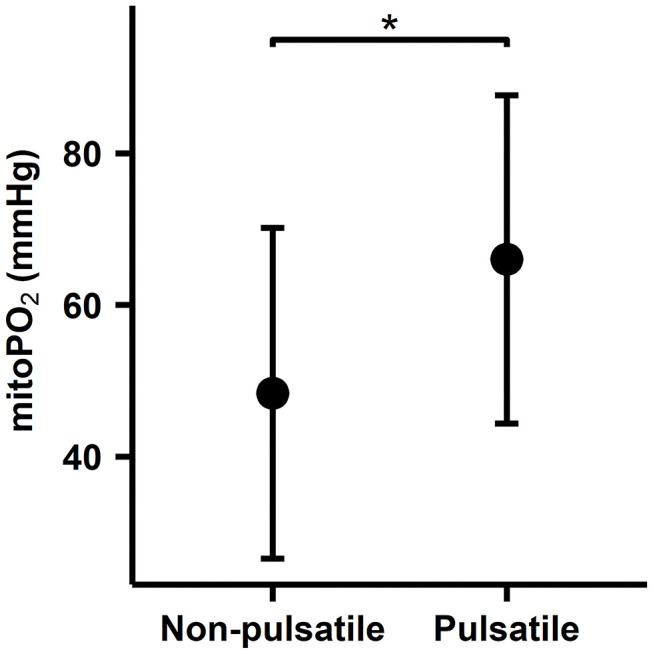
Cutaneous mitoPO was successfully measured in all patients and was 63.5 [40.0-74.8] mmHg at the surgery start and decreased significantly ( < 0.01) to 36.4 [18.4-56.0] mmHg by the end of the CPB run. StO at the surgery start was 80.5 [76.8-84.3]% and did not change significantly. Cross-clamping of the aorta and the switch to non-pulsatile flow resulted in a median cutaneous mitoPO decrease of 7 mmHg ( < 0.01). The cessation of the aortic cross-clamping period resulted in an increase of 4 mmHg ( < 0.01). Totally, four patients developed AKI and had a lower preoperative eGFR of 52 vs. 81 ml/min in the non-AKI group. The AKI group spent 32% of the operation time with a cutaneous mitoPO value under 20 mmHg as compared to 8% in the non-AKI group.
This pilot study illustrated the feasibility of measuring cutaneous mitoPO using the COMET monitor during cardiothoracic procedures. Moreover, in contrast to StO, mitoPO decreased significantly with the increasing CPB run time. Cutaneous mitoPO also significantly decreased during the aortic cross-clamping period and increased upon the release of the clamp, but StO did not. This emphasized the sensitivity of cutaneous mitoPO to detect circulatory and microvascular changes.
在心脏手术和体外循环(CPB)期间,充分的氧合对于维持器官功能至关重要。缺氧和高氧都会导致不良后果,且存在一个最佳氧合的狭窄窗口。当前的围手术期监测技术并不总是足以监测充分的氧合。非侵入性的COMET监测仪可能是一种通过测量皮肤线粒体氧张力(mitoPO)来监测氧合的工具。这项前瞻性研究探讨了在心胸手术过程中测量皮肤mitoPO的可行性。将皮肤mitoPO与通过近红外光谱法测量的组织氧合(StO)进行比较。
这项单中心观察性研究纳入了41例需要CPB的心脏手术患者。术前,患者在上臂涂抹5-氨基乙酰丙酸贴剂以进行mitoPO测量。麻醉诱导后,在整个手术过程中测量皮肤mitoPO和StO。观察患者直至出院,以观察急性肾功能不全(AKI)的发生情况。
所有患者均成功测量了皮肤mitoPO,手术开始时为63.5[40.0 - 74.8]mmHg,CPB结束时显著降低(<0.01)至36.4[18.4 - 56.0]mmHg。手术开始时StO为80.5[76.8 - 84.3]%,且无显著变化。主动脉交叉阻断和转为非搏动性血流导致皮肤mitoPO中位数下降7mmHg(<0.01)。主动脉交叉阻断期结束后上升4mmHg(<0.01)。共有4例患者发生AKI,其术前估算肾小球滤过率(eGFR)低于非AKI组,分别为52 vs. 81 ml/min。AKI组有32%的手术时间皮肤mitoPO值低于20mmHg,而非AKI组为8%。
这项前瞻性研究表明,在心胸手术过程中使用COMET监测仪测量皮肤mitoPO是可行的。此外,与StO不同,mitoPO随CPB运行时间的增加而显著降低。在主动脉交叉阻断期间皮肤mitoPO也显著降低,松开阻断钳后升高,但StO没有变化。这强调了皮肤mitoPO对检测循环和微血管变化的敏感性。