School of Social Sciences, Universiti Sains Malaysia, Minden, Penang, Malaysia.
Integrative Medicine Cluster Advanced Medical and Dental Institute, Universiti Sains Malaysia, Bertam, Pulau Pinang, Malaysia.
Eur J Cancer Care (Engl). 2022 Nov;31(6):e13669. doi: 10.1111/ecc.13669. Epub 2022 Aug 7.
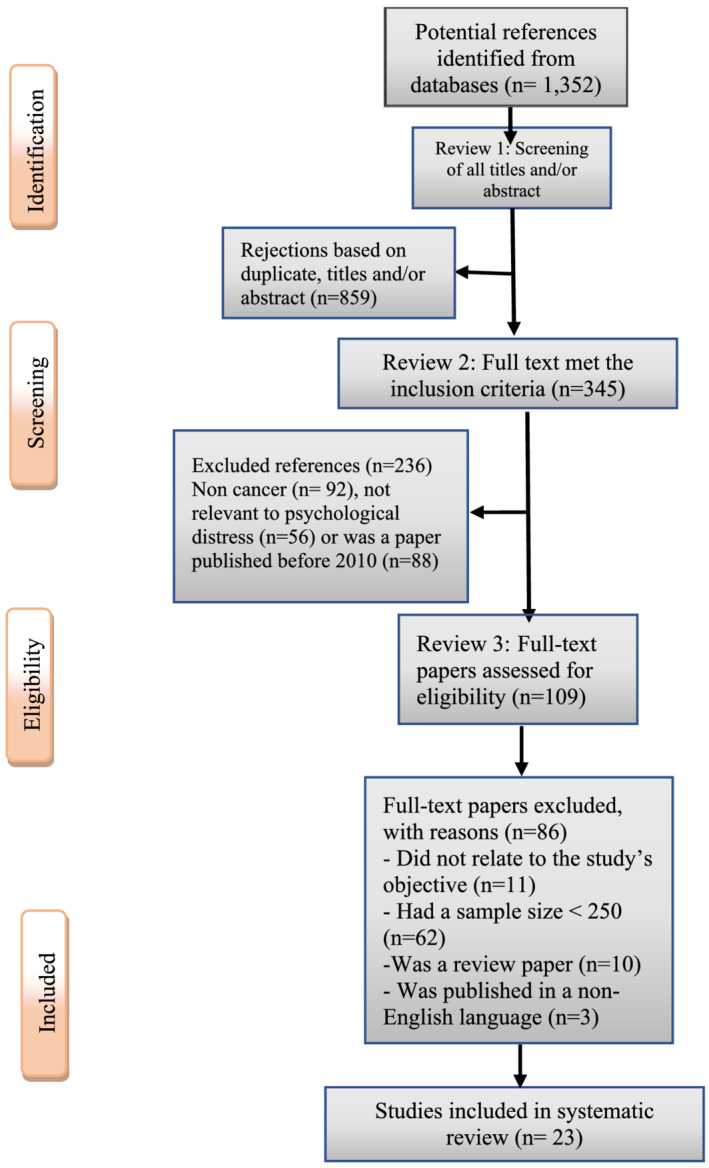
Psychological distress (including depression and anxiety) is common in the first years of cancer diagnosis but can differ by country and region. The aim of the present paper was to review the prevalence of psychological distress among cancer patients in the Southeast Asia (SEA) region. A systematic literature search was carried out using several databases (i.e., PubMed, PsychARTICLES, Embase, CINAHI, Web of Sciences, Plus, Scopus, and AHMED). Papers originally published in English language were taken into consideration if they (i) were published from 2010 to 2021 and (ii) reported the prevalence of psychological distress among patients with different types of cancer. A total of 23 studies met the inclusion criteria. The most frequently employed psychometric instrument for anxiety and depression screening was the Hospital Anxiety and Depression Scale (HADS). The prevalence of anxiety (ranging from 7% to 88%) was wider than that of depression (ranging from 3% to 65.5%) among patients with different types of cancer and living in various countries in the SEA region. The overall prevalence rate of psychological distress among cancer patients from the SEA region was not fundamentally very different from that of general populations. These findings provide useful information for health professionals and cancer patients to understand the negative role of psychological distress in quality of life and health. The research findings demonstrate the importance of counselling for psychological distress among cancer patients as means of effectively resolving their psychological problems and ultimately improving the quality of oncology medical care. Clinical recommendations for cancer management should incorporate the early identification of (and therapy for) psychological distress, as well as their monitoring during treatment.
心理困扰(包括抑郁和焦虑)在癌症诊断后的头几年很常见,但因国家和地区而异。本文旨在综述东南亚(SEA)地区癌症患者心理困扰的流行情况。使用多个数据库(即 PubMed、PsychARTICLES、Embase、CINAHI、Web of Sciences、Plus、Scopus 和 AHMED)进行了系统的文献检索。如果论文(i)发表于 2010 年至 2021 年期间,且(ii)报告了不同类型癌症患者心理困扰的流行情况,那么将考虑以英文发表的论文。共有 23 项研究符合纳入标准。用于焦虑和抑郁筛查的最常用心理计量工具是医院焦虑和抑郁量表(HADS)。不同类型癌症和居住在 SEA 地区不同国家的患者中,焦虑的流行率(7%至 88%)大于抑郁(3%至 65.5%)。SEA 地区癌症患者的总体心理困扰流行率与一般人群基本没有太大差异。这些发现为卫生专业人员和癌症患者提供了有用的信息,以了解心理困扰对生活质量和健康的负面影响。研究结果表明,对癌症患者进行心理咨询对于解决他们的心理问题,最终改善肿瘤学医疗质量非常重要。癌症管理的临床建议应包括早期识别(和治疗)心理困扰,并在治疗期间进行监测。