Department of Statistics, School of Physical & Decision Science, Babasaheb Bhimrao Ambedkar University, Lucknow, 226025, India.
Department of Library & Information Science, School of Information Science & Technology, Babasaheb Bhimrao Ambedkar University, Lucknow, 226025, India.
Curr Microbiol. 2022 Aug 10;79(9):286. doi: 10.1007/s00284-022-02985-4.
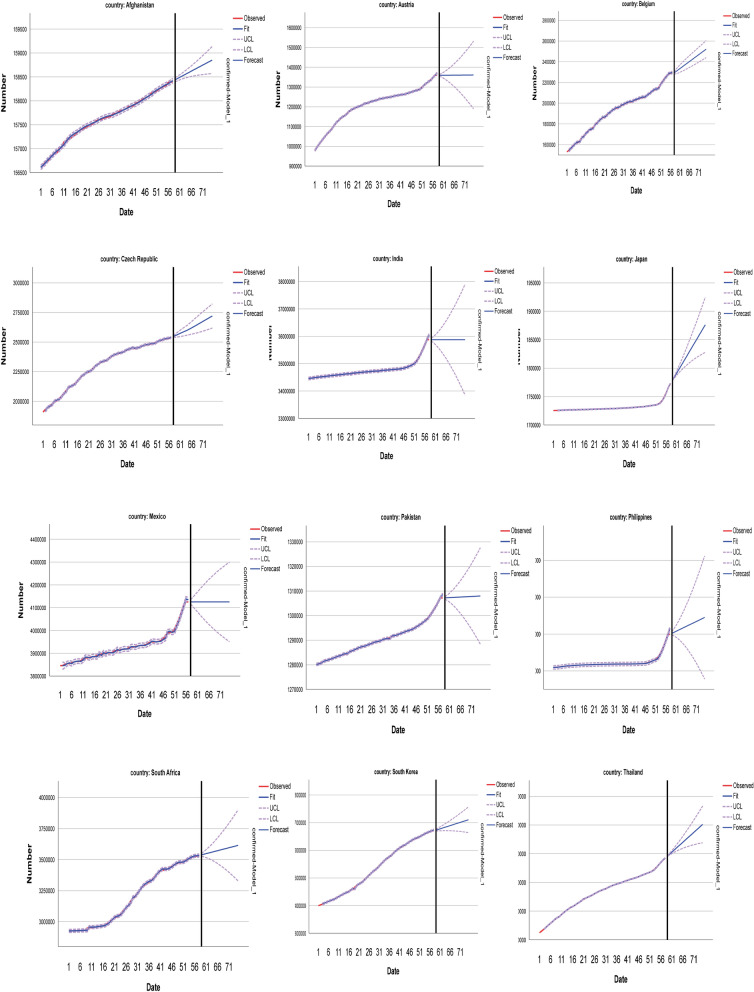
The COVID-19 pandemic has followed a wave pattern, with an increase in new cases followed by a drop. Several factors influence this pattern, including vaccination efficacy over time, human behavior, infection management measures used, emergence of novel variants of SARS-CoV-2, and the size of the vulnerable population, among others. In this study, we used three statistical approaches to analyze COVID-19 dissemination data collected from 15 November 2021 to 09 January 2022 for the prediction of further spread and to determine the behavior of the pandemic in the top 12 countries by infection incidence at that time, namely Distribution Fitting, Time Series Modeling, and Epidemiological Modeling. We fitted various theoretical distributions to data sets from different countries, yielding the best-fit distribution for the most accurate interpretation and prediction of the disease spread. Several time series models were fitted to the data of the studied countries using the expert modeler to obtain the best fitting models. Finally, we estimated the infection rates (β), recovery rates (γ), and Basic Reproduction Numbers ([Formula: see text]) for the countries using the compartmental model SIR (Susceptible-Infectious-Recovered). Following more research on this, our findings may be validated and interpreted. Therefore, the most refined information may be used to develop the best policies for breaking the disease's chain of transmission by implementing suppressive measures such as vaccination, which will also aid in the prevention of future waves of infection.
新冠疫情呈波浪式发展,新增病例数量先增加后减少。多种因素影响这种模式,包括疫苗接种效果随时间推移的变化、人类行为、感染管理措施的使用、SARS-CoV-2 新型变体的出现以及易感染人群的规模等。在这项研究中,我们使用了三种统计方法来分析 2021 年 11 月 15 日至 2022 年 1 月 9 日期间收集的新冠疫情传播数据,以预测疫情的进一步传播,并确定当时感染发病率最高的 12 个国家的疫情行为,即分布拟合、时间序列建模和流行病学建模。我们将各种理论分布拟合到来自不同国家的数据集中,为疾病传播的准确解释和预测提供了最佳拟合分布。使用专家建模器对研究国家的数据进行了多种时间序列模型拟合,以获得最佳拟合模型。最后,我们使用 SIR(易感-感染-恢复) compartmental 模型估计了这些国家的感染率(β)、恢复率(γ)和基本繁殖数([Formula: see text])。在对这方面进行更多研究后,我们的发现可能会得到验证和解释。因此,可以使用最精确的信息来制定最佳政策,通过实施疫苗接种等抑制措施来打破疾病的传播链,这也将有助于预防未来的感染浪潮。