Department of Psychiatry, College of Medicine, University of Florida, Gainesville, Florida, USA.
Univeristy of Florida, Evelyn F. and William L. McKnight Brain Institute, Gainesville, Florida, USA.
J Clin Nurs. 2024 Jan;33(1):288-303. doi: 10.1111/jocn.16463. Epub 2022 Aug 10.
(1) To investigate the vulnerability of nurses to experiencing professional burnout and low fulfilment across 5 months of the COVID-19 pandemic. (2) To identify modifiable variables in hospital leadership and individual vulnerabilities that may mitigate these effects.
Nurses were at increased risk for burnout and low fulfilment prior to the COVID-19 pandemic. Hospital leadership factors such as organisational structure and open communication and consideration of employee opinions are known to have positive impacts on work attitudes. Personal risk factors for burnout include symptoms of depression and anxiety.
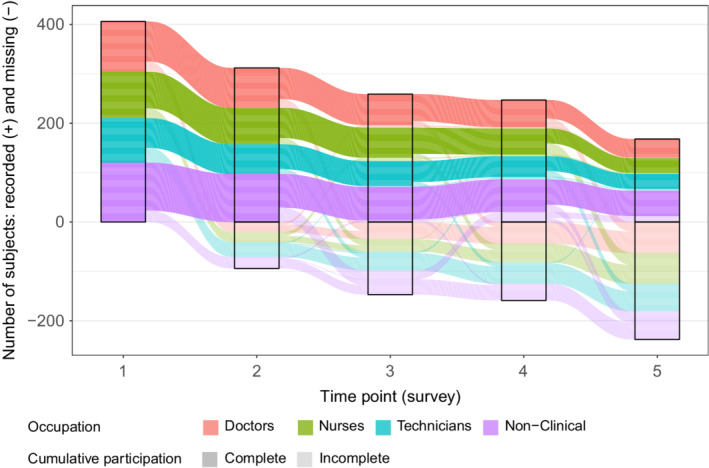
Healthcare workers (n = 406 at baseline, n = 234 longitudinal), including doctors (n = 102), nurses (n = 94), technicians (n = 90) and non-clinical administrative staff (n = 120), completed 5 online questionnaires, once per month, for 5 months. Participants completed self-report questionnaires on professional fulfilment and burnout, perceptions of healthcare leadership, and symptoms of anxiety and depression. Participants were recruited from various healthcare settings in the southeastern United States. The STROBE checklist was used to report the present study.
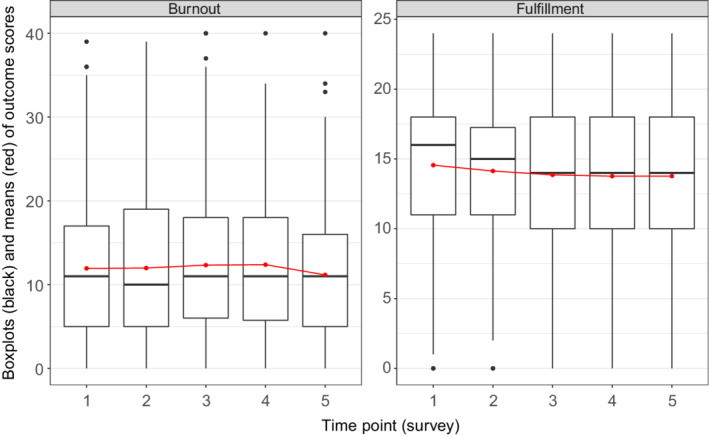
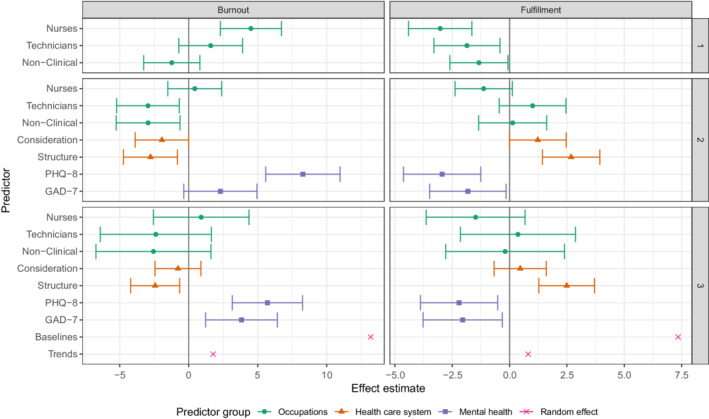
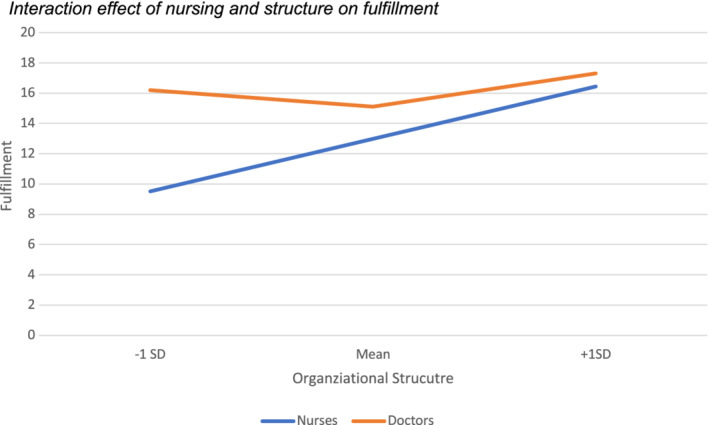
Both at baseline and across the 5 months, nurses working during the COVID-19 pandemic reported increased burnout and decreased fulfilment relative to doctors. For all participants, burnout remained largely steady and fulfilment decreased slightly. The strongest predictors of both burnout and fulfilment were organisational structure and depressive symptoms. Leadership consideration and anxiety symptoms had smaller, yet significant, relationships to burnout and fulfilment in longitudinal analyses.
Burnout and reduced fulfilment remain a problem for healthcare workers, especially nurses. Leadership styles and employee symptoms of depression and anxiety are appropriate targets for intervention.
Leadership wishing to reduce burnout and increase fulfilment among employees should increase levels of organisational support and consideration and expand supports to employees seeking treatment for depression and anxiety.
(1)在 COVID-19 大流行的 5 个月内,调查护士在经历职业倦怠和成就感低方面的脆弱性。(2)确定医院领导和个人脆弱性中的可改变变量,这些变量可能减轻这些影响。
在 COVID-19 大流行之前,护士患倦怠和成就感低的风险增加。医院领导因素,如组织结构和开放沟通以及考虑员工意见,已知对工作态度有积极影响。倦怠的个人风险因素包括抑郁和焦虑症状。
医疗保健工作者(基线时 n=406,纵向 n=234),包括医生(n=102)、护士(n=94)、技术人员(n=90)和非临床行政人员(n=120),每月完成 5 次在线问卷,共 5 个月。参与者完成了专业成就感和倦怠感、对医疗保健领导的看法以及焦虑和抑郁症状的自我报告问卷。参与者是从美国东南部的各种医疗保健环境中招募的。STROBE 清单用于报告本研究。
在 COVID-19 大流行期间工作的护士与医生相比,倦怠感增加,成就感降低。对于所有参与者,倦怠感基本保持稳定,成就感略有下降。组织结构和抑郁症状是倦怠感和成就感的最强预测因素。在纵向分析中,领导关注和焦虑症状与倦怠感和成就感也有较小但显著的关系。
倦怠感和成就感降低仍然是医疗保健工作者的一个问题,尤其是护士。领导风格和员工的抑郁和焦虑症状是干预的适当目标。
希望减少员工倦怠感和增加成就感的领导应该增加组织支持和关注的水平,并为寻求治疗抑郁和焦虑的员工提供更多支持。