Laboratorio de Microbiología de los Alimentos, Centro de Investigación y Asistencia Técnica a la Industria (CIATI), Expedicionarios del Desierto 1310, 8309 Centenario, Neuquén, Argentina; Consejo Nacional de Investigaciones Científicas y Técnicas (CONICET), Argentina.
Laboratorio Central "Mg. Luis Alfredo Pianciola", Ministerio de Salud de la Provincia de Neuquén, Gregorio Martinez 65, 8300 Neuquén, Argentina.
Sci Total Environ. 2021 Feb 20;756:144105. doi: 10.1016/j.scitotenv.2020.144105. Epub 2020 Nov 28.
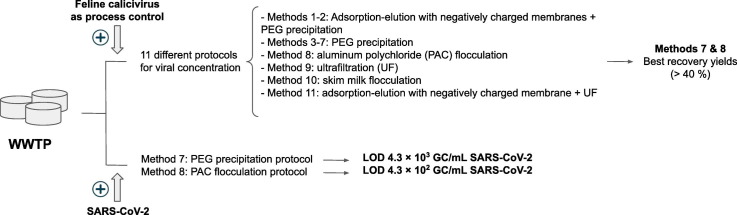
Wastewater-based epidemiology (WBE) is a useful tool that has the potential to act as a complementary approach to monitor the presence of SARS-CoV-2 in the community and as an early alarm system for COVID-19 outbreak. Many studies reported low concentrations of SARS-CoV-2 in sewage and also revealed the need for methodological validation for enveloped viruses concentration in wastewater. The aim of this study was to evaluate different methodologies for the concentration of viruses in wastewaters and to select and improve an option that maximizes the recovery of SARS-CoV-2. A total of 11 concentration techniques based on different principles were evaluated: adsorption-elution protocols with negatively charged membranes followed by polyethylene glycol (PEG) precipitation (Methods 1-2), PEG precipitation (Methods 3-7), aluminum polychloride (PAC) flocculation (Method 8), ultrafiltration (Method 9), skim milk flocculation (Method 10) and adsorption-elution with negatively charged membrane followed by ultrafiltration (Method 11). To evaluate the performance of these concentration techniques, feline calicivirus (FCV) was used as a process control in order to avoid the risk associated with handling SARS-CoV-2. Two protocols, one based on PEG precipitation and the other on PAC flocculation, showed high efficiency for FCV recovery from wastewater (62.2% and 45.0%, respectively). These two methods were then tested for the specific recovery of SARS-CoV-2. Both techniques could recover SARS-CoV-2 from wastewater, PAC flocculation showed a lower limit of detection (4.3 × 10 GC/mL) than PEG precipitation (4.3 × 10 GC/mL). This work provides a critical overview of current methods used for virus concentration in wastewaters and the analysis of sensitivity for the specific recovery of SARS-CoV-2 in sewage. The data obtained here highlights the viability of WBE for the surveillance of COVID-19 infections in the community.
基于污水的流行病学(WBE)是一种有用的工具,它有可能作为监测社区中 SARS-CoV-2 存在的补充方法,并作为 COVID-19 爆发的早期警报系统。许多研究报告称,污水中 SARS-CoV-2 的浓度较低,同时也揭示了需要对污水中包膜病毒进行方法学验证。本研究旨在评估污水中病毒浓缩的不同方法,并选择和改进一种能最大限度提高 SARS-CoV-2 回收率的方法。评估了基于不同原理的 11 种浓缩技术:带负电荷的膜吸附洗脱方案,然后用聚乙二醇(PEG)沉淀(方法 1-2)、PEG 沉淀(方法 3-7)、聚合氯化铝(PAC)絮凝(方法 8)、超滤(方法 9)、脱脂奶絮凝(方法 10)和带负电荷的膜吸附洗脱,然后用超滤(方法 11)。为了评估这些浓缩技术的性能,使用猫杯状病毒(FCV)作为过程控制,以避免处理 SARS-CoV-2 带来的风险。两种方案,一种基于 PEG 沉淀,另一种基于 PAC 絮凝,对从污水中回收 FCV 的效率较高(分别为 62.2%和 45.0%)。然后,这两种方法被用于 SARS-CoV-2 的特异性回收。这两种技术都可以从污水中回收 SARS-CoV-2,PAC 絮凝的检测下限(4.3×10 拷贝/毫升)低于 PEG 沉淀(4.3×10 拷贝/毫升)。这项工作提供了一个关于当前用于污水中病毒浓缩的方法的重要综述,以及对污水中 SARS-CoV-2 特异性回收的敏感性分析。这里获得的数据突出了 WBE 在监测社区 COVID-19 感染方面的可行性。