Department of Pediatrics and Department of Environmental Medicine, New York University School of Medicine, New York, NY 10016, United States.
Department of Pediatrics and Department of Environmental Medicine, New York University School of Medicine, New York, NY 10016, United States.
Environ Int. 2022 Sep;167:107449. doi: 10.1016/j.envint.2022.107449. Epub 2022 Aug 4.
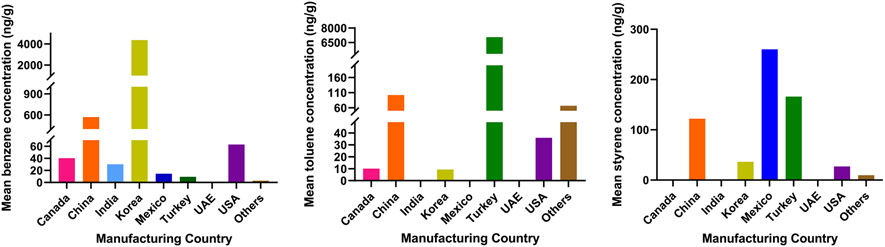
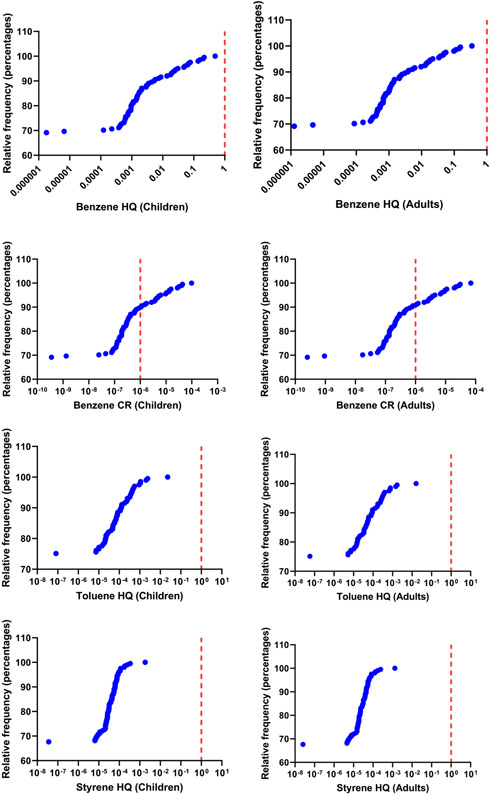
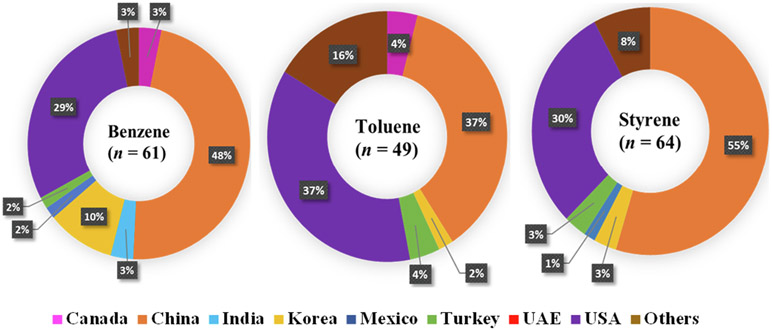
Human exposure to carcinogenic volatile organic compounds (VOCs), such as benzene, from hand sanitizers is a topic of current concern. In light of the heavy use of hand sanitizers during the COVID-19 pandemic, determination of exposure to toxicants present in these products deserves attention. The US Food and Drug Administration (FDA) had set an interim limit for benzene in alcohol-based hand sanitizers at 2000 parts-per-billion (ppb). We determined the concentrations of and exposure to three VOCs namely, benzene, toluene and styrene, in 200 hand sanitizers using high-resolution gas chromatography coupled with high-resolution mass spectrometry (HRGC-HRMS). Benzene, toluene and styrene were found in 31%, 25% and 32%, respectively, of the samples analyzed at mean concentrations of 395 (range: 0.181-22,300), 164 (range: 0.074-20,700) and 61.3 ng/g (range: 0.082-4200 ng/g), respectively. Benzene was found at concentrations > 2000 ng/g (above the FDA interim limit) in 5% of the samples, representing 9 brands. The mean potential dermal exposure doses (DEDs) to benzene (children/teenagers: 34.6; adults: 24.7 ng/kg-bw/d) were higher than those for toluene (children/teenagers: 14.4; adults: 10.3 ng/kg-bw/d) and styrene (children/teenagers: 5.37; adults: 3.83 ng/kg-bw/d) in the 200 hand sanitizers analyzed. The estimated cancer risk from exposure to benzene in children/teenagers and adults from hand sanitizer use (at an estimated usage rate of 5 g/day) was greater than the one-in-a-million risk benchmark (1.0 × 10) for 10% and 9% of the samples, respectively. To the best of our knowledge, this is the first study to determine both the concentrations of and exposure risks to benzene, toluene and styrene present in hand sanitizers.
人类接触致癌挥发性有机化合物(VOCs),如苯,来自洗手液,是当前关注的话题。鉴于在 COVID-19 大流行期间大量使用洗手液,因此值得关注这些产品中存在的有毒物质的暴露情况。美国食品和药物管理局(FDA)为含酒精的洗手液中苯的浓度设定了 2000 个十亿分之(ppb)的临时限值。我们使用高分辨率气相色谱-高分辨率质谱联用仪(HRGC-HRMS)测定了 200 种洗手液中三种 VOCs,即苯、甲苯和苯乙烯的浓度和暴露情况。在分析的样本中,苯、甲苯和苯乙烯的浓度分别为 31%、25%和 32%,平均浓度分别为 395(范围:0.181-22300)、164(范围:0.074-20700)和 61.3ng/g(范围:0.082-4200ng/g)。在 5%的样本中,苯的浓度超过 2000ng/g(高于 FDA 的临时限值),涉及 9 个品牌。苯的潜在皮肤暴露剂量(DED)平均值(儿童/青少年:34.6;成年人:24.7ng/kg-bw/d)高于甲苯(儿童/青少年:14.4;成年人:10.3ng/kg-bw/d)和苯乙烯(儿童/青少年:5.37;成年人:3.83ng/kg-bw/d)在分析的 200 种洗手液中。从儿童/青少年和成年人使用洗手液接触苯所产生的癌症风险(估计使用量为 5 克/天)估计分别超过了 100 万分之一(1.0×10)风险基准的 10%和 9%。据我们所知,这是首次测定洗手液中苯、甲苯和苯乙烯的浓度和暴露风险。