• 文献检索
  • 文档翻译
  • 深度研究
  • 学术资讯
  • Suppr Zotero 插件Zotero 插件
  • 邀请有礼
  • 套餐&价格
  • 历史记录
应用&插件
Suppr Zotero 插件Zotero 插件浏览器插件Mac 客户端Windows 客户端微信小程序
定价
高级版会员购买积分包购买API积分包
服务
文献检索文档翻译深度研究API 文档MCP 服务
关于我们
关于 Suppr公司介绍联系我们用户协议隐私条款
关注我们

Suppr 超能文献

核心技术专利:CN118964589B侵权必究
粤ICP备2023148730 号-1Suppr @ 2026

文献检索

告别复杂PubMed语法,用中文像聊天一样搜索,搜遍4000万医学文献。AI智能推荐,让科研检索更轻松。

立即免费搜索

文件翻译

保留排版,准确专业,支持PDF/Word/PPT等文件格式,支持 12+语言互译。

免费翻译文档

深度研究

AI帮你快速写综述,25分钟生成高质量综述,智能提取关键信息,辅助科研写作。

立即免费体验

SCDNet:一种基于深度学习的利用皮肤镜图像进行皮肤癌多分类的框架。

SCDNet: A Deep Learning-Based Framework for the Multiclassification of Skin Cancer Using Dermoscopy Images.

机构信息

Department of Computer Science, University of Management and Technology, Lahore 54000, Pakistan.

Department of Software Engineering, University of Management and Technology, Lahore 54000, Pakistan.

出版信息

Sensors (Basel). 2022 Jul 28;22(15):5652. doi: 10.3390/s22155652.

DOI:10.3390/s22155652
PMID:35957209
原文链接:https://pmc.ncbi.nlm.nih.gov/articles/PMC9371071/
Abstract

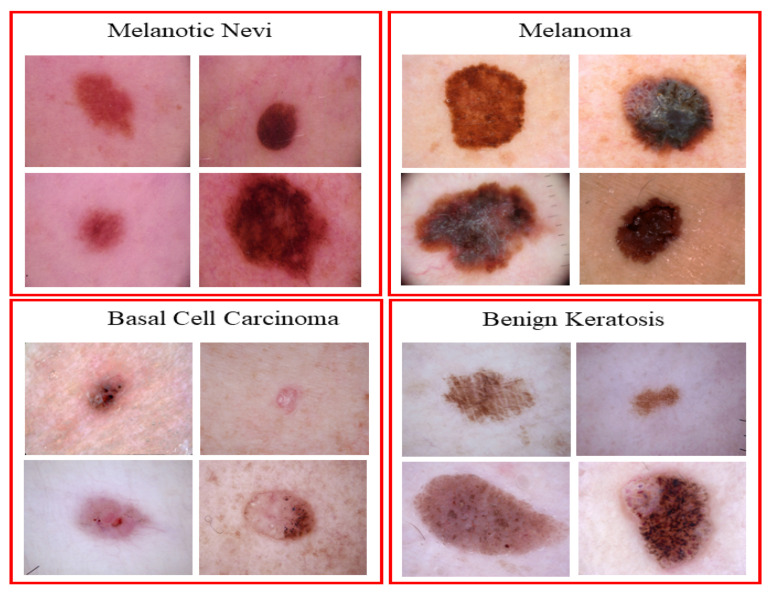
Skin cancer is a deadly disease, and its early diagnosis enhances the chances of survival. Deep learning algorithms for skin cancer detection have become popular in recent years. A novel framework based on deep learning is proposed in this study for the multiclassification of skin cancer types such as Melanoma, Melanocytic Nevi, Basal Cell Carcinoma and Benign Keratosis. The proposed model is named as SCDNet which combines Vgg16 with convolutional neural networks (CNN) for the classification of different types of skin cancer. Moreover, the accuracy of the proposed method is also compared with the four state-of-the-art pre-trained classifiers in the medical domain named Resnet 50, Inception v3, AlexNet and Vgg19. The performance of the proposed SCDNet classifier, as well as the four state-of-the-art classifiers, is evaluated using the ISIC 2019 dataset. The accuracy rate of the proposed SDCNet is 96.91% for the multiclassification of skin cancer whereas, the accuracy rates for Resnet 50, Alexnet, Vgg19 and Inception-v3 are 95.21%, 93.14%, 94.25% and 92.54%, respectively. The results showed that the proposed SCDNet performed better than the competing classifiers.

摘要

皮肤癌是一种致命的疾病,早期诊断可以提高生存机会。近年来,深度学习算法在皮肤癌检测中变得越来越流行。本研究提出了一种基于深度学习的新框架,用于对黑色素瘤、黑色素细胞痣、基底细胞癌和良性角化病等皮肤癌类型进行多分类。所提出的模型名为 SCDNet,它结合了 Vgg16 和卷积神经网络(CNN),用于对不同类型的皮肤癌进行分类。此外,还将所提出的方法与四个在医学领域中最先进的预训练分类器(Resnet 50、Inception v3、AlexNet 和 Vgg19)进行了准确性比较。使用 ISIC 2019 数据集评估了所提出的 SCDNet 分类器和四个最先进的分类器的性能。所提出的 SCDNet 在皮肤癌的多分类中的准确率为 96.91%,而 Resnet 50、Alexnet、Vgg19 和 Inception-v3 的准确率分别为 95.21%、93.14%、94.25%和 92.54%。结果表明,所提出的 SCDNet 比竞争分类器表现更好。

https://cdn.ncbi.nlm.nih.gov/pmc/blobs/cc0e/9371071/f4e128d02509/sensors-22-05652-g005.jpg
https://cdn.ncbi.nlm.nih.gov/pmc/blobs/cc0e/9371071/b02b01d56172/sensors-22-05652-g001.jpg
https://cdn.ncbi.nlm.nih.gov/pmc/blobs/cc0e/9371071/cbb93a5aa48c/sensors-22-05652-g002.jpg
https://cdn.ncbi.nlm.nih.gov/pmc/blobs/cc0e/9371071/8d345ad59eb4/sensors-22-05652-g003.jpg
https://cdn.ncbi.nlm.nih.gov/pmc/blobs/cc0e/9371071/541f8274465d/sensors-22-05652-g004.jpg
https://cdn.ncbi.nlm.nih.gov/pmc/blobs/cc0e/9371071/f4e128d02509/sensors-22-05652-g005.jpg
https://cdn.ncbi.nlm.nih.gov/pmc/blobs/cc0e/9371071/b02b01d56172/sensors-22-05652-g001.jpg
https://cdn.ncbi.nlm.nih.gov/pmc/blobs/cc0e/9371071/cbb93a5aa48c/sensors-22-05652-g002.jpg
https://cdn.ncbi.nlm.nih.gov/pmc/blobs/cc0e/9371071/8d345ad59eb4/sensors-22-05652-g003.jpg
https://cdn.ncbi.nlm.nih.gov/pmc/blobs/cc0e/9371071/541f8274465d/sensors-22-05652-g004.jpg
https://cdn.ncbi.nlm.nih.gov/pmc/blobs/cc0e/9371071/f4e128d02509/sensors-22-05652-g005.jpg

相似文献

1
SCDNet: A Deep Learning-Based Framework for the Multiclassification of Skin Cancer Using Dermoscopy Images.SCDNet:一种基于深度学习的利用皮肤镜图像进行皮肤癌多分类的框架。
Sensors (Basel). 2022 Jul 28;22(15):5652. doi: 10.3390/s22155652.
2
Multiple skin lesions diagnostics via integrated deep convolutional networks for segmentation and classification.基于集成深度卷积网络的多皮肤损伤诊断,用于分割和分类。
Comput Methods Programs Biomed. 2020 Jul;190:105351. doi: 10.1016/j.cmpb.2020.105351. Epub 2020 Jan 23.
3
Developing a Recognition System for Diagnosing Melanoma Skin Lesions Using Artificial Intelligence Algorithms.开发一种使用人工智能算法诊断黑色素瘤皮肤病变的识别系统。
Comput Math Methods Med. 2021 May 15;2021:9998379. doi: 10.1155/2021/9998379. eCollection 2021.
4
Multiclass skin lesion localization and classification using deep learning based features fusion and selection framework for smart healthcare.基于深度学习的特征融合与选择框架的多类别皮肤病变定位与分类在智能医疗中的应用。
Neural Netw. 2023 Mar;160:238-258. doi: 10.1016/j.neunet.2023.01.022. Epub 2023 Jan 24.
5
Melanoma diagnosis using deep learning techniques on dermatoscopic images.基于皮肤镜图像的深度学习技术进行黑色素瘤诊断。
BMC Med Imaging. 2021 Jan 6;21(1):6. doi: 10.1186/s12880-020-00534-8.
6
Melanoma segmentation using deep learning with test-time augmentations and conditional random fields.使用带有测试时增强和条件随机场的深度学习进行黑色素瘤分割。
Sci Rep. 2022 Mar 10;12(1):3948. doi: 10.1038/s41598-022-07885-y.
7
Computer Aided Diagnosis of Melanoma Using Deep Neural Networks and Game Theory: Application on Dermoscopic Images of Skin Lesions.基于深度神经网络和博弈论的黑色素瘤计算机辅助诊断:应用于皮肤病变的皮肤镜图像。
Int J Mol Sci. 2022 Nov 10;23(22):13838. doi: 10.3390/ijms232213838.
8
Skin Cancer Classification Using Deep Spiking Neural Network.基于深度尖峰神经网络的皮肤癌分类
J Digit Imaging. 2023 Jun;36(3):1137-1147. doi: 10.1007/s10278-023-00776-2. Epub 2023 Jan 23.
9
Fusing fine-tuned deep features for skin lesion classification.融合精调的深度特征进行皮肤病变分类。
Comput Med Imaging Graph. 2019 Jan;71:19-29. doi: 10.1016/j.compmedimag.2018.10.007. Epub 2018 Nov 3.
10
A Multi-Stage Faster RCNN-Based iSPLInception for Skin Disease Classification Using Novel Optimization.基于多阶段 Faster RCNN 的 iSPLInception 结合新型优化方法用于皮肤病分类
J Digit Imaging. 2023 Oct;36(5):2210-2226. doi: 10.1007/s10278-023-00848-3. Epub 2023 Jun 15.

引用本文的文献

1
A deep learning framework for automated early diagnosis and classification of skin cancer lesions in dermoscopy images.一种用于皮肤镜图像中皮肤癌病变自动早期诊断和分类的深度学习框架。
Sci Rep. 2025 Aug 25;15(1):31234. doi: 10.1038/s41598-025-15655-9.
2
Explainable deep learning approaches for high precision early melanoma detection using dermoscopic images.使用皮肤镜图像进行高精度早期黑色素瘤检测的可解释深度学习方法。
Sci Rep. 2025 Jul 8;15(1):24533. doi: 10.1038/s41598-025-09938-4.
3
Next-generation approach to skin disorder prediction employing hybrid deep transfer learning.

本文引用的文献

1
The Double-Edged Sword of Oxidative Stress in Skin Damage and Melanoma: From Physiopathology to Therapeutical Approaches.氧化应激在皮肤损伤和黑色素瘤中的双刃剑效应:从生理病理学到治疗方法
Antioxidants (Basel). 2022 Mar 23;11(4):612. doi: 10.3390/antiox11040612.
2
A Comprehensive Analysis of Recent Deep and Federated-Learning-Based Methodologies for Brain Tumor Diagnosis.基于深度和联邦学习的脑肿瘤诊断方法的最新综合分析
J Pers Med. 2022 Feb 13;12(2):275. doi: 10.3390/jpm12020275.
3
BDCNet: multi-classification convolutional neural network model for classification of COVID-19, pneumonia, and lung cancer from chest radiographs.
采用混合深度迁移学习的皮肤病预测新一代方法。
Front Big Data. 2025 Feb 19;8:1503883. doi: 10.3389/fdata.2025.1503883. eCollection 2025.
4
A robust deep learning framework for multiclass skin cancer classification.一种用于多类皮肤癌分类的强大深度学习框架。
Sci Rep. 2025 Feb 10;15(1):4938. doi: 10.1038/s41598-025-89230-7.
5
Towards unbiased skin cancer classification using deep feature fusion.迈向基于深度特征融合的无偏皮肤癌分类
BMC Med Inform Decis Mak. 2025 Jan 31;25(1):48. doi: 10.1186/s12911-025-02889-w.
6
Minimal sourced and lightweight federated transfer learning models for skin cancer detection.用于皮肤癌检测的轻量级最小源联邦迁移学习模型。
Sci Rep. 2025 Jan 21;15(1):2605. doi: 10.1038/s41598-024-82402-x.
7
Diagnosis and prognosis of melanoma from dermoscopy images using machine learning and deep learning: a systematic literature review.利用机器学习和深度学习从皮肤镜图像诊断黑色素瘤及判断预后:一项系统文献综述
BMC Cancer. 2025 Jan 13;25(1):75. doi: 10.1186/s12885-024-13423-y.
8
Skin Cancer Detection Using Transfer Learning and Deep Attention Mechanisms.基于迁移学习和深度注意力机制的皮肤癌检测
Diagnostics (Basel). 2025 Jan 3;15(1):99. doi: 10.3390/diagnostics15010099.
9
Evaluation of an acne lesion detection and severity grading model for Chinese population in online and offline healthcare scenarios.针对中国人群在在线和线下医疗场景中的痤疮皮损检测与严重程度分级模型的评估。
Sci Rep. 2025 Jan 7;15(1):1119. doi: 10.1038/s41598-024-84670-z.
10
Decoding skin cancer classification: perspectives, insights, and advances through researchers' lens.解读皮肤癌分类:透过研究者视角的观点、见解与进展
Sci Rep. 2024 Dec 18;14(1):30542. doi: 10.1038/s41598-024-81961-3.
BDCNet:用于从胸部X光片中对新冠肺炎、肺炎和肺癌进行分类的多分类卷积神经网络模型。
Multimed Syst. 2022;28(3):815-829. doi: 10.1007/s00530-021-00878-3. Epub 2022 Jan 18.
4
A Computer-Aided Diagnosis System Using Deep Learning for Multiclass Skin Lesion Classification.基于深度学习的多类别皮肤病变分类的计算机辅助诊断系统。
Comput Intell Neurosci. 2021 Dec 6;2021:9619079. doi: 10.1155/2021/9619079. eCollection 2021.
5
Analysis of the ISIC image datasets: Usage, benchmarks and recommendations.国际皮肤影像协作组(ISIC)图像数据集分析:用途、基准和建议。
Med Image Anal. 2022 Jan;75:102305. doi: 10.1016/j.media.2021.102305. Epub 2021 Nov 16.
6
Acral melanoma detection using dermoscopic images and convolutional neural networks.使用皮肤镜图像和卷积神经网络检测肢端黑色素瘤
Vis Comput Ind Biomed Art. 2021 Oct 7;4(1):25. doi: 10.1186/s42492-021-00091-z.
7
Skin cancer detection from dermoscopic images using deep learning and fuzzy k-means clustering.基于深度学习和模糊 K-均值聚类的皮肤癌检测。
Microsc Res Tech. 2022 Jan;85(1):339-351. doi: 10.1002/jemt.23908. Epub 2021 Aug 27.
8
A novel melanoma prediction model for imbalanced data using optimized SqueezeNet by bald eagle search optimization.基于白头鹰优化算法优化 SqueezeNet 的不平衡数据新型黑色素瘤预测模型。
Comput Biol Med. 2021 Sep;136:104712. doi: 10.1016/j.compbiomed.2021.104712. Epub 2021 Aug 4.
9
Integrating Patient Data Into Skin Cancer Classification Using Convolutional Neural Networks: Systematic Review.利用卷积神经网络将患者数据整合到皮肤癌分类中:系统评价。
J Med Internet Res. 2021 Jul 2;23(7):e20708. doi: 10.2196/20708.
10
Uncertainty quantification in skin cancer classification using three-way decision-based Bayesian deep learning.基于三向决策贝叶斯深度学习的皮肤癌分类中的不确定性量化。
Comput Biol Med. 2021 Aug;135:104418. doi: 10.1016/j.compbiomed.2021.104418. Epub 2021 Apr 28.