Yadav Bindu, Kaur Vikender, Narayan Om Prakash, Yadav Shashank Kumar, Kumar Ashok, Wankhede Dhammaprakash Pandhari
Division of Germplasm Evaluation, ICAR-National Bureau of Plant Genetic Resources, New Delhi, India.
College of Arts and Sciences, University of Florida, Gainesville, FL, United States.
Front Plant Sci. 2022 Jul 25;13:931275. doi: 10.3389/fpls.2022.931275. eCollection 2022.
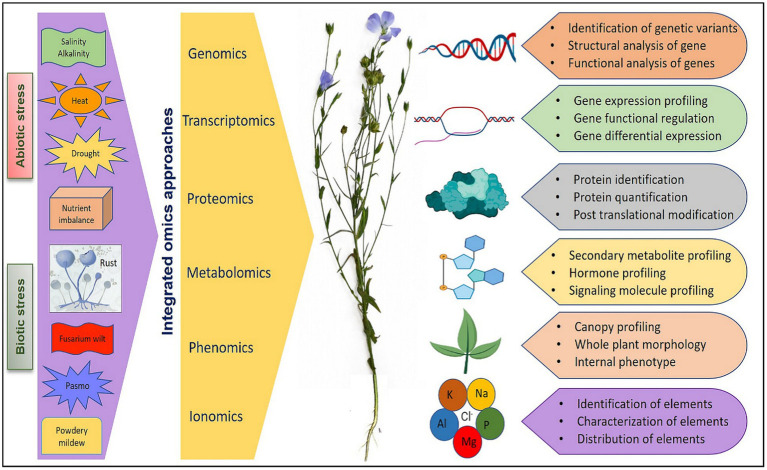
Flax ( L.) or linseed is one of the important industrial crops grown all over the world for seed oil and fiber. Besides oil and fiber, flax offers a wide range of nutritional and therapeutic applications as a feed and food source owing to high amount of -linolenic acid (omega-3 fatty acid), lignans, protein, minerals, and vitamins. Periodic losses caused by unpredictable environmental stresses such as drought, heat, salinity-alkalinity, and diseases pose a threat to meet the rising market demand. Furthermore, these abiotic and biotic stressors have a negative impact on biological diversity and quality of oil/fiber. Therefore, understanding the interaction of genetic and environmental factors in stress tolerance mechanism and identification of underlying genes for economically important traits is critical for flax improvement and sustainability. In recent technological era, numerous omics techniques such as genomics, transcriptomics, metabolomics, proteomics, phenomics, and ionomics have evolved. The advancements in sequencing technologies accelerated development of genomic resources which facilitated finer genetic mapping, quantitative trait loci (QTL) mapping, genome-wide association studies (GWAS), and genomic selection in major cereal and oilseed crops including flax. Extensive studies in the area of genomics and transcriptomics have been conducted post flax genome sequencing. Interestingly, research has been focused more for abiotic stresses tolerance compared to disease resistance in flax through transcriptomics, while the other areas of omics such as metabolomics, proteomics, ionomics, and phenomics are in the initial stages in flax and several key questions remain unanswered. Little has been explored in the integration of omic-scale data to explain complex genetic, physiological and biochemical basis of stress tolerance in flax. In this review, the current status of various omics approaches for elucidation of molecular pathways underlying abiotic and biotic stress tolerance in flax have been presented and the importance of integrated omics technologies in future research and breeding have been emphasized to ensure sustainable yield in challenging environments.
亚麻(Linum usitatissimum L.)或亚麻籽是一种重要的经济作物,在全球范围内种植,用于生产种子油和纤维。除了油和纤维外,由于富含α-亚麻酸(ω-3脂肪酸)、木脂素、蛋白质、矿物质和维生素,亚麻作为饲料和食物来源还具有广泛的营养和治疗应用。干旱、高温、盐碱化和疾病等不可预测的环境胁迫造成的周期性损失,对满足不断增长的市场需求构成了威胁。此外,这些非生物和生物胁迫因素对生物多样性以及油/纤维的质量都有负面影响。因此,了解胁迫耐受机制中遗传和环境因素的相互作用,并鉴定经济重要性状的潜在基因,对于亚麻的改良和可持续性发展至关重要。在当今的技术时代,涌现了许多组学技术,如基因组学、转录组学、代谢组学、蛋白质组学、表型组学和离子组学。测序技术的进步加速了基因组资源的开发,这有助于在包括亚麻在内的主要谷类和油料作物中进行更精细的遗传图谱绘制、数量性状位点(QTL)定位、全基因组关联研究(GWAS)和基因组选择。亚麻基因组测序后,在基因组学和转录组学领域进行了广泛的研究。有趣的是,通过转录组学,与亚麻抗病性相比,对非生物胁迫耐受性的研究更为集中,而代谢组学、蛋白质组学、离子组学和表型组学等其他组学领域在亚麻研究中尚处于初始阶段,一些关键问题仍未得到解答。在整合组学规模的数据以解释亚麻胁迫耐受性的复杂遗传、生理和生化基础方面,研究较少。在这篇综述中,介绍了用于阐明亚麻非生物和生物胁迫耐受性潜在分子途径的各种组学方法的现状,并强调了整合组学技术在未来研究和育种中的重要性,以确保在具有挑战性的环境中实现可持续产量。