Wei Yanyan, Wang Tingting, Li Guoguang, Feng Junhui, Deng Lianbang, Xu Haiting, Yin Lu, Ma Jinbao, Chen Dongning, Chen Jingxu
Beijing Hui-Long-Guan Hospital, Peking University, Beijing, China.
School of Mental Health, Bengbu Medical College, Bengbu, Anhui, China.
Front Psychiatry. 2022 Jul 26;13:941728. doi: 10.3389/fpsyt.2022.941728. eCollection 2022.
The systemic immune-inflammation index (SII), system inflammation response index (SIRI), neutrophil/high-density lipoprotein (HDL) ratio (NHR), lymphocyte/HDL ratio (LHR), monocyte/HDL ratio (MHR), and platelet/HDL ratio (PHR) have been recently investigated as new markers for inflammation. The purpose of this research is to use large-scale clinical data to discuss and compare the predictive ability of the SII, SIRI, NHR, LHR, MHR, and PHR in patients with schizophrenia (SCZ) and bipolar disorder (BD), to investigate potential biomarkers.
In this retrospective, naturalistic, cross-sectional study, we collected the hematological parameter data of 13,329 patients with SCZ, 4,061 patients with BD manic episodes (BD-M), and 1,944 patients with BD depressive episodes (BD-D), and 5,810 healthy subjects served as the healthy control (HC) group. The differences in the SII, SIRI, NHR, LHR, MHR, and PHR were analyzed, and a receiver operating characteristic (ROC) curve was used to analyze the diagnostic potential of these parameters.
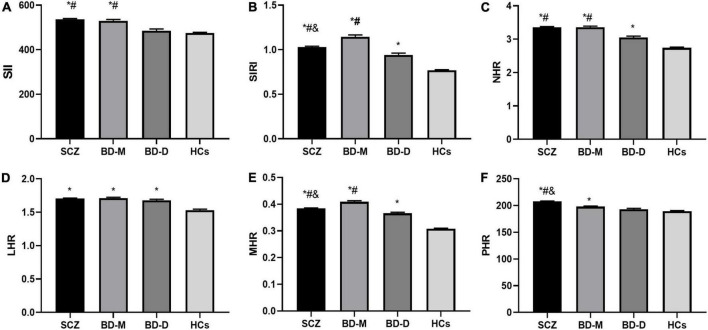
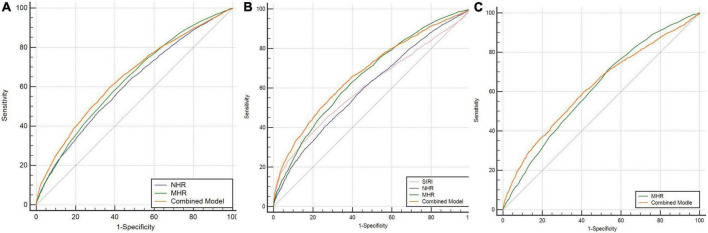
Compared with the HC group, the values of the SII, SIRI, NHR, LHR, MHR, and PHR and the levels of neutrophils, monocytes, and triglycerides (TG) were higher in SCZ and BD groups, and levels of platelets, cholesterol (CHO), HDL, low-density lipoprotein (LDL), and apoprotein B (Apo B) were lower in SCZ and BD groups. Compared to the BD group, the values of the SIRI, lymphocytes, monocytes, and HDL were lower and the values of the SII, NHR, PHR, and platelet were higher in the SCZ group. In contrast to the BD-D group, the values of the SII; SIRI; NHR; and MHR; and levels of neutrophils, monocytes, and platelets were higher in the BD-M group, and the levels of CHO, TG, LDL, and Apo B were lower in the BD-M group. The MHR and NHR were predictors for differentiating the SCZ group from the HC group; the SIRI, NHR, and MHR were predictors for differentiating the BD-M group from the HC group; and the MHR was a predictor for differentiating the BD-D group from the HC group. The combination model of the indicators improved diagnostic effectiveness.
Our study highlights the role of systemic inflammation in the pathophysiology of SCZ, BD-M, and BD-D, the association between inflammation and lipid metabolism, and these inflammation and lipid metabolism indicators showed different variation patterns in SCZ, BD-D, and BD-M.
全身免疫炎症指数(SII)、系统炎症反应指数(SIRI)、中性粒细胞/高密度脂蛋白(HDL)比值(NHR)、淋巴细胞/HDL比值(LHR)、单核细胞/HDL比值(MHR)和血小板/HDL比值(PHR)最近已作为炎症的新标志物进行了研究。本研究的目的是利用大规模临床数据来探讨和比较SII、SIRI、NHR、LHR、MHR和PHR对精神分裂症(SCZ)和双相情感障碍(BD)患者的预测能力,以探究潜在的生物标志物。
在这项回顾性、自然主义、横断面研究中,我们收集了13329例SCZ患者、4061例BD躁狂发作(BD-M)患者、1944例BD抑郁发作(BD-D)患者的血液学参数数据,以及5810名健康受试者作为健康对照组(HC)。分析了SII、SIRI、NHR、LHR、MHR和PHR的差异,并使用受试者工作特征(ROC)曲线分析这些参数的诊断潜力。
与HC组相比,SCZ组和BD组的SII、SIRI、NHR、LHR、MHR和PHR值以及中性粒细胞、单核细胞和甘油三酯(TG)水平较高,而SCZ组和BD组的血小板、胆固醇(CHO)、HDL、低密度脂蛋白(LDL)和载脂蛋白B(Apo B)水平较低。与BD组相比,SCZ组的SIRI、淋巴细胞、单核细胞和HDL值较低,而SII、NHR、PHR和血小板值较高。与BD-D组相比,BD-M组的SII、SIRI、NHR和MHR值以及中性粒细胞、单核细胞和血小板水平较高,而BD-M组的CHO、TG、LDL和Apo B水平较低。MHR和NHR是区分SCZ组与HC组的预测指标;SIRI、NHR和MHR是区分BD-M组与HC组的预测指标;MHR是区分BD-D组与HC组的预测指标。指标的组合模型提高了诊断效能。
我们的研究突出了全身炎症在SCZ、BD-M和BD-D病理生理学中的作用,炎症与脂质代谢之间的关联,并且这些炎症和脂质代谢指标在SCZ、BD-D和BD-M中表现出不同的变化模式。