Electric Power Research Institute, 3420 Hillview Avenue, Palo Alto, CA, 94304, USA.
Nat Commun. 2022 Aug 12;13(1):4743. doi: 10.1038/s41467-022-32468-w.
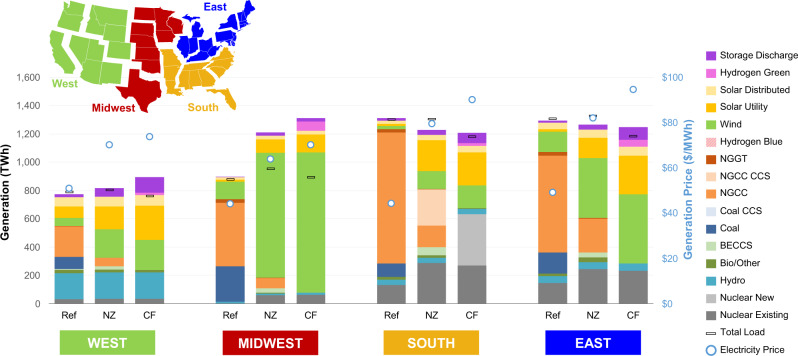
Replacing coal with natural gas has contributed to recent emissions reductions in the electric sector, but there are questions about the near- and long-term roles for gas under deep decarbonization. In this study, we assess the potential role for natural gas and carbon removal in deeply decarbonized electricity systems in the U.S. and evaluate the robustness of these insights to key technology and policy assumptions. We find that natural-gas-fired generation can lower the cost of electric sector decarbonization, a result that is robust to a range of sensitivities, when carbon removal is allowed under policy. Accelerating decarbonization to reach net-zero in 2035 entails greater contributions from natural gas than in 2050. Nonetheless, wind and solar have higher generation shares than natural gas for most regions and scenarios (52-66% variable renewables for net-zero scenarios versus 0-19% for gas), suggesting that natural gas generation can be substituted more easily than its capacity.
用天然气替代煤炭推动了电力行业近期的减排,但在深度脱碳背景下,天然气在近期和长期内的作用仍存在疑问。本研究评估了美国深度脱碳电力系统中天然气和碳去除的潜在作用,并评估了在关键技术和政策假设下这些观点的稳健性。我们发现,在政策允许碳去除的情况下,天然气的使用可以降低电力部门脱碳的成本,这一结果在各种敏感性下都是稳健的。为了在 2035 年实现净零排放,与 2050 年相比,需要天然气做出更大的贡献。尽管如此,对于大多数地区和情景,风能和太阳能的发电份额高于天然气(净零情景下的可变可再生能源占 52-66%,而天然气占 0-19%),这表明天然气发电比其容量更容易被替代。