Fu Jialei, Tan Li-Juan, Lee Jung Eun, Shin Sangah
Department of Food and Nutrition, Chung-Ang University, Seoul, South Korea.
Department of Food and Nutrition, College of Human Ecology, Seoul National University, Seoul, South Korea.
Front Nutr. 2022 Jul 28;9:946361. doi: 10.3389/fnut.2022.946361. eCollection 2022.
An increasing prevalence of cognitive disorders warrants comprehensive systematic reviews on the effect of diet on cognitive health. Studies have suggested that the Mediterranean (MeDi) diet has protective effects against metabolic diseases. However, comprehensive systematic reviews on the effect of the MeDi diet on the cognitive decline are limited. We investigated whether adherence to the MeDi diet could lower the risk of the cognitive disorder or improve cognitive function in older adults.
In this systematic review and meta-analysis, PubMed, Web of Science, PsycINFO, Scopus, and Cochrane databases were searched from inception to June 2021. Cohort studies and randomized controlled trials (RCTs) were included. The effect sizes were estimated as log risk ratios and standard mean differences (SMDs) with 95% confidence intervals (CIs). The Newcastle-Ottawa score and Cochrane Collaboration's tool were used to assess the risk of bias in cohort studies and RCTs, respectively.
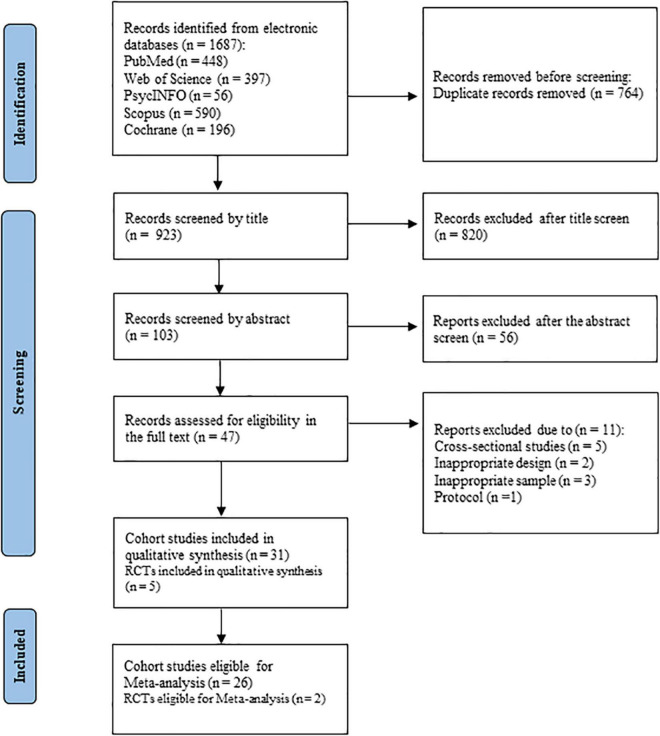
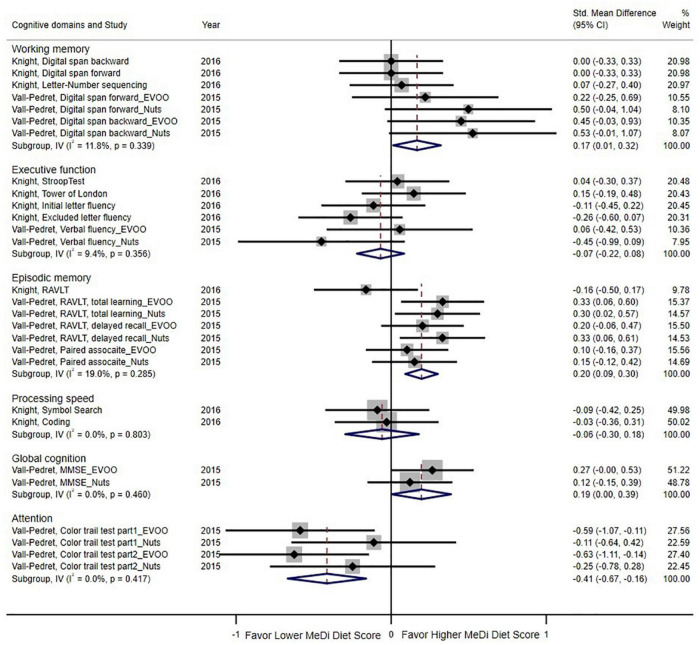
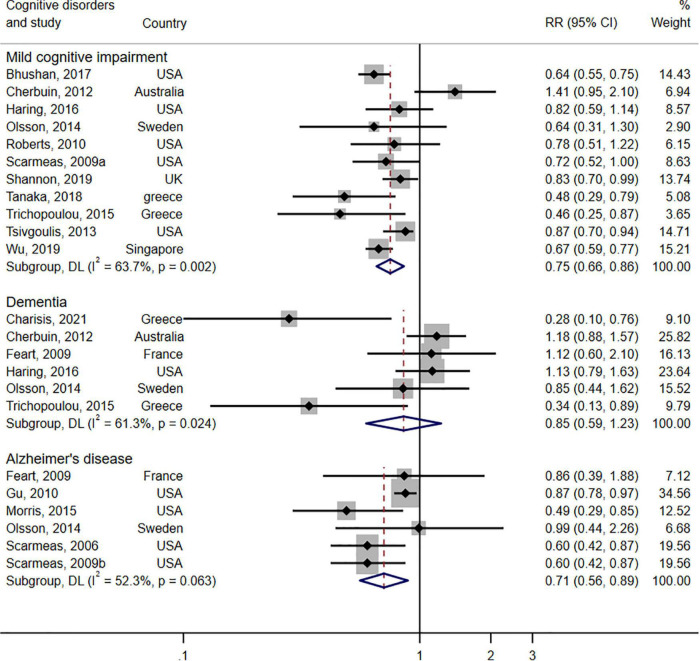
Of the 1,687 screened studies, 31 cohort studies and five RCTs met the eligibility criteria for qualitative analysis; 26 cohort studies and two RCTs were included in the meta-analysis. In the cohort studies, high adherence to the MeDi diet was associated with lower risk of mild cognitive impairment (MCI) [risk ratio (RR) = 0.75 (0.66-0.86)], and Alzheimer's disease (AD) [RR = 0.71 (0.56-0.89)]. In the RCTs, high adherence to the MeDi diet was associated with better episodic [SMD = 0.20 (0.09-0.30)] and working memories [SMD = 0.17 (0.01-0.32)] than lowest group.
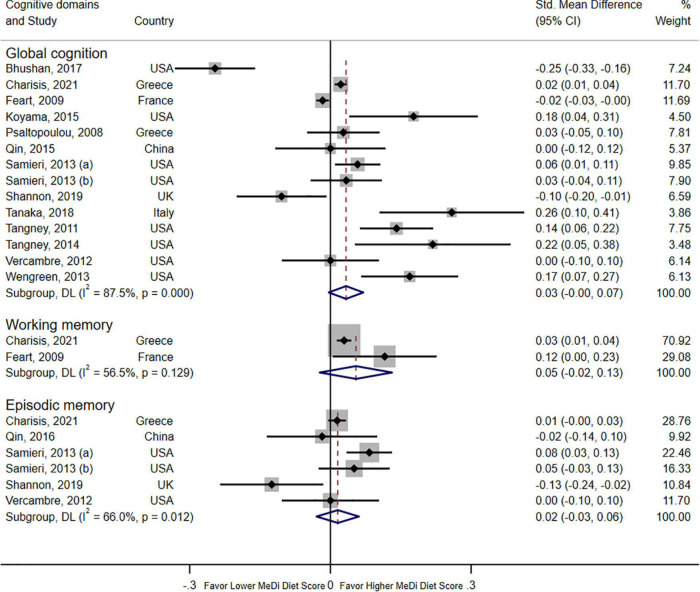
Adherence to the MeDi diet may reduce the risk of MCI and AD. However, other associations with cognitive outcomes (global cognition, working memory, and episodic memory) remain open to interpretation. Overall, the MeDi diet is recommended to prevent or delay cognitive disorders and improve cognitive function. Further, long-term RCTs are warranted to strengthen the evidence.
[https://www.crd.york.ac.uk], identifier [CRD42021276801].
认知障碍患病率不断上升,因此有必要对饮食对认知健康的影响进行全面系统的综述。研究表明,地中海饮食对代谢性疾病具有保护作用。然而,关于地中海饮食对认知衰退影响的全面系统综述有限。我们调查了坚持地中海饮食是否可以降低老年人患认知障碍的风险或改善其认知功能。
在这项系统综述和荟萃分析中,检索了从数据库建立至2021年6月的PubMed、科学网、PsycINFO、Scopus和Cochrane数据库。纳入队列研究和随机对照试验(RCT)。效应大小以对数风险比和标准平均差(SMD)及95%置信区间(CI)进行估计。分别使用纽卡斯尔-渥太华评分和Cochrane协作工具评估队列研究和RCT中的偏倚风险。
在1687项筛选研究中,31项队列研究和5项RCT符合定性分析的纳入标准;26项队列研究和2项RCT纳入荟萃分析。在队列研究中,高度坚持地中海饮食与轻度认知障碍(MCI)风险较低相关[风险比(RR)=0.75(0.66-0.86)],与阿尔茨海默病(AD)风险较低相关[RR = 0.71(0.56-0.89)]。在RCT中,与最低坚持组相比,高度坚持地中海饮食与更好的情景记忆[SMD = 0.20(0.09-0.30)]和工作记忆[SMD = 0.17(0.01-0.32)]相关。
坚持地中海饮食可能会降低MCI和AD的风险。然而,与其他认知结果(整体认知、工作记忆和情景记忆)的关联仍有待解读。总体而言,建议采用地中海饮食来预防或延缓认知障碍并改善认知功能。此外,有必要进行长期RCT以加强证据。