Moro Cecile, Valverde Audrey, Dole Marjorie, Hoh Kam Jaimie, Hamilton Catherine, Liebert Ann, Bicknell Brian, Benabid Alim-Louis, Magistretti Pierre, Mitrofanis John
FDD and CEA-LETI, Clinatec, Université Grenoble Alpes, Grenoble, France.
Well Red Pty Ltd., Launceston, TAS, Australia.
Front Neurosci. 2022 Jul 28;16:942536. doi: 10.3389/fnins.2022.942536. eCollection 2022.
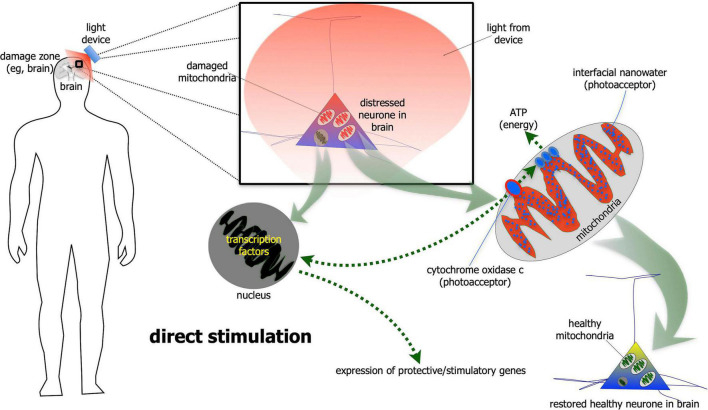
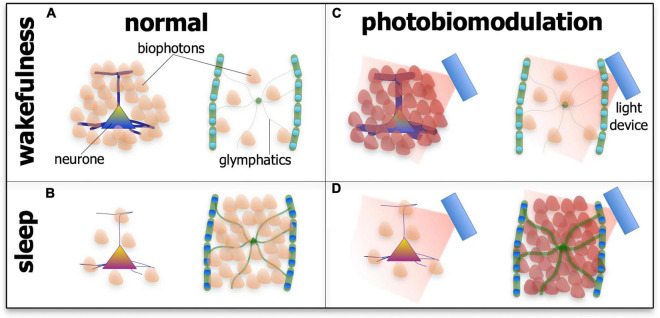
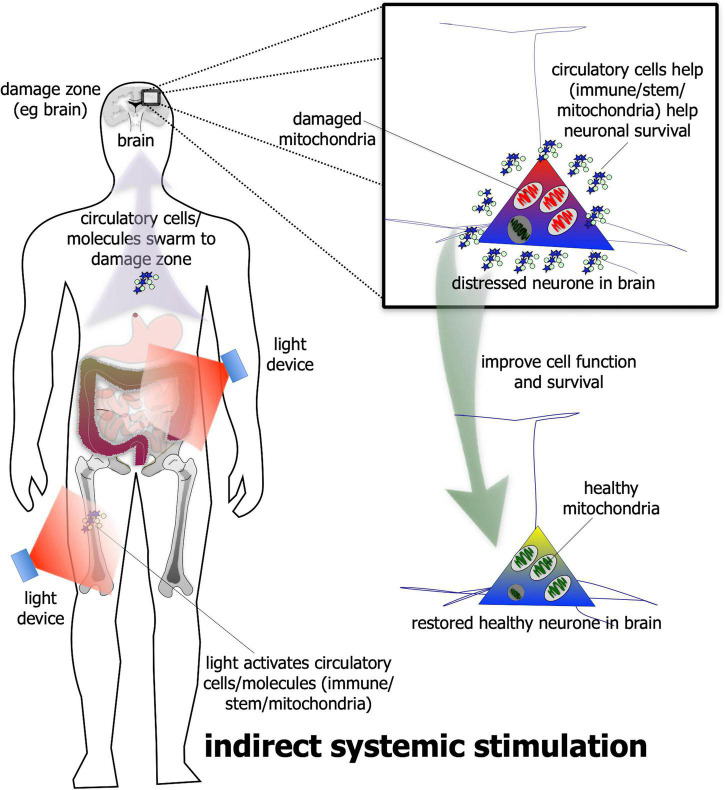
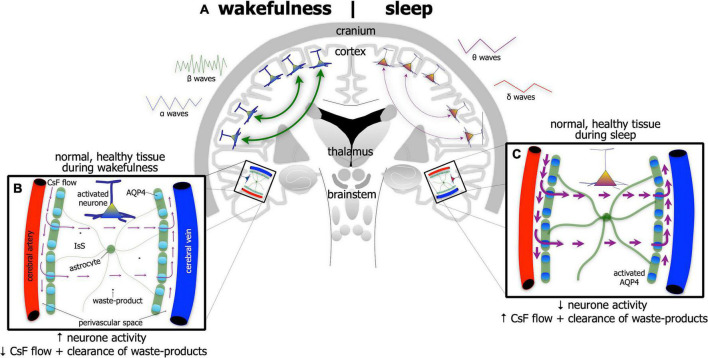
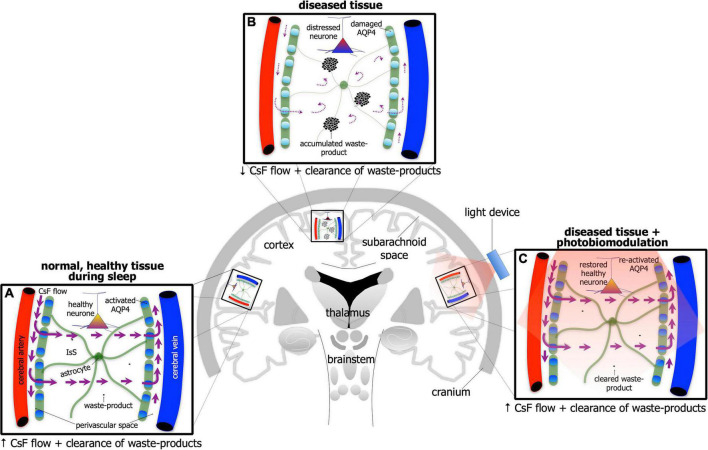
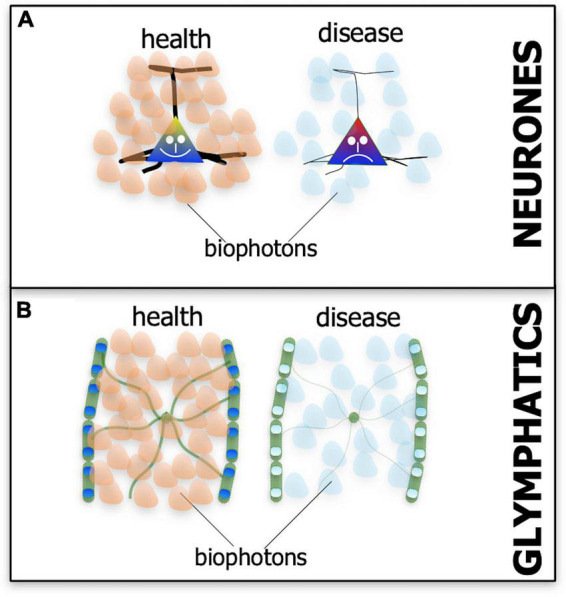
Over the last seventy years or so, many previous studies have shown that photobiomodulation, the use of red to near infrared light on body tissues, can improve central and peripheral neuronal function and survival in both health and in disease. These improvements are thought to arise principally from an impact of photobiomodulation on mitochondrial and non-mitochondrial mechanisms in a range of different cell types, including neurones. This impact has downstream effects on many stimulatory and protective genes. An often-neglected feature of nearly all of these improvements is that they have been induced during the state of wakefulness. Recent studies have shown that when applied during the state of sleep, photobiomodulation can also be of benefit, but in a different way, by improving the flow of cerebrospinal fluid and the clearance of toxic waste-products from the brain. In this review, we consider the potential differential effects of photobiomodulation dependent on the state of arousal. We speculate that the effects of photobiomodulation is on different cells and systems depending on whether it is applied during wakefulness or sleep, that it may follow a circadian rhythm. We speculate further that the arousal-dependent photobiomodulation effects are mediated principally through a biophoton - ultra-weak light emission - network of communication and repair across the brain.
在过去约七十年间,许多先前的研究表明,光生物调节,即在身体组织上使用红光至近红外光,在健康和疾病状态下均可改善中枢和外周神经元功能以及神经元存活。这些改善被认为主要源于光生物调节对一系列不同细胞类型(包括神经元)中线粒体和非线粒体机制的影响。这种影响对许多刺激和保护基因具有下游效应。几乎所有这些改善中一个常常被忽视的特征是,它们都是在清醒状态下诱导产生的。最近的研究表明,在睡眠状态下应用光生物调节时,也可能有益,但方式不同,即通过改善脑脊液流动以及清除大脑中的有毒废物。在这篇综述中,我们考虑光生物调节根据觉醒状态可能产生的不同效应。我们推测,光生物调节的效应取决于它是在清醒还是睡眠期间应用,对不同的细胞和系统产生影响,并且可能遵循昼夜节律。我们进一步推测,依赖于觉醒状态的光生物调节效应主要通过一个生物光子——超微弱光发射——贯穿大脑的通信和修复网络来介导。