Department of Public Health and Primary Care, University of Cambridge, Cambridge, UK.
School of Clinical Medicine, University of Cambridge, Cambridge, UK.
Age Ageing. 2022 Aug 2;51(8). doi: 10.1093/ageing/afac188.
uncertainty pervades the complex illness trajectories experienced by older adults with multimorbidity. Uncertainty is experienced by older people, their informal carers and professionals providing care, yet is incompletely understood. We aimed to identify and synthesise systematically the experience of uncertainty in advanced multimorbidity from patient, carer and professional perspectives.
systematic literature review of published and grey qualitative literature from 9 databases (Prospero CRD 42021227480).
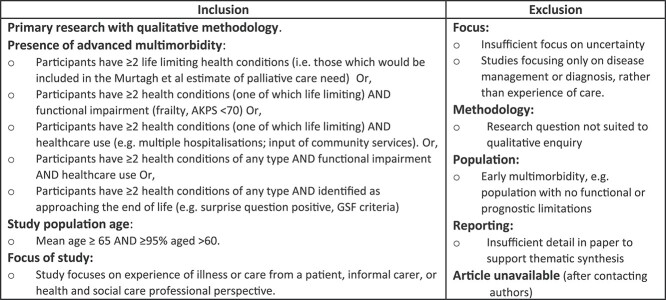
older people with advanced multimorbidity, and informal carers/professionals providing care to this group. Exclusion criteria: early multimorbidity, insufficient focus on uncertainty.
weight-of-evidence assessment was used to appraise included articles. We undertook thematic synthesis of multi-perspective experiences and response to uncertainty.
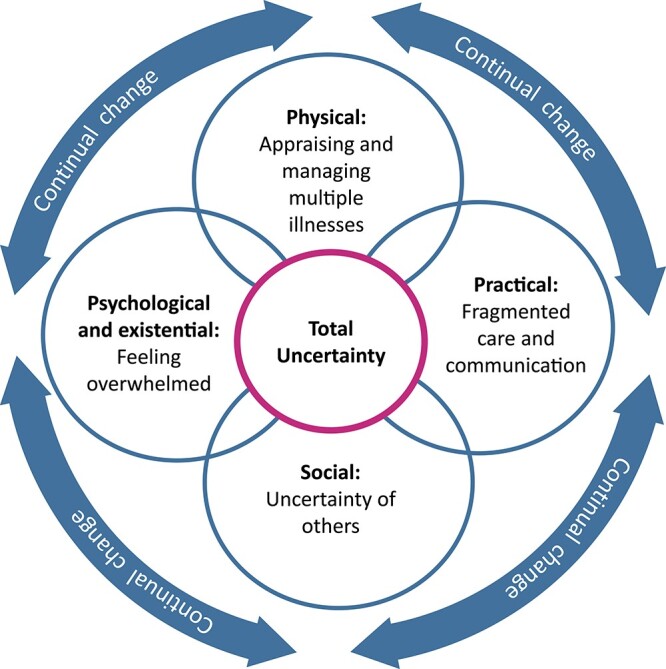
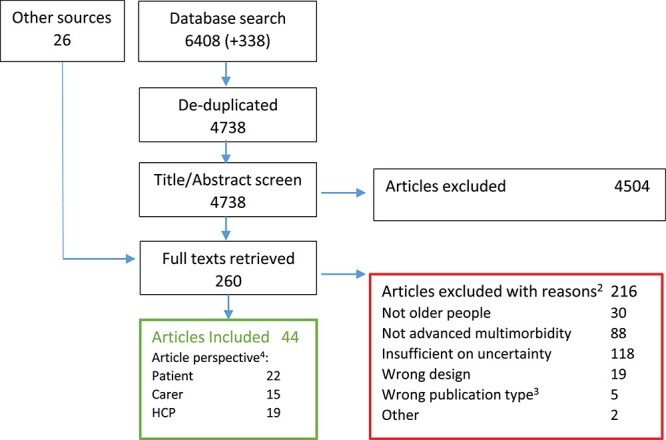
from 4,738 unique search results, we included 44 articles relating to 40 studies. 22 focused on patient experiences of uncertainty (n = 460), 15 on carer experiences (n = 197), and 19 on health professional experiences (n = 490), with 10 exploring multiple perspectives. We identified a shared experience of 'Total Uncertainty' across five domains: 'appraising and managing multiple illnesses'; 'fragmented care and communication'; 'feeling overwhelmed'; 'uncertainty of others' and 'continual change'. Participants responded to uncertainty by either active (addressing, avoiding) or passive (accepting) means.
the novel concept of 'Total Uncertainty' represents a step change in our understanding of illness experience in advanced multimorbidity. Patients, carers and health professionals experienced uncertainty in similar domains, suggesting a shared understanding is feasible. The domains of total uncertainty form a useful organising framework for health professionals caring for older adults with multimorbidity.
老年人多病共存的复杂疾病轨迹充满不确定性。老年人、他们的非正式照顾者和提供护理的专业人员都有这种体验,但这种体验并没有被完全理解。我们旨在从患者、照顾者和专业人员的角度确定和系统地综合多病共存的晚期不确定性体验。
对 9 个数据库(Prospéro CRD42021227480)中已发表和灰色定性文献进行系统的文献综述。
患有晚期多病共存的老年人,以及为该群体提供护理的非正式照顾者/专业人员。排除标准:早期多病共存,对不确定性的关注不足。
使用证据权重评估来评估纳入的文章。我们对多视角体验和对不确定性的反应进行了主题综合分析。
从 4738 个独特的搜索结果中,我们纳入了 44 篇文章,涉及 40 项研究。22 项研究关注患者对不确定性的体验(n=460),15 项研究关注照顾者的体验(n=197),19 项研究关注卫生专业人员的体验(n=490),其中 10 项研究探讨了多个视角。我们在五个领域确定了一种共同的“全面不确定性”体验:“评估和管理多种疾病”;“分散的护理和沟通”;“感到不知所措”;“他人的不确定性”和“持续变化”。参与者通过主动(处理、避免)或被动(接受)的方式对不确定性做出反应。
“全面不确定性”的新概念代表了我们对晚期多病共存疾病体验理解的一个重大变化。患者、照顾者和卫生专业人员在相似的领域体验到不确定性,这表明可以达成共同的理解。全面不确定性的领域为照顾多病共存的老年人的卫生专业人员提供了一个有用的组织框架。