Department of Laboratory and Infectious Sciences, A. Gemelli University Hospital IRCCS, 00168 Rome, Italy.
Digestive Disease Center, A. Gemelli University Hospital IRCCS, Catholic University of Sacred Heart, 00168 Rome, Italy.
Biomed Res Int. 2022 Aug 8;2022:5787373. doi: 10.1155/2022/5787373. eCollection 2022.
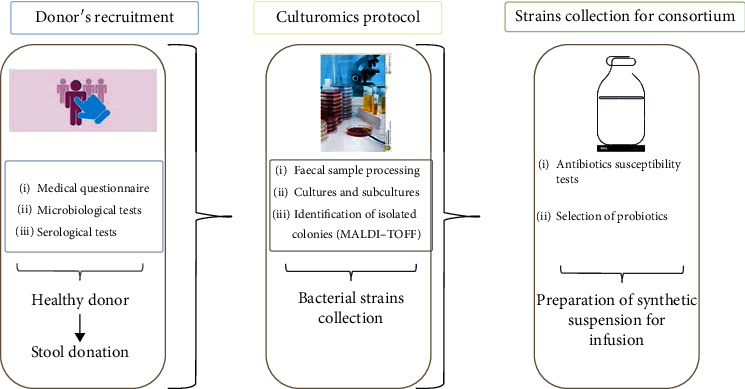
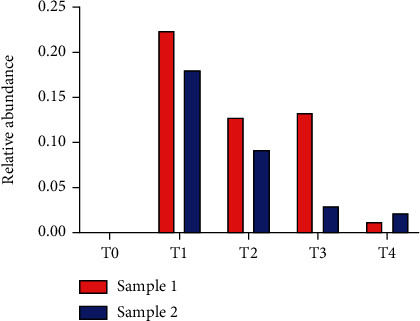
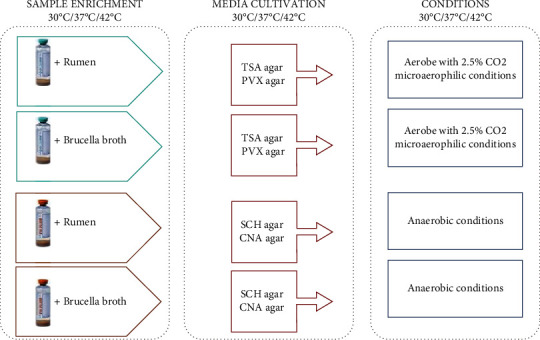
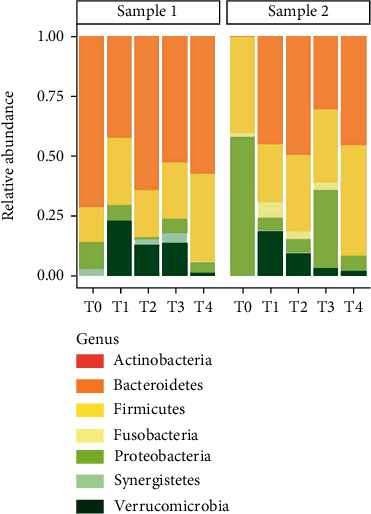
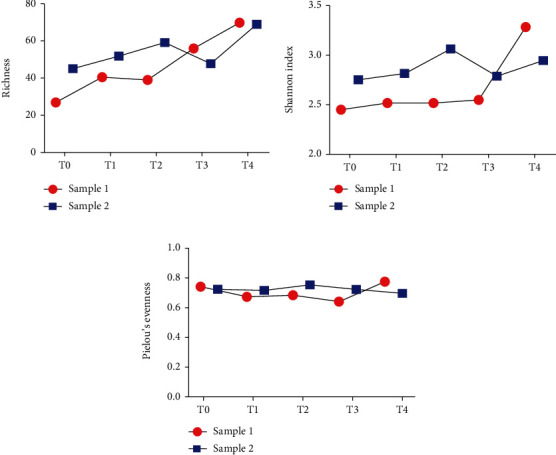
Fecal microbiota transplantation (FMT) consists of infusion of feces from a donor to a recipient patient in order to restore the resident microbial population. FMT has shown to be a valid clinical option for infections (CDI). However, this approach shows several criticalities, such as the recruiting and screening of voluntary donors. Our aim was to evaluate the therapeutic efficacy of a synthetic bacterial suspension defined "Bacterial Consortium" (BC) infused in the colon of CDI patients. The suspension was composed by 13 microbial species isolated by culturomics protocols from healthy donors' feces. The efficacy of the treatment was assessed both clinically and by metagenomics typing. Fecal samples of the recipient patients were collected before and after infusion. DNA samples obtained from feces at different time points (preinfusion, 7, 15, 30, and 90 days after infusion) were analyzed by next-generation sequencing. Before infusion, patient 1 showed an intestinal microbiota dominated by the phylum . Seven days after the infusion, decreased, followed by an implementation of and . Patient 2, before infusion, showed a strong abundance of and a significant deficiency of and . Seven days after infusion, strongly decreased, while and increased. Metagenomics data revealed an "awakening" by microbial species absent or low concentrated at time T0 and present after the infusion. In conclusion, the infusion of selected bacteria would act as a trigger factor for "bacterial repopulation" representing an innovative treatment in patients with infections.
粪便微生物移植(FMT)是将供体的粪便输注给受体患者,以恢复其肠道常驻微生物群。FMT 已被证明是治疗 感染(CDI)的有效临床选择。然而,这种方法存在一些关键问题,例如自愿供体的招募和筛选。我们的目的是评估一种名为“细菌联合体”(BC)的合成细菌悬浮液在 CDI 患者结肠中的治疗效果。该悬浮液由通过培养组学方法从健康供体粪便中分离出的 13 种微生物组成。通过临床和宏基因组分型来评估治疗效果。在输注前后收集受体患者的粪便样本。从粪便中获得的 DNA 样本在不同时间点(输注前、输注后 7、15、30 和 90 天)进行下一代测序分析。输注前,患者 1 的肠道微生物群以 门为主。输注后 7 天,减少,随后实施和。输注前,患者 2 显示出 和 的强烈丰度, 和 的显著缺乏。输注后 7 天,强烈减少,而 和 增加。宏基因组数据显示,在时间 T0 时不存在或浓度较低的微生物物种在输注后出现“觉醒”。总之,选择细菌的输注将作为“细菌再定植”的触发因素,代表了感染患者的一种创新治疗方法。