The DataLab, Nuffield Department of Primary Care Health Sciences, University of Oxford, Oxford, United Kingdom.
London School of Hygiene and Tropical Medicine, London, United Kingdom.
Euro Surveill. 2022 Aug;27(33). doi: 10.2807/1560-7917.ES.2022.27.33.2100885.
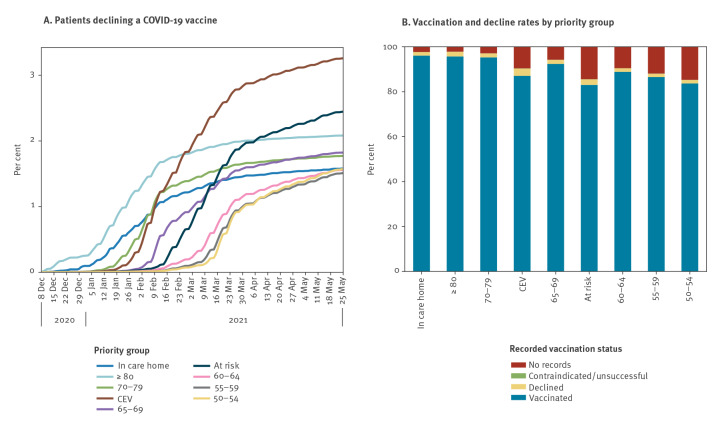
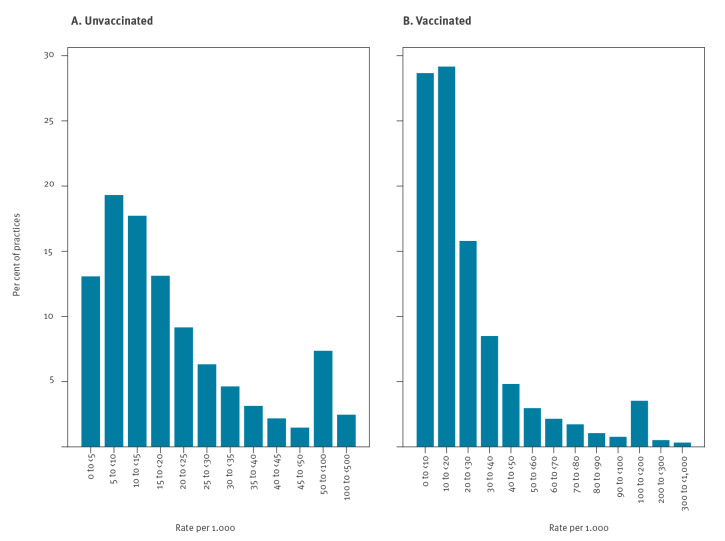
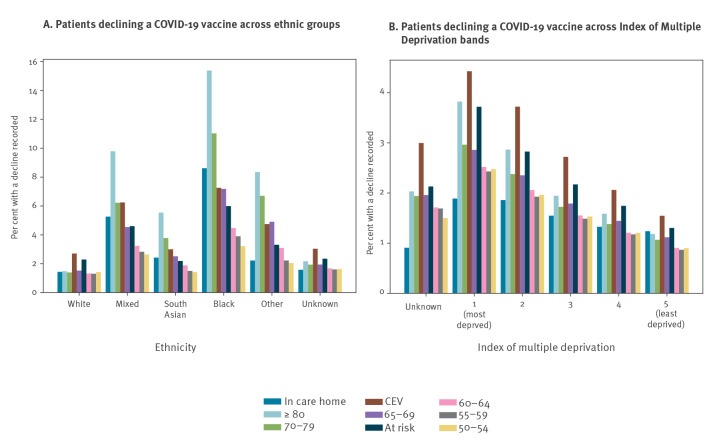
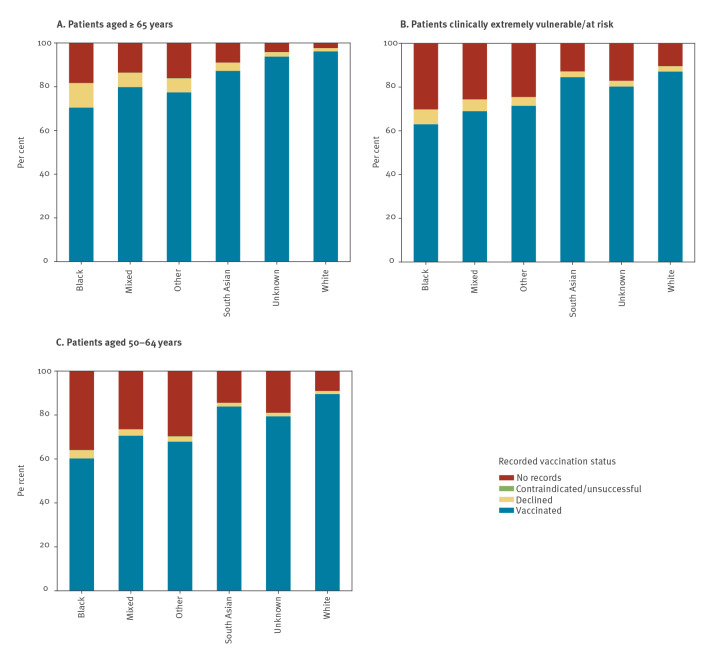
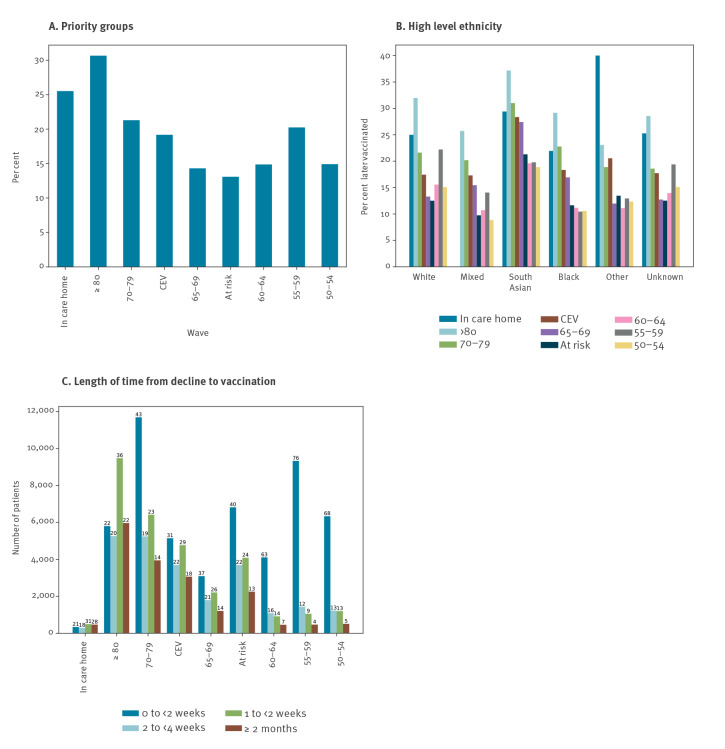
BackgroundPriority patients in England were offered COVID-19 vaccination by mid-April 2021. Codes in clinical record systems can denote the vaccine being declined.AimWe describe records of COVID-19 vaccines being declined, according to clinical and demographic factors.MethodsWith the approval of NHS England, we conducted a retrospective cohort study between 8 December 2020 and 25 May 2021 with primary care records for 57.9 million patients using OpenSAFELY, a secure health analytics platform. COVID-19 vaccination priority patients were those aged ≥ 50 years or ≥ 16 years clinically extremely vulnerable (CEV) or 'at risk'. We describe the proportion recorded as declining vaccination for each group and stratified by clinical and demographic subgroups, subsequent vaccination and distribution of clinical code usage across general practices.ResultsOf 24.5 million priority patients, 663,033 (2.7%) had a decline recorded, while 2,155,076 (8.8%) had neither a vaccine nor decline recorded. Those recorded as declining, who were subsequently vaccinated (n = 125,587; 18.9%) were overrepresented in the South Asian population (32.3% vs 22.8% for other ethnicities aged ≥ 65 years). The proportion of declining unvaccinated patients was highest in CEV (3.3%), varied strongly with ethnicity (black 15.3%, South Asian 5.6%, white 1.5% for ≥ 80 years) and correlated positively with increasing deprivation.ConclusionsClinical codes indicative of COVID-19 vaccinations being declined are commonly used in England, but substantially more common among black and South Asian people, and in more deprived areas. Qualitative research is needed to determine typical reasons for recorded declines, including to what extent they reflect patients actively declining.
背景
2021 年 4 月中旬,英国为优先级患者提供了 COVID-19 疫苗接种。临床记录系统中的代码可以表示拒绝接种疫苗。
目的
根据临床和人口统计学因素,我们描述了拒绝 COVID-19 疫苗接种的记录。
方法
在英格兰国民保健署的批准下,我们于 2020 年 12 月 8 日至 2021 年 5 月 25 日期间,使用 OpenSAFELY(一个安全的健康分析平台)对 5790 万患者的初级保健记录进行了回顾性队列研究。COVID-19 疫苗接种优先级患者为年龄≥50 岁或临床极度脆弱(CEV)或“有风险”的年龄≥16 岁。我们描述了每个组中记录的拒绝接种疫苗的比例,并按临床和人口统计学亚组、随后的疫苗接种和一般实践中临床代码使用的分布进行分层。
结果
在 2450 万优先级患者中,有 663033 人(2.7%)记录了拒绝接种疫苗,而有 2155076 人(8.8%)既没有接种疫苗也没有记录拒绝接种疫苗。随后接种疫苗的记录为拒绝接种疫苗的患者(n=125587;18.9%)在南亚人群中所占比例过高(≥65 岁的其他种族为 32.3%,南亚人为 22.8%)。拒绝接种疫苗的未接种患者比例在 CEV 中最高(3.3%),与种族差异很大(≥80 岁的黑人 15.3%,南亚人 5.6%,白人 1.5%),与贫困程度呈正相关。
结论
在英国,指示 COVID-19 疫苗接种被拒绝的临床代码被广泛使用,但在黑人和南亚人群中以及在较贫困地区更为常见。需要进行定性研究以确定记录拒绝的典型原因,包括在多大程度上反映了患者的主动拒绝。