Liehr Thomas
Institute of Human Genetics, Jena University Hospital, Friedrich Schiller University, Am Klinikum 1, 07747, Jena, Germany.
Mol Cytogenet. 2022 Aug 19;15(1):36. doi: 10.1186/s13039-022-00612-2.
Non-invasive prenatal testing (NIPT) has had an incomparable triumph in prenatal diagnostics in the last decade. Over 1400 research articles have been published, predominantly praising the advantages of this test.
The present study identified among the 1400 papers 24 original and one review paper, which were suited to re-evaluate the efficacy of > 750,000 published NIPT-results. Special attention was given to false-positive and false-negative result-rates. Those were discussed under different aspects-mainly from a patient-perspective.
A 27: 1 rate of false-positive compared to false-negative NIPT results was found. Besides, according to all reported, real-positive, chromosomally aberrant NIPT cases, 90% of those would have been aborted spontaneously before birth. These findings are here discussed under aspects like (i) How efficient is NIPT compared to first trimester screening? (ii) What are the differences in expectations towards NIPT from specialists and the public? and (iii) There should also be children born suffering from not by NIPT tested chromosomal aberrations; why are those never reported in all available NIPT studies?
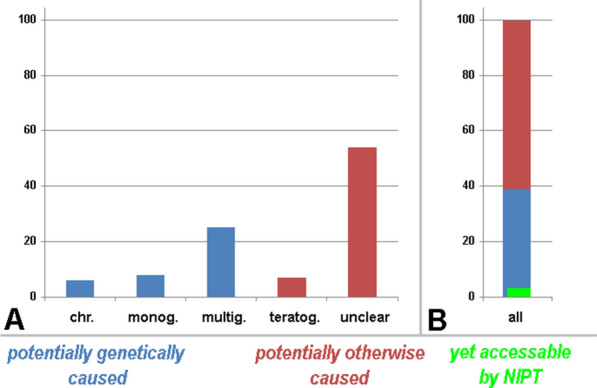
Even though much research has been published on NIPT, unbiased figures concerning NIPT and first trimester screening efficacy are yet not available. While false positive rates of different NIPT tests maybe halfway accurate, reported false-negative rates are most likely too low. The latter is as NIPT-cases with negative results for tested conditions are yet not in detail followed up for cases with other genetic or teratogenic caused disorders. This promotes an image in public, that NIPT is suited to replace all invasive tests, and also to solve the problem of inborn errors in humans, if not now then in near future. Overall, it is worth discussing the usefulness of NIPT in practical clinical application. Particularly, asking for unbiased figures concerning the efficacy of first trimester-screening compared to NIPT, and for really comprehensive data on false-positive and false-negative NIPT results.
在过去十年中,无创产前检测(NIPT)在产前诊断领域取得了无与伦比的成功。已发表了1400多篇研究文章,主要是称赞这项检测的优点。
本研究在这1400篇论文中筛选出24篇原创论文和1篇综述论文,这些论文适合重新评估超过75万例已发表的NIPT结果的有效性。特别关注假阳性和假阴性结果率。从不同方面对其进行了讨论——主要是从患者的角度。
发现NIPT假阳性与假阴性结果的比例为27:1。此外,根据所有报道的真正阳性、染色体异常的NIPT病例,其中90%在出生前会自然流产。本文从以下方面讨论了这些发现:(i)与孕早期筛查相比,NIPT的效率如何?(ii)专家和公众对NIPT的期望有何不同?以及(iii)应该有患有未通过NIPT检测的染色体异常的儿童出生;为什么在所有可用的NIPT研究中都从未报道过这些情况?
尽管已经发表了许多关于NIPT的研究,但关于NIPT和孕早期筛查有效性的无偏数据仍然不可得。虽然不同NIPT检测的假阳性率可能大致准确,但报道的假阴性率很可能过低。后者是因为对于检测条件为阴性的NIPT病例,尚未对其他遗传或致畸原因导致的疾病病例进行详细随访。这在公众中营造了一种印象,即NIPT适合取代所有侵入性检测,并且即使现在不能解决人类先天性疾病问题,在不久的将来也能解决。总体而言,值得讨论NIPT在实际临床应用中的实用性。特别是,需要关于孕早期筛查与NIPT有效性的无偏数据,以及关于NIPT假阳性和假阴性结果的真正全面的数据。