Institute of Neuroinformatics, UZH and ETH Zurich, Switzerland.
PLoS Comput Biol. 2022 Aug 25;18(8):e1010382. doi: 10.1371/journal.pcbi.1010382. eCollection 2022 Aug.
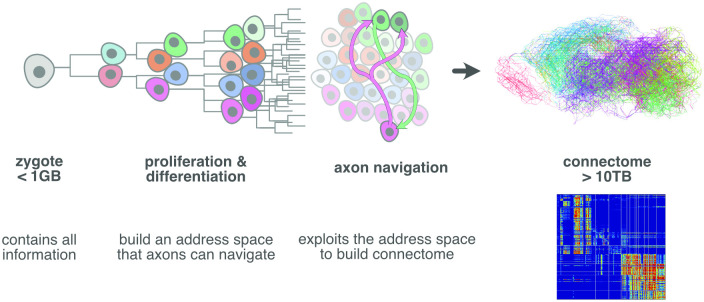
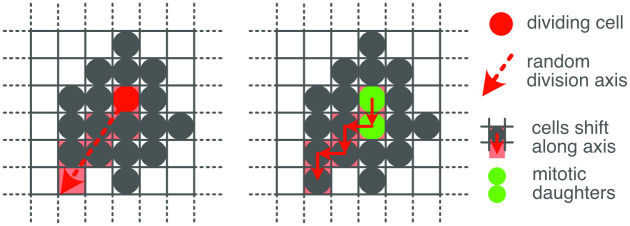
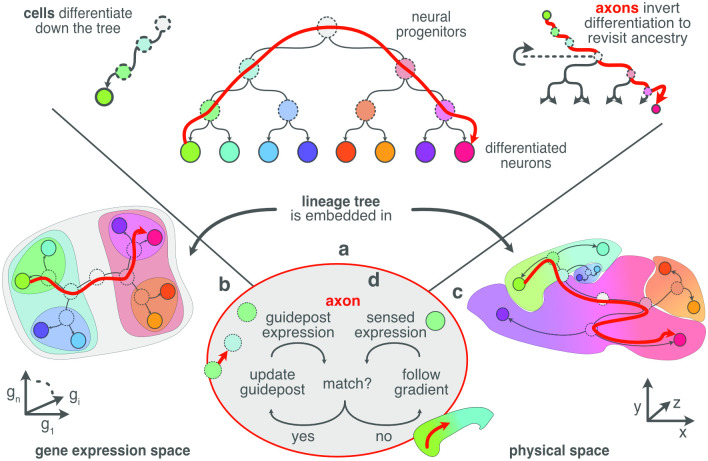
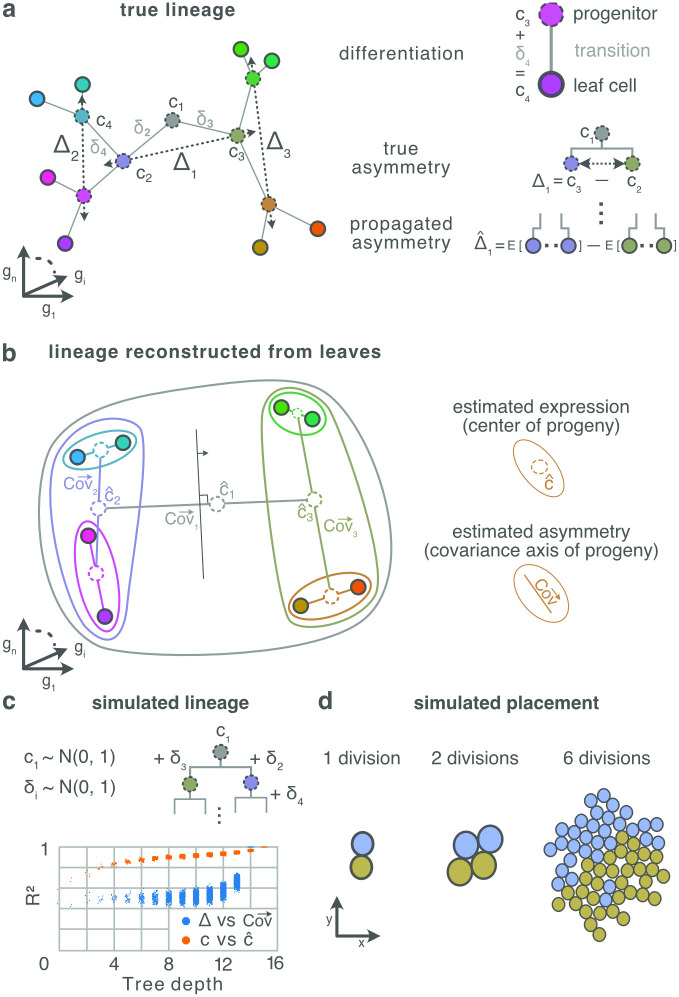
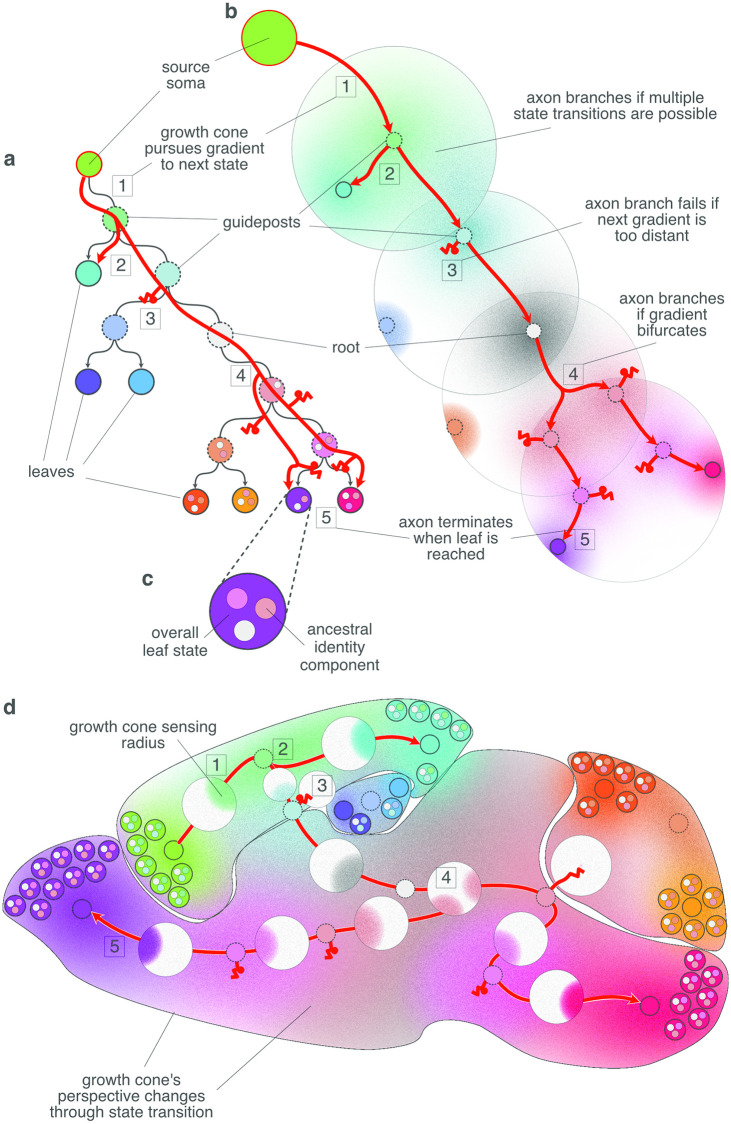
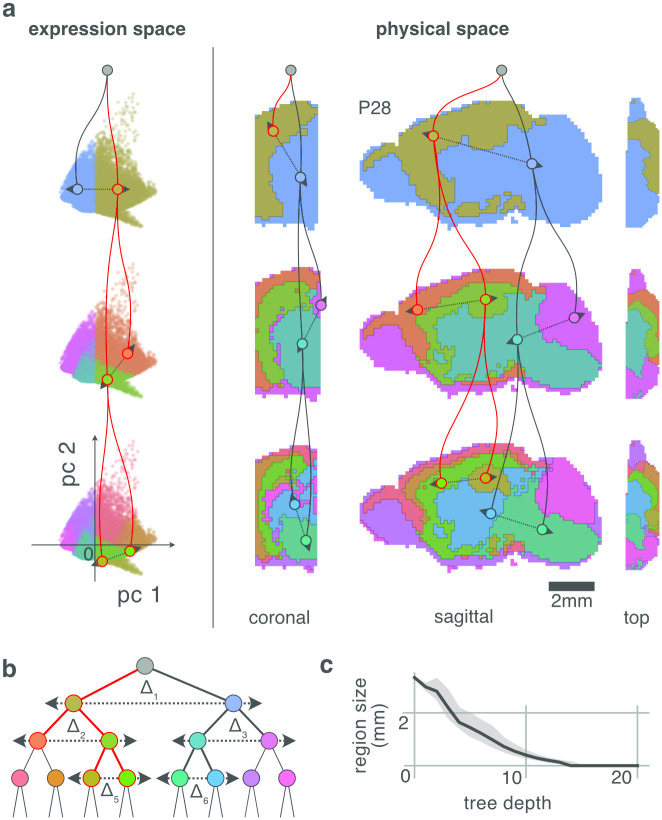
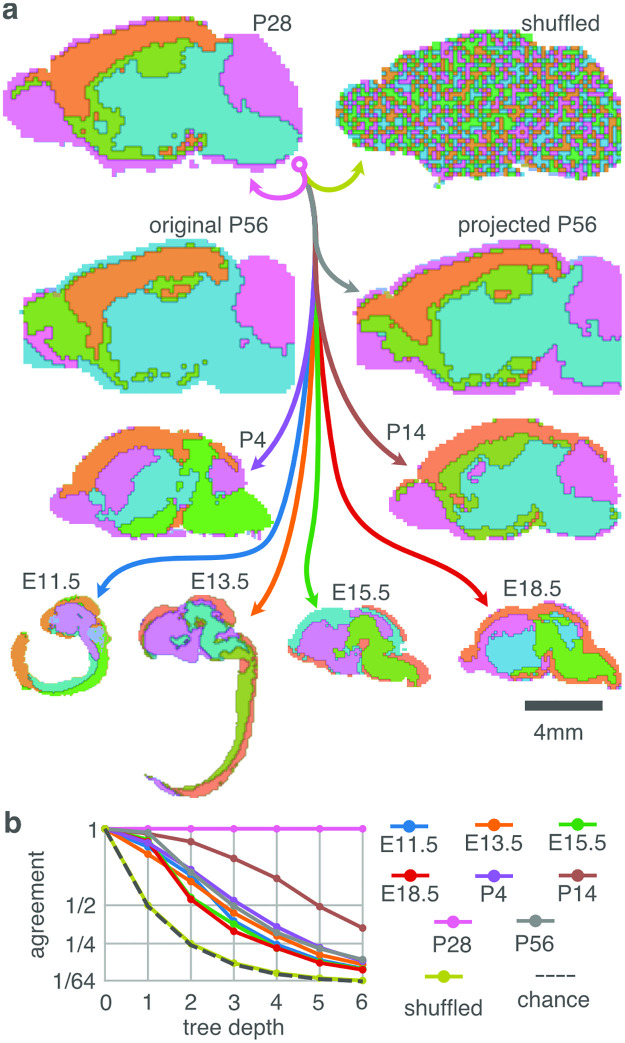
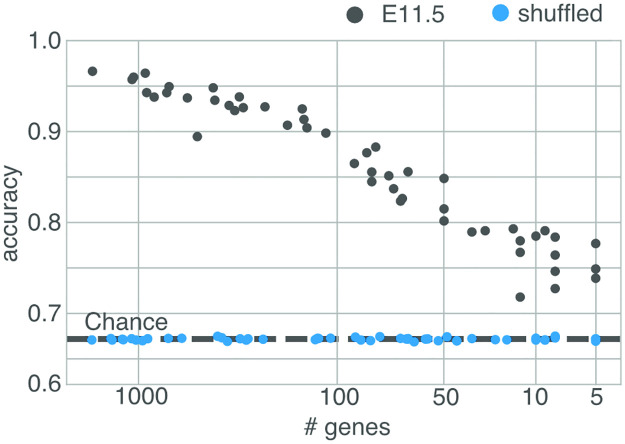
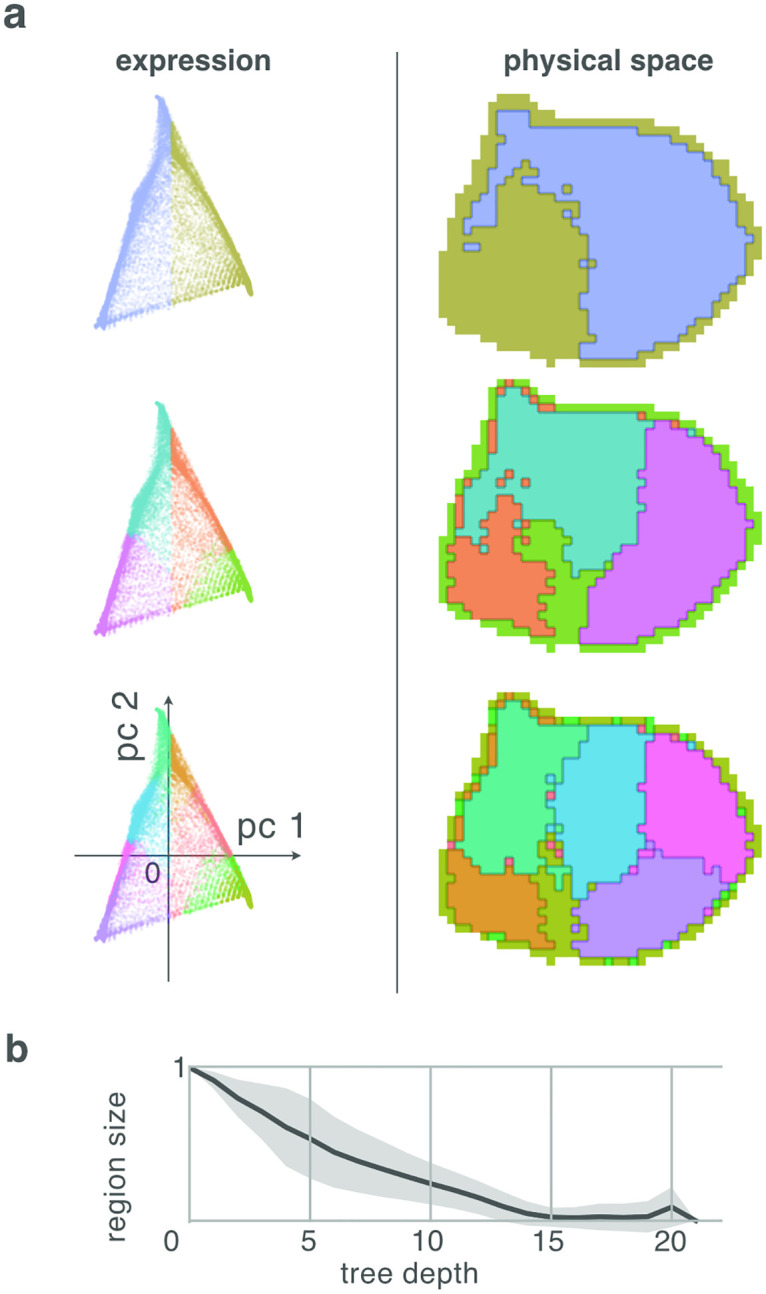
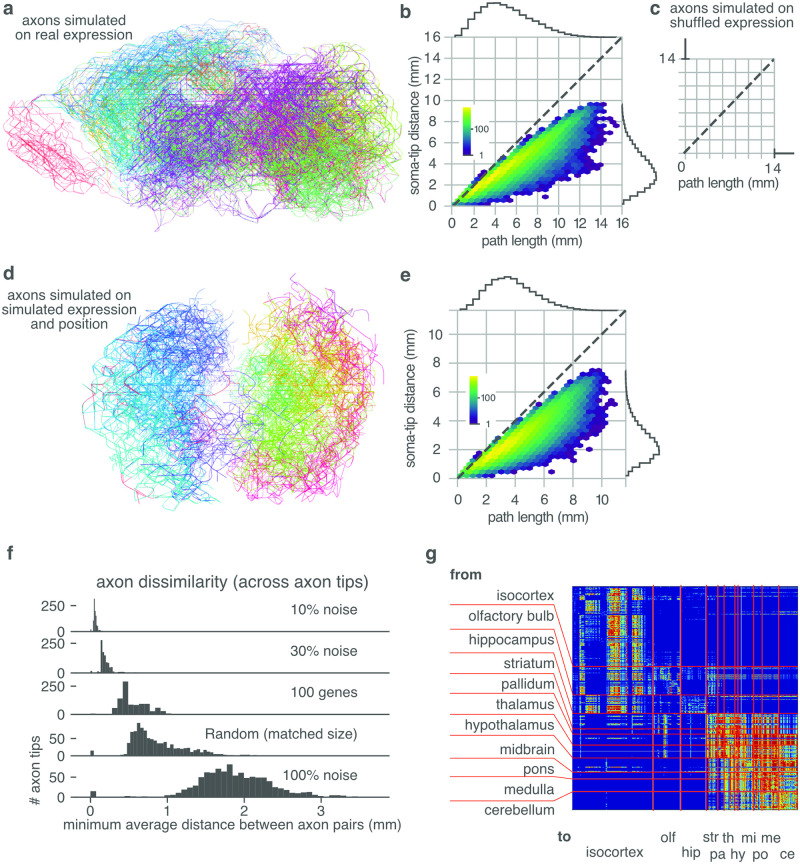
During brain development, billions of axons must navigate over multiple spatial scales to reach specific neuronal targets, and so build the processing circuits that generate the intelligent behavior of animals. However, the limited information capacity of the zygotic genome puts a strong constraint on how, and which, axonal routes can be encoded. We propose and validate a mechanism of development that can provide an efficient encoding of this global wiring task. The key principle, confirmed through simulation, is that basic constraints on mitoses of neural stem cells-that mitotic daughters have similar gene expression to their parent and do not stray far from one another-induce a global hierarchical map of nested regions, each marked by the expression profile of its common progenitor population. Thus, a traversal of the lineal hierarchy generates a systematic sequence of expression profiles that traces a staged route, which growth cones can follow to their remote targets. We have analyzed gene expression data of developing and adult mouse brains published by the Allen Institute for Brain Science, and found them consistent with our simulations: gene expression indeed partitions the brain into a global spatial hierarchy of nested contiguous regions that is stable at least from embryonic day 11.5 to postnatal day 56. We use this experimental data to demonstrate that our axonal guidance algorithm is able to robustly extend arbors over long distances to specific targets, and that these connections result in a qualitatively plausible connectome. We conclude that, paradoxically, cell division may be the key to uniting the neurons of the brain.
在大脑发育过程中,数十亿个轴突必须在多个空间尺度上导航,以到达特定的神经元靶点,从而构建产生动物智能行为的处理回路。然而,合子基因组的信息容量有限,这对轴突路径的编码方式和可以编码的路径都有很强的限制。我们提出并验证了一种可以有效地对这种全局布线任务进行编码的发育机制。通过模拟验证了其关键原理,即神经干细胞有丝分裂的基本约束条件——有丝分裂的子细胞与亲代细胞具有相似的基因表达,且彼此之间不会偏离太远——会诱导出嵌套区域的全局层次图,每个区域都由其共同祖细胞群体的表达谱标记。因此,线性层次结构的遍历会生成一个系统的表达谱序列,追踪一个阶段性的路线,生长锥可以沿着这个路线到达它们的远程靶点。我们分析了艾伦脑科学研究所发表的发育中和成年期小鼠大脑的基因表达数据,并发现它们与我们的模拟结果一致:基因表达确实将大脑划分为一个具有嵌套连续区域的全局空间层次结构,该结构至少从胚胎第 11.5 天到出生后第 56 天都保持稳定。我们使用这些实验数据证明,我们的轴突导向算法能够稳健地将树突延伸到远距离的特定靶点,并且这些连接会产生一个具有合理连接体的连接体。我们的结论是,矛盾的是,细胞分裂可能是将大脑神经元连接起来的关键。