Hunan Key Laboratory of Skin Cancer and Psoriasis, Hunan Engineering Research Center of Skin Health and Disease, Department of Dermatology, Xiangya Hospital, Central South University, Changsha 410008, China.
National Engineering Research Center of Personalized Diagnostic and Therapeutic Technology, Changsha 410008, China.
Int J Environ Res Public Health. 2022 Aug 13;19(16):10011. doi: 10.3390/ijerph191610011.
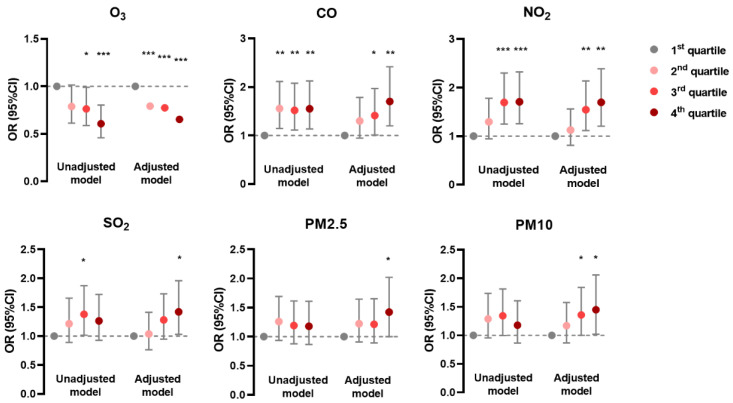
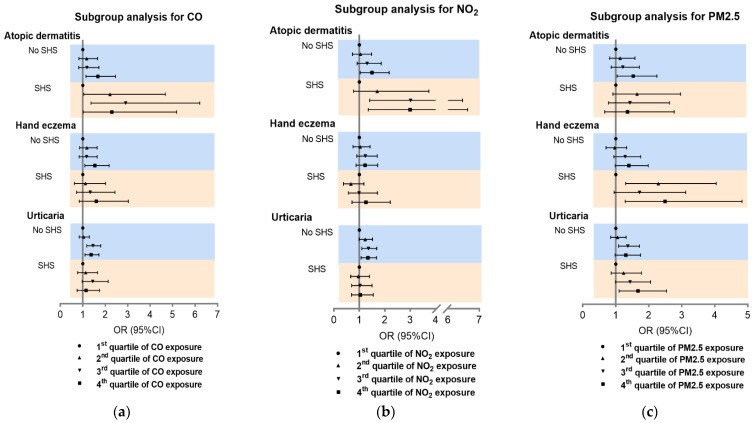
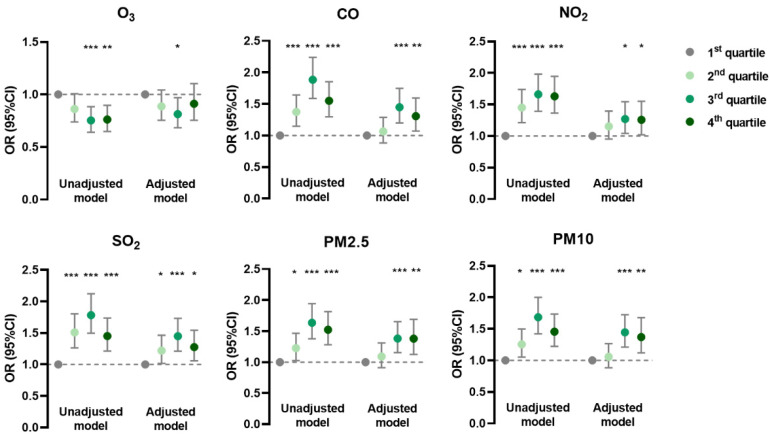
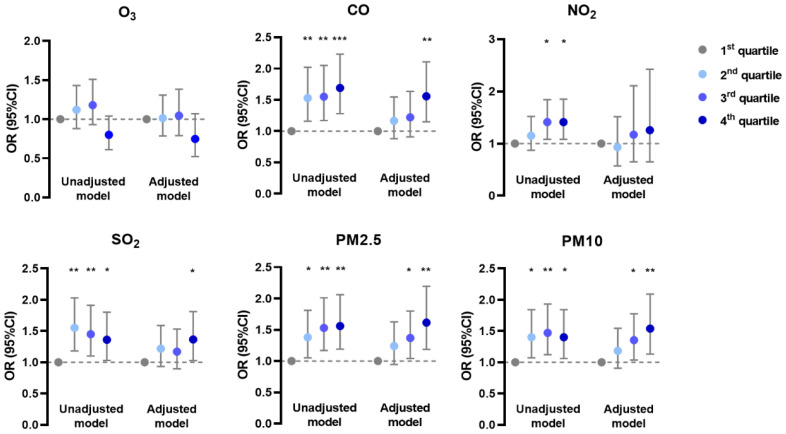
Atopic dermatitis (AD), chronic hand eczema (CHE), and urticaria are common inflammatory skin diseases among adolescents and associated with air quality. However, the synergistic effects of ambient air pollution and second-hand smoke (SHS) have been unclear. We conducted a cross-sectional study including 20,138 Chinese college students where dermatological examinations and a questionnaire survey were carried out. A generalized linear mixed model was applied for the association between individualized exposure of O3, CO, NO2, SO2, PM2.5, and PM10 and the prevalence of inflammatory skin diseases. Interactions between air pollutants and SHS were analyzed. As a result, CO, NO2, SO2, PM2.5, and PM10 were positively correlated with the prevalence of AD, CHE, and urticaria. Higher frequency of SHS exposure contributed to increased probabilities of AD (p = 0.042), CHE (p < 0.001), and urticaria (p = 0.002). Of note, CO (OR: 2.57 (1.16−5.69) in third quartile) and NO2 (OR: 2.38 (1.07−5.27) in third quartile) had positive interactions with SHS for AD, and PM2.5 synergized with SHS for CHE (OR: 2.25 (1.22−4.15) for second quartile). Subgroup analyses agreed with the synergistic results. In conclusion, SHS and ambient air pollution are both associated with inflammatory skin diseases, and they have a synergistic effect on the prevalence of AD and CHE.
特应性皮炎(AD)、慢性手部湿疹(CHE)和荨麻疹是青少年常见的炎症性皮肤病,与空气质量有关。然而,环境空气污染和二手烟(SHS)的协同作用尚不清楚。我们进行了一项横断面研究,纳入了 20138 名中国大学生,进行了皮肤检查和问卷调查。应用广义线性混合模型分析 O3、CO、NO2、SO2、PM2.5 和 PM10 的个体暴露与炎症性皮肤病患病率之间的关系。分析了空气污染物与 SHS 之间的相互作用。结果表明,CO、NO2、SO2、PM2.5 和 PM10 与 AD、CHE 和荨麻疹的患病率呈正相关。SHS 暴露频率越高,AD(p = 0.042)、CHE(p < 0.001)和荨麻疹(p = 0.002)的概率越高。值得注意的是,CO(OR:2.57(1.16-5.69)在第三四分位数)和 NO2(OR:2.38(1.07-5.27)在第三四分位数)与 AD 有正交互作用,PM2.5 与 CHE 有协同作用(OR:2.25(1.22-4.15)在第二四分位数)。亚组分析结果与协同作用一致。总之,SHS 和环境空气污染均与炎症性皮肤病相关,它们对 AD 和 CHE 的患病率有协同作用。