Intelligent Transport Cluster, Faculty of Technology, University of Portsmouth, Portsmouth PO1 3HF, UK.
School of Architecture, Building and Civil Engineering, Loughborough University, Loughborough LE11 3TU, UK.
Int J Environ Res Public Health. 2022 Aug 15;19(16):10065. doi: 10.3390/ijerph191610065.
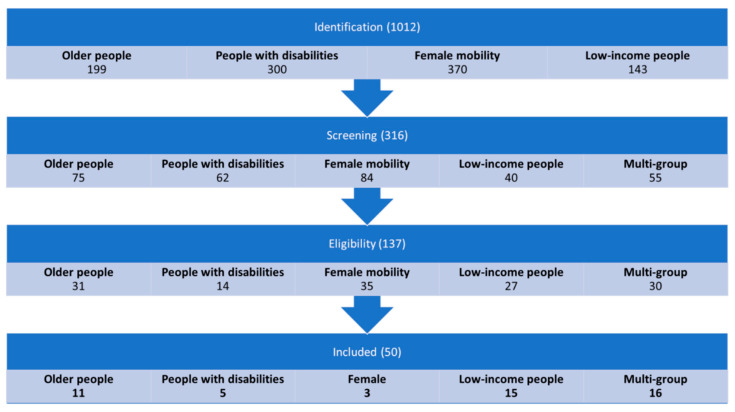
Since the emergence of COVID-19, travel restrictions due to the pandemic have influenced several activities, in particular the mobility patterns of individuals. Our main goal is to draw the attention of scholars and policy makers to a specific segment of the population, namely (1) older people, (2) persons with disabilities (PwDs), (3) females, and (4) low-income population that are more vulnerable for travel behaviour change due to crisis such as the COVID-19 pandemic. This article systematically reviews the studies that have explored the implications of COVID-19 for the mobility and activities of individuals pre-, during, and post-pandemic using the PRISMA method. It is found that there are a few studies regarding the travel and mobility needs and challenges of older people and PwDs, and there is no direct study concerning female and low-income individuals while such crisis exist. Questions such as "What are the adverse impacts of restrictions on their travel behaviour?", "How can they travel safely to work, shopping, and medical centres?", "Which transportation modes can be more effective for them?", and "What are the government and policy makers' role in providing accessible and affordable mobility services in the presence of such crisis?" are without relevant answers in the literature.
自 COVID-19 出现以来,由于疫情而实施的旅行限制影响了多项活动,特别是个人的流动模式。我们的主要目标是提请学者和决策者注意特定人群,即(1)老年人、(2)残疾人(PwDs)、(3)女性和(4)低收入人群,由于 COVID-19 等危机,他们更容易改变旅行行为。本文使用 PRISMA 方法系统地回顾了探讨 COVID-19 对个人在大流行前、期间和之后的流动性和活动的影响的研究。结果发现,关于老年人和残疾人的旅行和移动需求以及挑战的研究较少,而在这种危机存在的情况下,没有直接针对女性和低收入个人的研究。诸如“限制对他们的旅行行为有哪些不利影响?”、“他们如何安全地前往工作、购物和医疗中心?”、“哪些交通方式对他们更有效?”以及“在这种危机存在的情况下,政府和决策者在提供可及和负担得起的移动服务方面扮演什么角色?”等问题在文献中没有相关答案。