Iio Kentaro, Guo Xiaoyu, Kong Xiaoqiang, Rees Kelly, Bruce Wang Xiubin
Traf-IQ, Inc., 14811 St. Mary's Lane, Suite 180, Houston, TX 77079, United States.
Zachry Department of Civil and Environmental Engineering, 3135 TAMU, College Station, TX 77843-3136, United States.
Transp Res Interdiscip Perspect. 2021 Jun;10:100333. doi: 10.1016/j.trip.2021.100333. Epub 2021 Mar 2.
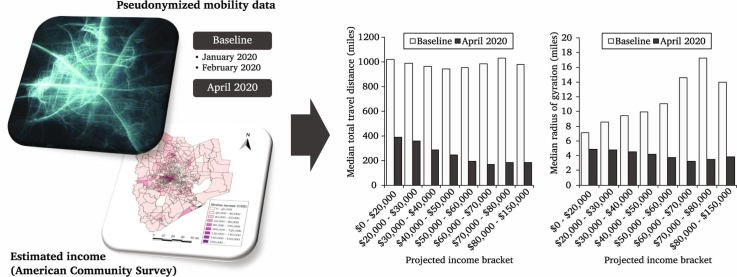
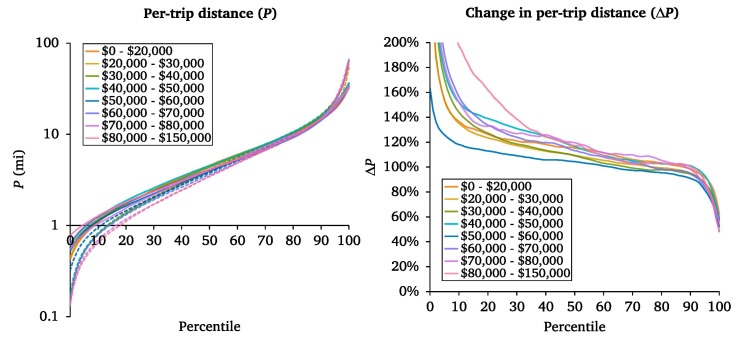
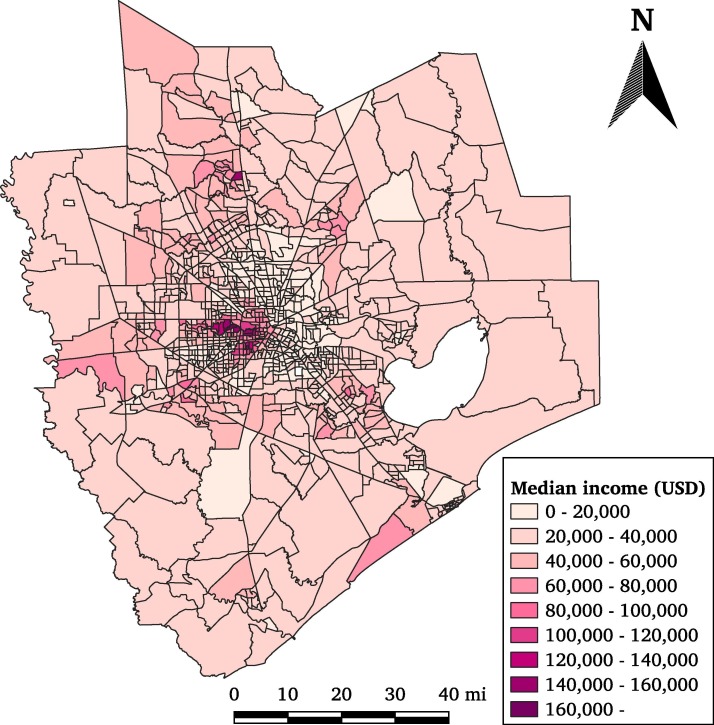
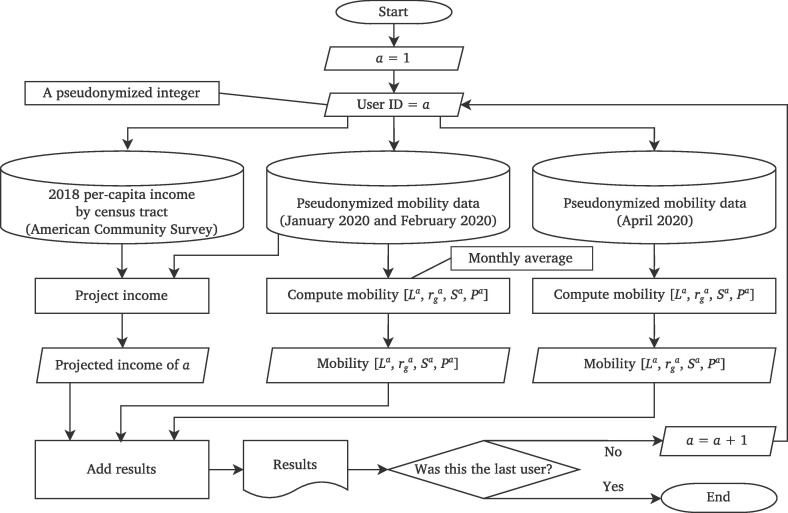
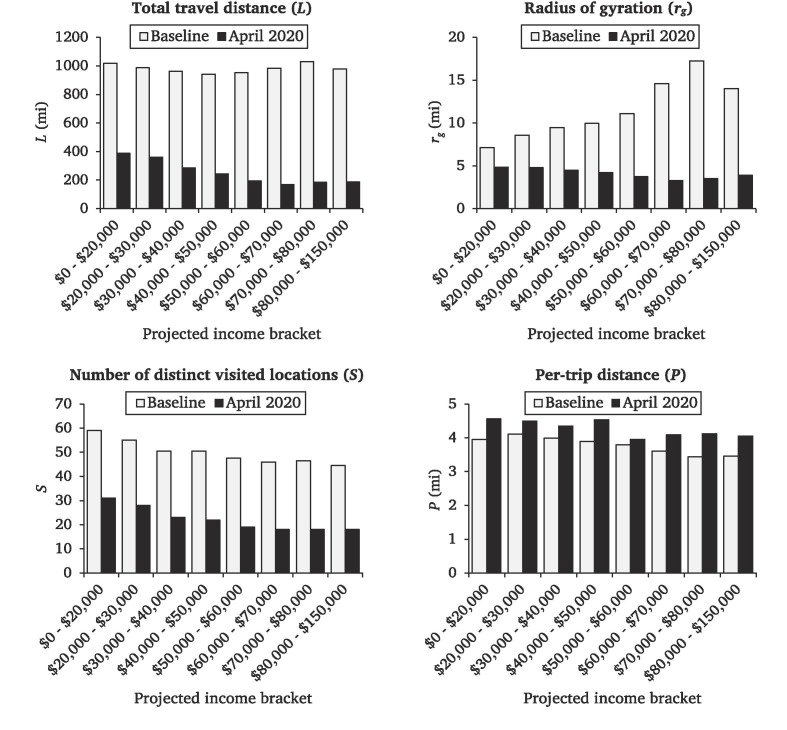
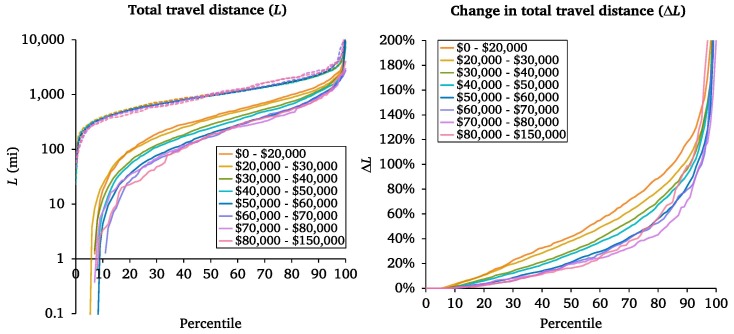
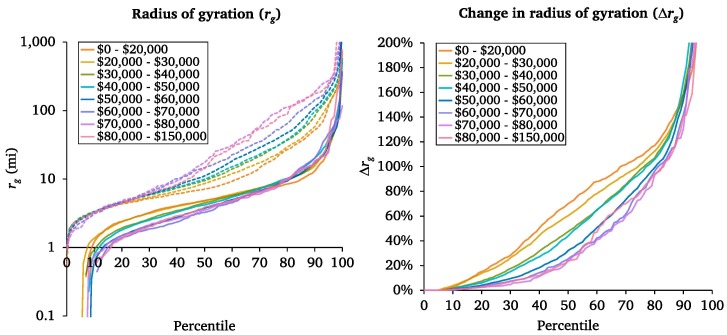
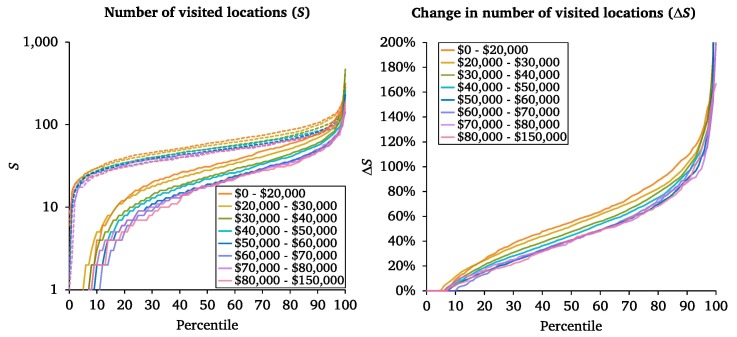
In response to the coronavirus disease 2019 (COVID-19) pandemic, governments have encouraged and ordered citizens to practice social distancing, particularly by working and studying at home. Intuitively, only a subset of people have the ability to practice remote work. However, there has been little research on the disparity of mobility adaptation across different income groups in US cities during the pandemic. The authors worked to fill this gap by quantifying the impacts of the pandemic on human mobility by income in Greater Houston, Texas. We determined human mobility using pseudonymized, spatially disaggregated cell phone location data. A longitudinal study across estimated income groups was conducted by measuring the total travel distance, radius of gyration, number of visited locations, and per-trip distance in April 2020 compared to the data in a baseline. An apparent disparity in mobility was found across estimated income groups. In particular, there was a strong negative correlation (ρ = -0.90) between a traveler's estimated income and travel distance in April. Disparities in mobility adaptability were further shown since those in higher income brackets experienced larger percentage drops in the radius of gyration and the number of distinct visited locations than did those in lower income brackets. The findings of this study suggest a need to understand the reasons behind the mobility inflexibility among low-income populations during the pandemic. The study illuminates an equity issue which may be of interest to policy makers and researchers alike in the wake of an epidemic.
为应对2019年冠状病毒病(COVID-19)大流行,各国政府鼓励并命令公民保持社交距离,尤其是通过在家工作和学习来实现。直观地说,只有一部分人有能力进行远程工作。然而,关于疫情期间美国城市不同收入群体在出行适应性方面的差异,此前几乎没有相关研究。作者致力于填补这一空白,通过量化疫情对得克萨斯州大休斯顿地区不同收入人群出行的影响来进行研究。我们使用经过匿名处理的、按空间细分的手机位置数据来确定人员流动情况。通过测量2020年4月与基线数据相比的总出行距离、回转半径、到访地点数量和单次出行距离,对不同估计收入群体进行了一项纵向研究。研究发现不同估计收入群体在出行方面存在明显差异。特别是,4月份旅行者的估计收入与出行距离之间存在很强的负相关(ρ = -0.90)。由于高收入群体的回转半径和不同到访地点数量的下降百分比比低收入群体更大,因此进一步显示出出行适应性的差异。这项研究的结果表明有必要了解疫情期间低收入人群出行灵活性不足背后的原因。该研究揭示了一个公平问题,在疫情之后,这可能会引起政策制定者和研究人员的关注。