Badr-Eldin Shaimaa M, Aldawsari Hibah M, Kotta Sabna, Deb Pran Kishore, Venugopala Katharigatta N
Department of Pharmaceutics, Faculty of Pharmacy, King Abdulaziz University, Jeddah 21589, Saudi Arabia.
Center of Excellence for Drug Research and Pharmaceutical Industries, King Abdulaziz University, Jeddah 21589, Saudi Arabia.
Pharmaceuticals (Basel). 2022 Jul 27;15(8):926. doi: 10.3390/ph15080926.
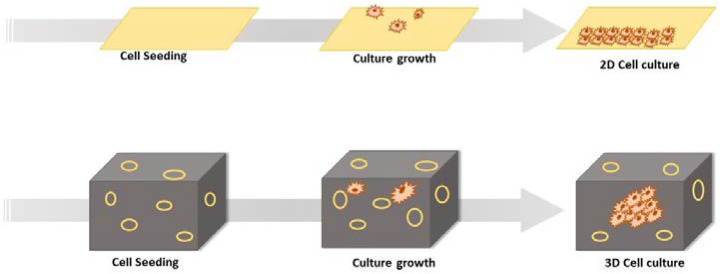
Despite tremendous advancements in technologies and resources, drug discovery still remains a tedious and expensive process. Though most cells are cultured using 2D monolayer cultures, due to lack of specificity, biochemical incompatibility, and cell-to-cell/matrix communications, they often lag behind in the race of modern drug discovery. There exists compelling evidence that 3D cell culture models are quite promising and advantageous in mimicking in vivo conditions. It is anticipated that these 3D cell culture methods will bridge the translation of data from 2D cell culture to animal models. Although 3D technologies have been adopted widely these days, they still have certain challenges associated with them, such as the maintenance of a micro-tissue environment similar to in vivo models and a lack of reproducibility. However, newer 3D cell culture models are able to bypass these issues to a maximum extent. This review summarizes the basic principles of 3D cell culture approaches and emphasizes different 3D techniques such as hydrogels, spheroids, microfluidic devices, organoids, and 3D bioprinting methods. Besides the progress made so far in 3D cell culture systems, the article emphasizes the various challenges associated with these models and their potential role in drug repositioning, including perspectives from the COVID-19 pandemic.
尽管在技术和资源方面取得了巨大进步,但药物研发仍然是一个繁琐且昂贵的过程。虽然大多数细胞是使用二维单层培养法进行培养的,但由于缺乏特异性、生化不相容性以及细胞间/细胞与基质间的通讯,它们在现代药物研发竞赛中往往落后。有令人信服的证据表明,三维细胞培养模型在模拟体内条件方面非常有前景且具有优势。预计这些三维细胞培养方法将弥合二维细胞培养数据与动物模型之间的转化差距。尽管如今三维技术已被广泛采用,但它们仍存在一些相关挑战,例如维持类似于体内模型的微组织环境以及缺乏可重复性。然而,更新的三维细胞培养模型能够在最大程度上绕过这些问题。本综述总结了三维细胞培养方法的基本原理,并着重介绍了不同的三维技术,如水凝胶、球体、微流控装置、类器官和三维生物打印方法。除了三维细胞培养系统迄今取得的进展外,本文还强调了与这些模型相关的各种挑战及其在药物重新定位中的潜在作用,包括来自新冠疫情的观点。