Instituto de Investigación de la Cadena Láctea (INTA-CONICET), Estación Experimental Agropecuaria Rafaela, Rafaela, Argentina.
Instituto de Virología e Innovaciones Tecnológicas, Centro de Investigaciones en Ciencias Veterinarias y Agronómicas, (INTA-CONICET), Hurlingham, Argentina.
Front Immunol. 2022 Aug 10;13:980514. doi: 10.3389/fimmu.2022.980514. eCollection 2022.
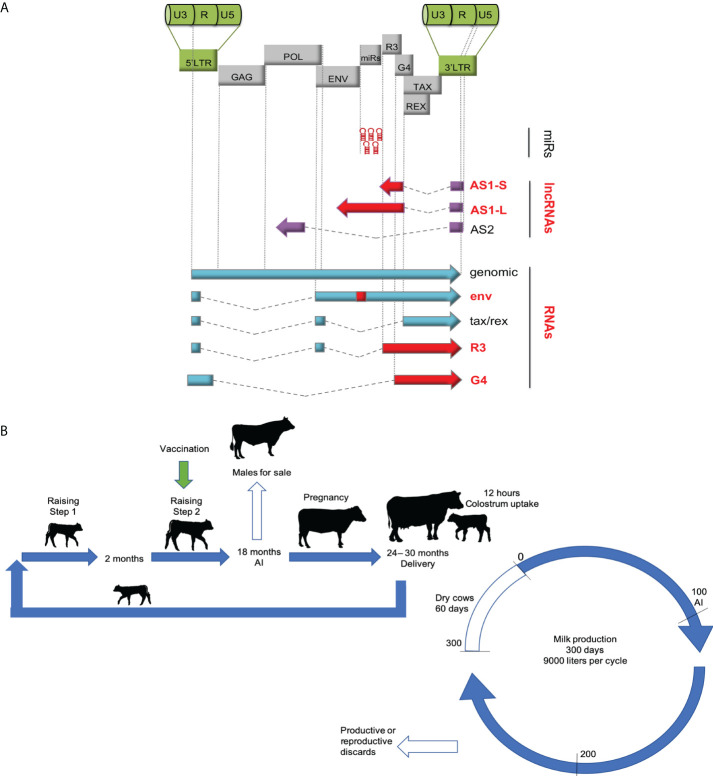
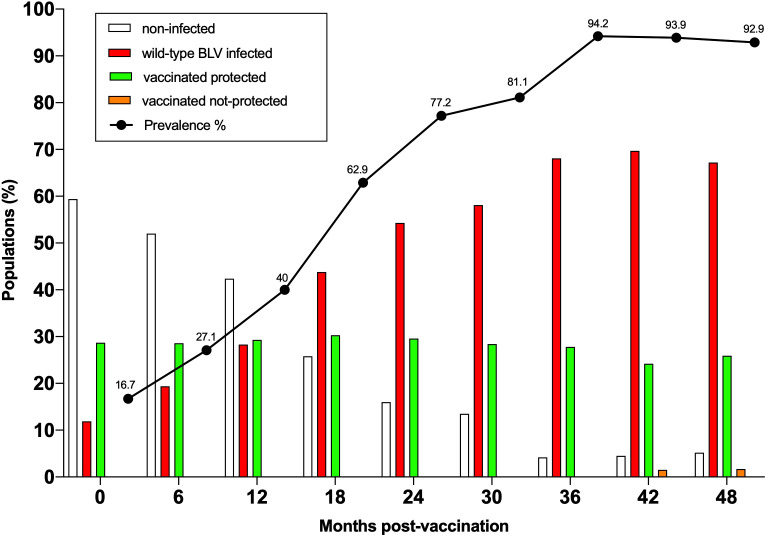
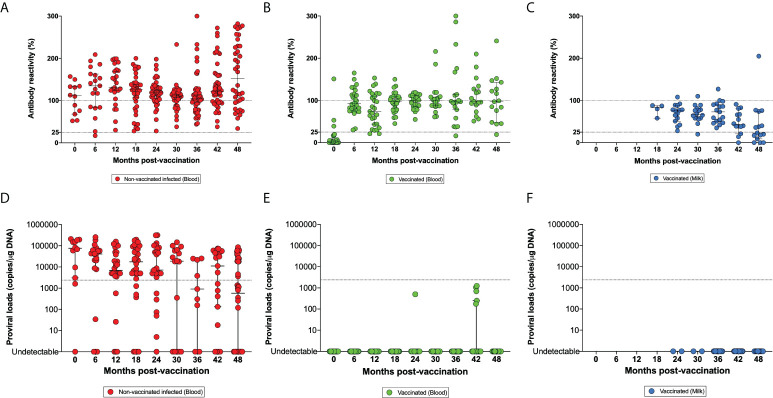
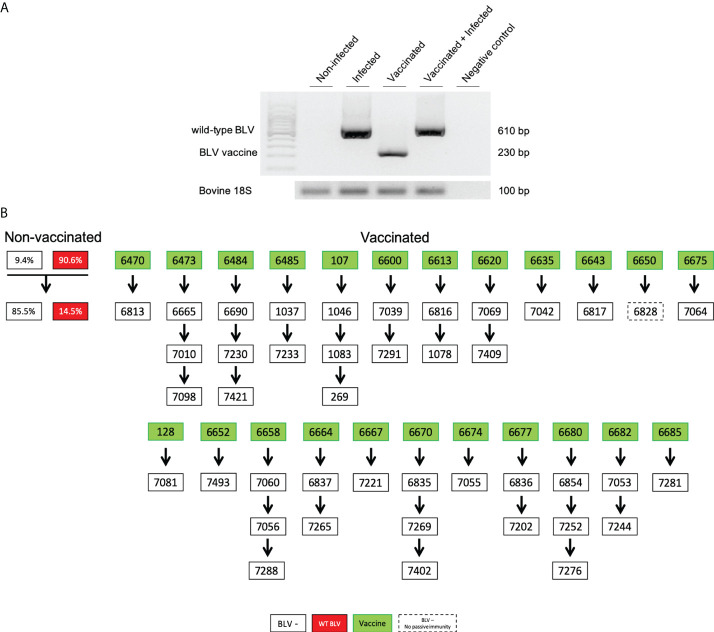
Previous attempts to develop a vaccine against bovine leukemia virus (BLV) have not been successful because of inadequate or short-lived stimulation of all immunity components. In this study, we designed an approach based on an attenuated BLV provirus by deleting genes dispensable for infectivity but required for efficient replication. The ability of the vaccine to protect from natural BLV infection was investigated in the context of dairy productive conditions in an endemic region. The attenuated vaccine was tested in a farm in which the prevalence rose from 16.7% in young cattle at the beginning of the study to more than 90% in adult individuals. Sterilizing immunity was obtained in 28 out of 29 vaccinated heifers over a period of 48 months, demonstrating the effectiveness of the vaccine. As indicated by the antiviral antibody titers, the humoral response was slightly reduced compared to wild-type infection. After initial post-vaccination bursts, the proviral loads of the attenuated vaccine remained most frequently undetectable. During the first dairy cycle, proviral DNA was not detected by nested-PCR in milk samples from vaccinated cows. During the second dairy cycle, provirus was sporadically detected in milk of two vaccinated cows. Forty-two calves born from vaccinated cows were negative for proviral DNA but had antiviral antibodies in their peripheral blood. The attenuated strain was not transmitted to sentinels, further supporting the safety of the vaccine. Altogether, these data thus demonstrate that the vaccine against BLV is safe and effective in herd conditions characterized by a very high incidence. This cost-effective approach will thus decrease the prevalence of BLV without modification of production practices. After facing a series of challenges pertaining to effectiveness and biosafety, the vaccine is now available for further large-scale delivery. The different challenges and hurdles that were bypassed may be informative for the development of a vaccine against HTLV-1.
先前针对牛白血病病毒 (BLV) 开发疫苗的尝试都未能成功,这是因为对所有免疫成分的刺激不足或短暂。在这项研究中,我们设计了一种方法,基于缺失对感染性不是必需但对有效复制必不可少的 BLV 前病毒,从而达到减毒效果。在地方性流行地区的奶牛生产条件下,我们研究了这种疫苗对自然 BLV 感染的保护能力。在该地区的一个农场中对该减毒疫苗进行了测试,该农场中,牛白血病病毒的流行率从研究开始时小牛的 16.7%上升到成年个体的 90%以上。在 48 个月的时间里,29 只接种疫苗的小母牛中有 28 只获得了绝育性免疫,证明了该疫苗的有效性。如抗病毒抗体滴度所示,与野生型感染相比,体液免疫反应略有降低。在初始接种后爆发后,减毒疫苗的前病毒载量最常检测不到。在第一个泌乳周期中,通过巢式 PCR 在接种牛的奶样中未检测到前病毒 DNA。在第二个泌乳周期中,在两只接种牛的奶中偶然检测到前病毒。从接种牛所生的 42 头小牛的外周血中均未检测到前病毒 DNA,但具有抗病毒抗体。该减毒株未传播给哨兵动物,这进一步支持了疫苗的安全性。总之,这些数据表明,在感染率非常高的牛群条件下,该 BLV 疫苗是安全有效的。这种具有成本效益的方法将在不改变生产实践的情况下降低 BLV 的流行率。在面对与有效性和生物安全性相关的一系列挑战之后,该疫苗现已可用于进一步的大规模推广。在克服了不同的挑战和障碍后,该疫苗的研发可能会为 HTLV-1 疫苗的研发提供信息。