Centre for Vaccines and Immunology, National Institute for Communicable Diseases, National Health Laboratory Service, Johannesburg, South Africa.
Department of Virology, School of Pathology, Faculty of Health Sciences, University of the Witwatersrand, Johannesburg, South Africa.
BMC Public Health. 2022 Aug 30;22(1):1647. doi: 10.1186/s12889-022-14069-w.
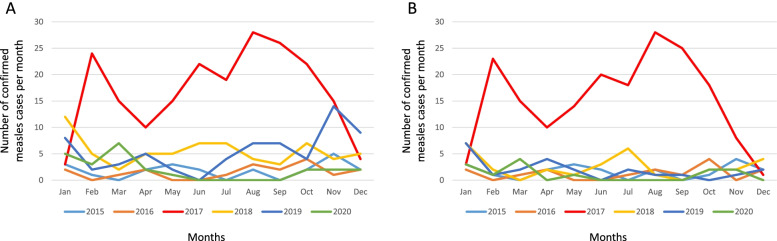
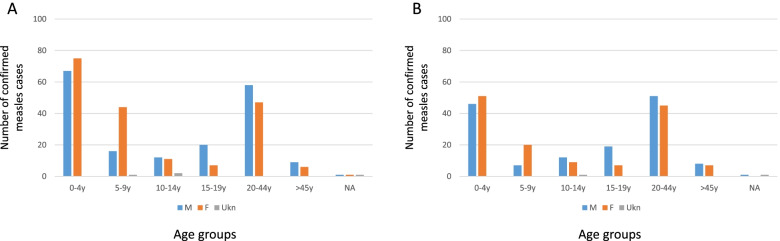
In 2012 the World Health Organization (WHO) aimed to eliminate measles in five regions by 2020. This retrospective descriptive study reviewed measles surveillance data in South Africa for the period 2015-2020 to document the epidemiology of measles and the progress made towards meeting the 2020 measles elimination goal.A total of 22,578 specimens were tested over the period 2015-2020 yielding 401 (1.8%) confirmed measles cases, 321 (1.4%) compatible and 21,856 (96.8%) discarded cases. The most affected age group was 0-4 year olds. At the provincial level, South Africa achieved adequate surveillance, defined as more than two cases of febrile rash notified annually per 100 000 popoulation, except for KwaZulu-Natal and Limpopo in 2020, probably due to COVID-19 lockdown restrictions. Of confirmed cases, only 26% were vaccinated, 3% were too young to receive vaccines, 5% were not vaccinated, and 65% had unknown vaccination status. Measles vaccine effectiveness amongst 1-4 year olds was 80%. Using the standard case definition, South Africa achieved the measles elimination target of less than one case per one million nationally in years 2015, 2016 and 2020. The years 2017 to 2019 had incidence rates exceeding one per million nationally. Using a narrow case definition, that excluded positive rubella cases, improved the indicators with only the year 2017 having an incidence rate of more than one per million.South Africa displays intermittent measles outbreaks approximately six-yearly interspersed by inter-epidemic periods in which the country meets measles elimination targets. Intense effort is needed to increase the vaccine coverage to avoid periodic outbreaks. Enhanced molecular testing of each case will be required as measles incidence declines regionally.
2012 年,世界卫生组织(WHO)旨在到 2020 年消除五个区域的麻疹。本回顾性描述性研究审查了南非 2015-2020 年期间的麻疹监测数据,以记录麻疹的流行病学情况以及实现 2020 年消除麻疹目标的进展情况。在此期间共检测了 22578 份标本,发现 401 例(1.8%)确诊麻疹病例,321 例(1.4%)疑似麻疹病例,21856 例(96.8%)排除麻疹病例。受影响最严重的年龄组是 0-4 岁。在省级层面,南非除 2020 年夸祖鲁-纳塔尔省和林波波省外,其他省份均实现了足够的监测,定义为每年每 10 万人口有超过两例发热出疹病例报告,这可能是由于 COVID-19 封锁限制所致。在确诊病例中,只有 26%的人接种过疫苗,3%的人太小不能接种疫苗,5%的人未接种疫苗,65%的人疫苗接种情况未知。1-4 岁儿童麻疹疫苗效力为 80%。使用标准病例定义,南非在 2015 年、2016 年和 2020 年全国麻疹发病率低于每百万人 1 例的消除目标。2017 年至 2019 年全国发病率超过每百万人 1 例。使用狭义的病例定义,排除了阳性风疹病例,仅 2017 年的发病率超过了每百万人 1 例,从而改善了指标。南非每隔六年左右就会发生间歇性麻疹暴发,其间是麻疹流行得到控制的流行间期。需要加强努力,提高疫苗覆盖率,以避免周期性暴发。随着麻疹发病率在该地区下降,需要对每个病例进行强化分子检测。