Laboratory of Microbiology, Wageningen University & Research, Wageningen, Netherlands.
Division of Human Nutrition and Health, Wageningen University & Research, Wageningen, Netherlands.
Front Immunol. 2022 Aug 18;13:954845. doi: 10.3389/fimmu.2022.954845. eCollection 2022.
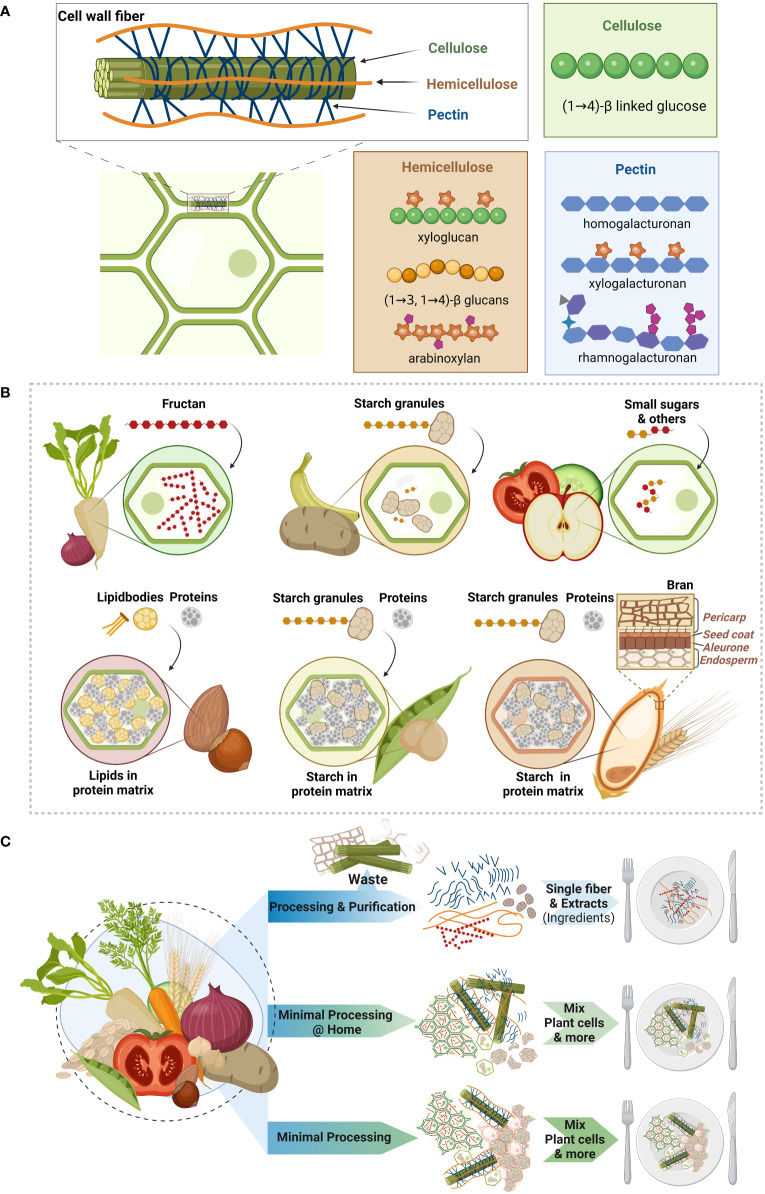
Dietary fibers contribute to structure and storage reserves of plant foods and fundamentally impact human health, partly by involving the intestinal microbiota, notably in the colon. Considerable attention has been given to unraveling the interaction between fiber type and gut microbiota utilization, focusing mainly on single, purified fibers. Studying these fibers in isolation might give us insights into specific fiber effects, but neglects how dietary fibers are consumed daily and impact our digestive tract: as intrinsic structures that include the cell matrix and content of plant tissues. Like our ancestors we consume fibers that are entangled in a complex network of plants cell walls that further encapsulate and shield intra-cellular fibers, such as fructans and other components from immediate breakdown. Hence, the physiological behavior and consequent microbial breakdown of these intrinsic fibers differs from that of single, purified fibers, potentially entailing unexplored health effects. In this mini-review we explain the difference between intrinsic and isolated fibers and discuss their differential impact on digestion. Subsequently, we elaborate on how food processing influences intrinsic fiber structure and summarize available human intervention studies that used intrinsic fibers to assess gut microbiota modulation and related health outcomes. Finally, we explore current research gaps and consequences of the intrinsic plant tissue structure for future research. We postulate that instead of further processing our already (extensively) processed foods to create new products, we should minimize this processing and exploit the intrinsic health benefits that are associated with the original cell matrix of plant tissues.
膳食纤维是植物性食物结构和储存的重要组成部分,对人类健康有重要影响,部分原因是它与肠道微生物群相互作用,特别是在结肠中。人们已经非常关注揭示纤维类型和肠道微生物群利用之间的相互作用,主要集中在单一的、纯化的纤维上。研究这些单独的纤维可以使我们深入了解特定纤维的作用,但忽略了膳食纤维是如何被日常消耗并影响我们的消化道的:它们作为植物组织的细胞基质和内容物的固有结构。就像我们的祖先一样,我们消耗的纤维是缠绕在植物细胞壁的复杂网络中的,这些细胞壁进一步包裹和保护细胞内纤维,如低聚果糖和其他成分,使其免受立即分解。因此,这些内在纤维的生理行为和随后的微生物分解与单一的、纯化的纤维不同,可能涉及尚未探索的健康影响。在这篇迷你综述中,我们解释了内在纤维和分离纤维之间的区别,并讨论了它们对消化的不同影响。随后,我们阐述了食品加工如何影响内在纤维结构,并总结了已有的人体干预研究,这些研究使用内在纤维来评估肠道微生物群的调节和相关的健康结果。最后,我们探讨了当前的研究空白以及植物组织内在结构对未来研究的影响。我们假设,与其进一步加工我们已经(广泛)加工过的食物来创造新产品,不如尽量减少这种加工,并利用与植物组织原始细胞基质相关的内在健康益处。