Popovic Marko
School of Life Sciences, Technical University of Munich, Freising 85354 , Germany.
Microb Risk Anal. 2022 Dec;22:100232. doi: 10.1016/j.mran.2022.100232. Epub 2022 Aug 31.
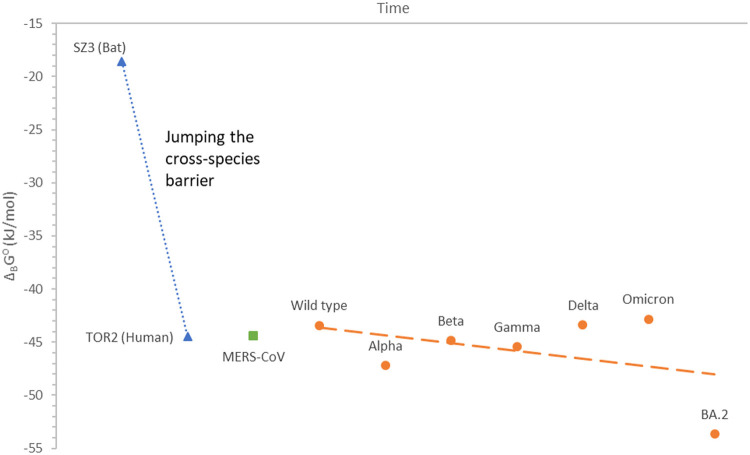
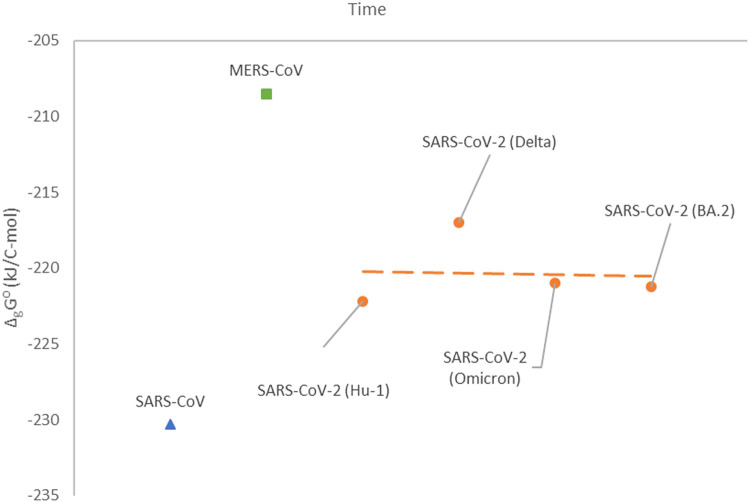
During the COVID-19 pandemic, many statistical and epidemiological studies have been published, trying to predict the future development of the SARS-CoV-2 pandemic. However, it would be beneficial to have a specific, mechanistic biophysical model, based on the driving forces of processes performed during virus-host interactions and fundamental laws of nature, allowing prediction of future evolution of SARS-CoV-2 and other viruses. In this paper, an attempt was made to predict the development of the pandemic, based on biothermodynamic parameters: Gibbs energy of binding and Gibbs energy of growth. Based on analysis of biothermodynamic parameters of various variants of SARS-CoV-2, SARS-CoV and MERS-CoV that appeared during evolution, an attempt was made to predict the future directions of evolution of SARS-CoV-2 and potential occurrence of new strains that could lead to new pandemic waves. Possible new mutations that could appear in the future could lead to changes in chemical composition, biothermodynamic properties (driving forces of new virus strains) and biological properties of SARS CoV-2 that represent a risk for humanity.
在新冠疫情期间,已经发表了许多统计和流行病学研究,试图预测严重急性呼吸综合征冠状病毒2(SARS-CoV-2)大流行的未来发展。然而,基于病毒-宿主相互作用过程中的驱动力和自然基本规律,建立一个特定的、机械的生物物理模型,从而能够预测SARS-CoV-2和其他病毒的未来演变,将是有益的。在本文中,我们尝试基于生物热力学参数(结合吉布斯自由能和生长吉布斯自由能)来预测大流行的发展。通过分析在进化过程中出现的SARS-CoV-2、SARS-CoV和中东呼吸综合征冠状病毒(MERS-CoV)各种变体的生物热力学参数,我们尝试预测SARS-CoV-2未来的进化方向以及可能出现导致新一波大流行的新毒株。未来可能出现的新突变可能导致SARS-CoV-2的化学成分、生物热力学性质(新病毒株的驱动力)和生物学性质发生变化,这对人类构成风险。