Ramírez-Aportela Erney, Carazo Jose M, Sorzano Carlos Oscar S
Biocomputing Unit, National Centre for Biotechnology (CNB CSIC), Darwin 3, Campus Universidad Autónoma de Madrid, Cantoblanco, Madrid 28049, Spain.
Universidad CEU San Pablo, Campus Urb. Montepríncipe, Boadilla del Monte, Madrid 28668, Spain.
IUCrJ. 2022 Aug 3;9(Pt 5):632-638. doi: 10.1107/S2052252522006959. eCollection 2022 Sep 1.
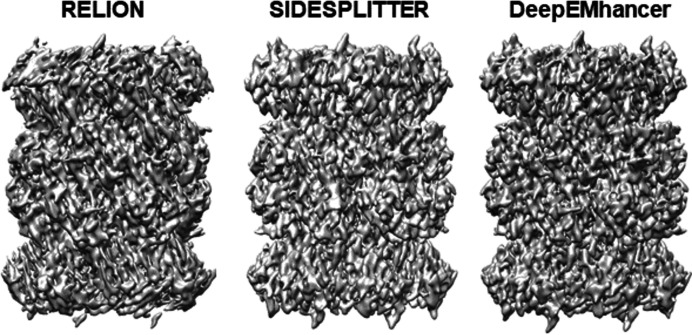
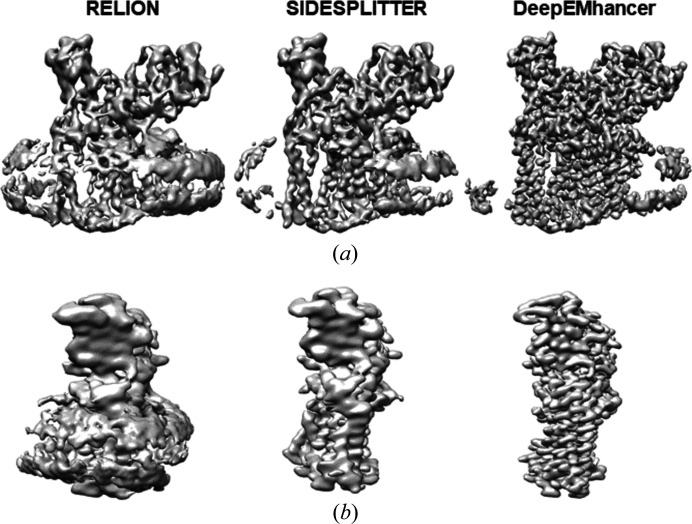
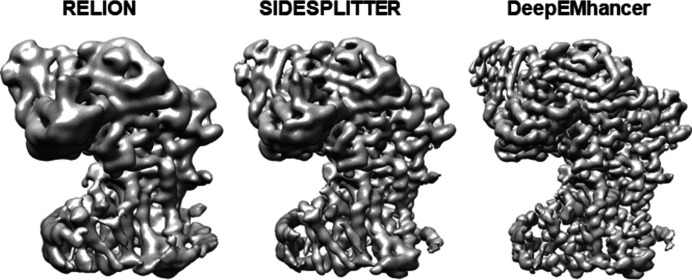
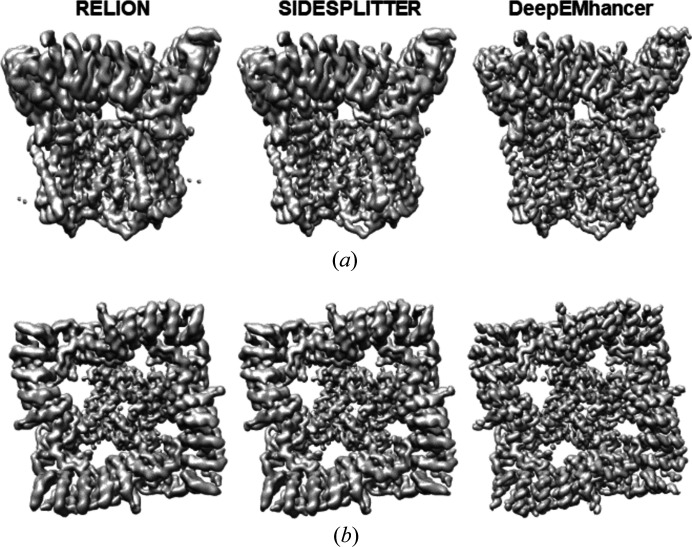
Single-particle cryo-electron microscopy has become a powerful technique for the 3D structure determination of biological molecules. The last decade has seen an astonishing development of both hardware and software, and an exponential growth of new structures obtained at medium-high resolution. However, the knowledge accumulated in this field over the years has hardly been utilized as feedback in the reconstruction of new structures. In this context, this article explores the use of the deep-learning approach as a regularizer in the refinement process. introduces prior information derived from macromolecular structures, and contributes to noise reduction and signal enhancement, as well as a higher degree of isotropy. These features have a direct effect on image alignment and reduction of overfitting during iterative refinement. The advantages of this combination are demonstrated for several membrane proteins, for which it is especially useful because of their high disorder and flexibility.
单颗粒冷冻电子显微镜已成为确定生物分子三维结构的强大技术。在过去十年中,硬件和软件都有了惊人的发展,中高分辨率新结构的数量呈指数增长。然而,多年来在该领域积累的知识在新结构重建中几乎未被用作反馈。在此背景下,本文探讨了深度学习方法作为精修过程中的正则化器的应用。引入了源自大分子结构的先验信息,有助于降噪和信号增强,以及更高程度的各向同性。这些特征对图像对齐和迭代精修过程中过拟合的减少有直接影响。这种结合的优势在几种膜蛋白上得到了证明,由于它们的高度无序和灵活性,这种结合对它们特别有用。