Institute of Medical Biometry and Epidemiology, University Medical Center Hamburg-Eppendorf, 20246 Hamburg, Germany.
Institute for Biometrics and Epidemiology, German Diabetes Center (DDZ), Leibniz Institute for Diabetes Research, Heinrich Heine University, 40225 Düsseldorf, Germany.
Int J Environ Res Public Health. 2022 Aug 31;19(17):10880. doi: 10.3390/ijerph191710880.
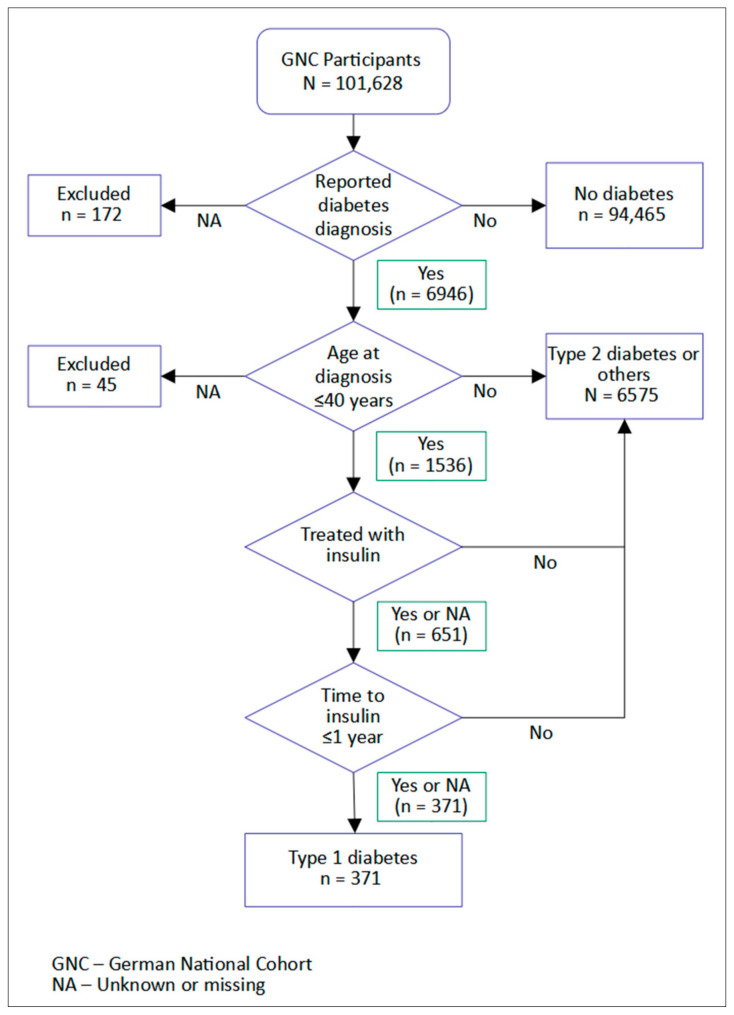
(1) Background: Global incidence of type 1 diabetes (T1D) is rising and nearly half occurred in adults. However, it is unclear if certain early-life childhood T1D risk factors were also associated with adult-onset T1D. This study aimed to assess associations between birth order, delivery mode or daycare attendance and type 1 diabetes (T1D) risk in a population-based cohort and whether these were similar for childhood- and adult-onset T1D (cut-off age 15); (2) Methods: Data were obtained from the German National Cohort (NAKO Gesundheitsstudie) baseline assessment. Self-reported diabetes was classified as T1D if: diagnosis age ≤ 40 years and has been receiving insulin treatment since less than one year after diagnosis. Cox regression was applied for T1D risk analysis; (3) Results: Analyses included 101,411 participants (100 childhood- and 271 adult-onset T1D cases). Compared to "only-children", HRs for second- or later-born individuals were 0.70 (95% CI = 0.50-0.96) and 0.65 (95% CI = 0.45-0.94), respectively, regardless of parental diabetes, migration background, birth year and perinatal factors. In further analyses, higher birth order reduced T1D risk in children and adults born in recent decades. Caesarean section and daycare attendance showed no clear associations with T1D risk; (4) Conclusions: Birth order should be considered in both children and adults' T1D risk assessment for early detection.
(1) 背景:全球 1 型糖尿病(T1D)发病率正在上升,近一半发生在成年人中。然而,目前尚不清楚某些儿童期 T1D 危险因素是否也与成人发病的 T1D 相关。本研究旨在评估出生顺序、分娩方式或日托出勤率与基于人群的队列中 1 型糖尿病(T1D)风险之间的关联,以及这些因素是否与儿童和成人发病的 T1D (截止年龄 15 岁)相关;(2) 方法:数据来自德国国家队列(NAKO Gesundheitsstudie)的基线评估。如果自我报告的糖尿病符合以下条件,则将其分类为 T1D:诊断年龄≤40 岁,且自诊断后不到一年开始接受胰岛素治疗。采用 Cox 回归分析 T1D 风险;(3) 结果:分析共纳入 101411 名参与者(100 例儿童发病和 271 例成人发病 T1D 病例)。与“独生子”相比,第二胎或以上出生的个体的 HR 分别为 0.70(95%CI=0.50-0.96)和 0.65(95%CI=0.45-0.94),无论父母是否患有糖尿病、移民背景、出生年份和围产期因素如何;(4) 结论:在儿童和成人的 T1D 风险评估中,应考虑出生顺序,以便早期发现 T1D。