Workie Andualem Belachew, Shih Shao-Ju
Faculty of Materials Science and Engineering, Bahir Dar Institute of Technology, Bahir Dar University P. O. Box 26 Bahir Dar Ethiopia.
Department of Materials Science and Engineering, National Taiwan University of Science and Technology 43 Sec. 4 Keelung Road Taipei 10607 Taiwan.
RSC Adv. 2022 Aug 16;12(36):23143-23152. doi: 10.1039/d2ra03235j.
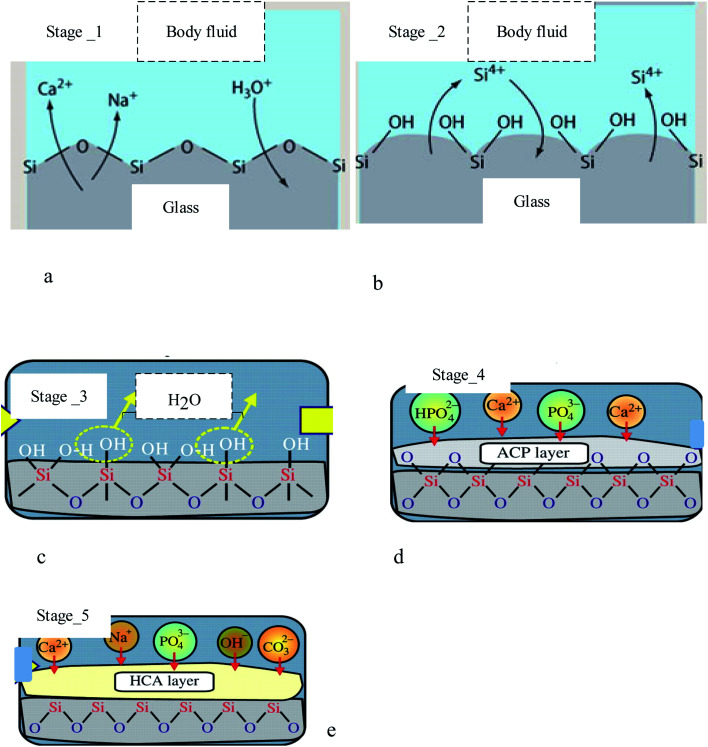
Apparently, bioactive glass-ceramics are made by doing a number of steps, such as creating a microstructure from dispersed crystals within the residual glass, which provides high bending strength, and apatite crystallizes on surfaces of glass-ceramics when calcium ions are present in the blood. Apatite crystals grow on the glass and ceramic surfaces due to the hydrated silica. These materials are biocompatible with living bone in a matter of weeks, don't weaken mechanically or histologically, and exhibit good osteointegration as well as mechanical properties that are therapeutically relevant, such as fracture toughness and flexural strength. As part of this study, we examined mechanical properties, process mechanisms involved in apatite formation, and potential applications for bioactive glass-ceramic in orthopedic surgery, including load-bearing devices.
显然,生物活性玻璃陶瓷是通过一系列步骤制成的,比如在残余玻璃中由分散的晶体形成微观结构,这能提供高抗弯强度,并且当血液中存在钙离子时,磷灰石会在玻璃陶瓷表面结晶。由于水合二氧化硅,磷灰石晶体在玻璃和陶瓷表面生长。这些材料在几周内就能与活骨生物相容,不会在机械性能或组织学上变弱,并且展现出良好的骨整合以及与治疗相关的机械性能,如断裂韧性和抗弯强度。作为本研究的一部分,我们研究了机械性能、磷灰石形成所涉及的过程机制,以及生物活性玻璃陶瓷在骨科手术中的潜在应用,包括承重装置。