The First Affiliated Hospital of Soochow University, Soochow, 215006, People's Republic of China.
Suzhou Municipal Hospital, Soochow, 215006, People's Republic of China.
BMC Med Imaging. 2022 Sep 14;22(1):166. doi: 10.1186/s12880-022-00875-6.
This study is aimed to explore the value of mammography-based radiomics signature for preoperative prediction of triple-negative breast cancer (TNBC).
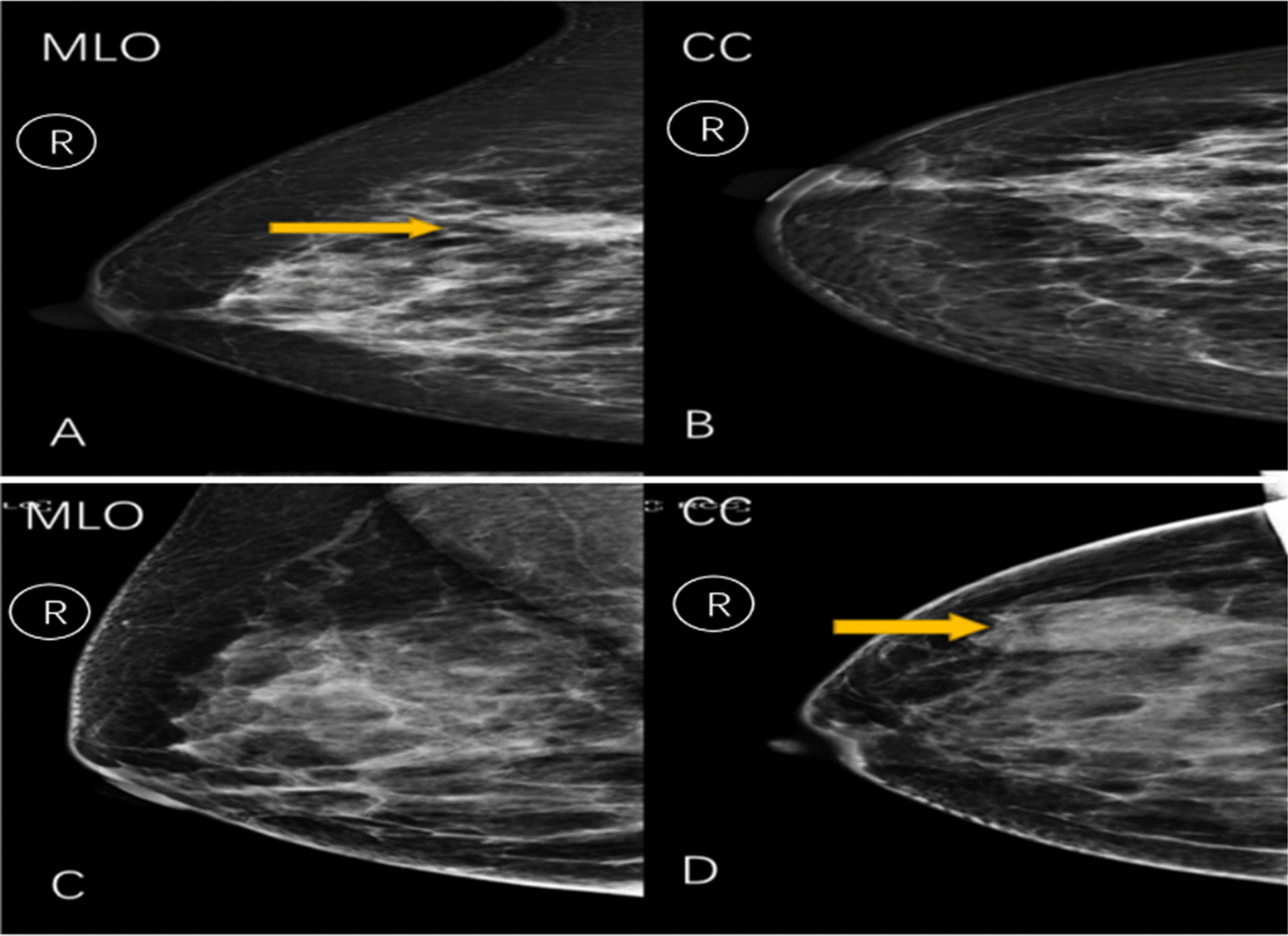
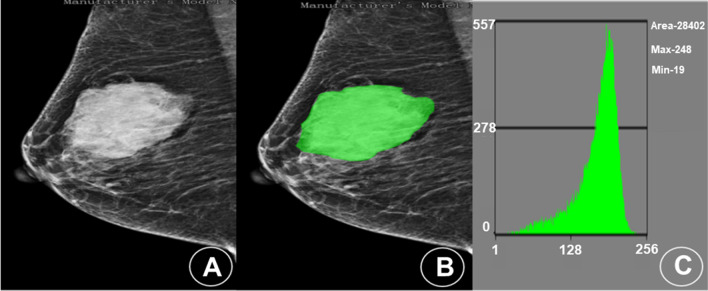
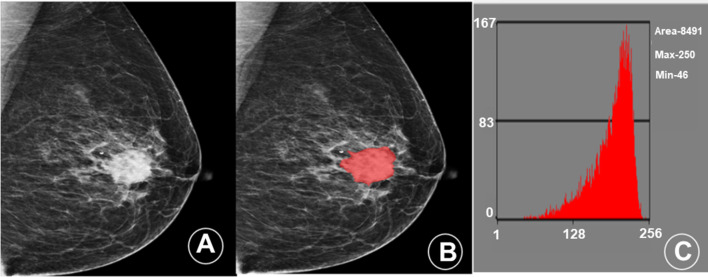
Initially, the clinical and X-ray data of patients (n = 319, age of 54 ± 14) with breast cancer (triple-negative-65, non-triple-negative-254) from the First Affiliated Hospital of Soochow University (n = 211, as a training set) and Suzhou Municipal Hospital (n = 108, as a verification set) from January 2018 to February 2021 are retrospectively analyzed. Comparing the mediolateral oblique (MLO) and cranial cauda (CC) mammography images, the mammography images with larger lesion areas are selected, and the image segmentation and radiomics feature extraction are then performed by the MaZda software. Further, the Fisher coefficients (Fisher), classification error probability combined average correlation coefficients (POE + ACC), and mutual information (MI) are used to select three sets of feature subsets. Moreover, the score of each patient's radiomics signature (Radscore) is calculated. Finally, the receiver operating characteristic curve (ROC) is analyzed to calculate the AUC, accuracy, sensitivity, specificity, positive predictive value, and negative predictive value of TNBC.
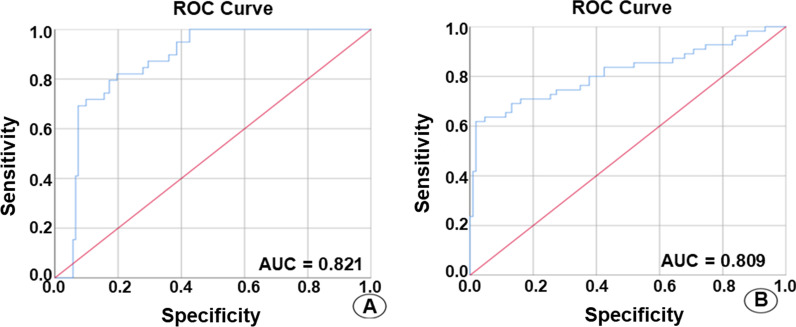
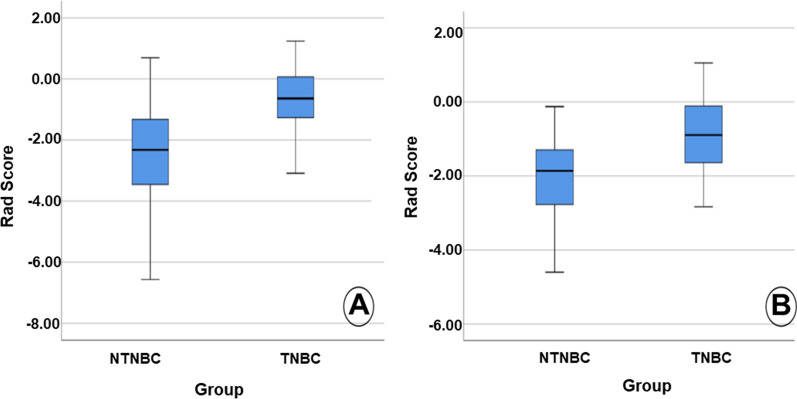
A significant difference in the mammography manifestation between the triple-negative and the non-triple-negative groups (P < 0.001) is observed. The (POE + ACC)-NDA method showed the highest accuracy of 88.39%. The Radscore of triple-negative and non-triple-negative groups in the training set includes - 0.678 (- 1.292, 0.088) and - 2.536 (- 3.496, - 1.324), respectively, with a statistically significant difference (Z = - 6.314, P < 0.001). In contrast, the Radscore in the validation set includes - 0.750 (- 1.332, - 0.054) and - 2.223 (- 2.963, - 1.256), with a statistically significant difference (Z = - 4.669, P < 0.001). In the training set, the AUC, accuracy, sensitivity, specificity, positive predictive value and negative predictive value of TNBC include 0.821 (95% confidence interval 0.752-0.890), 74.4%, 82.5%, 72.5%, 41.2%, and 94.6%, respectively. In the validation set, the AUC, accuracy, sensitivity, specificity, positive predictive value and negative predictive value of TNBC are of 0.809 (95% confidence interval 0.711-0.907), 80.6%, 72.0%, 80.7%, 55.5%, and 93.1%, respectively.
In summary, we firmly believe that this mammography-based radiomics signature could be useful in the preoperative prediction of TNBC due to its high value.
本研究旨在探讨基于乳腺 X 线摄影的放射组学特征在术前预测三阴性乳腺癌(TNBC)中的价值。
回顾性分析 2018 年 1 月至 2021 年 2 月苏州大学附属第一医院(n=211,作为训练集)和苏州市立医院(n=108,作为验证集)的 319 例(年龄 54±14 岁)乳腺癌患者(三阴性 65 例,非三阴性 254 例)的临床和 X 射线数据。比较了内外斜位(MLO)和头尾位(CC)乳腺 X 线摄影图像,选择病变面积较大的乳腺 X 线摄影图像,然后使用 MaZda 软件进行图像分割和放射组学特征提取。进一步采用 Fisher 系数(Fisher)、分类错误概率结合平均相关系数(POE+ACC)和互信息(MI)分别选择三组特征子集。此外,计算每位患者放射组学特征的评分(Radscore)。最后,通过绘制受试者工作特征曲线(ROC),计算 TNBC 的 AUC、准确率、敏感度、特异度、阳性预测值和阴性预测值。
三阴性和非三阴性组之间的乳腺 X 线表现存在显著差异(P<0.001)。(POE+ACC)-NDA 方法的准确率最高,为 88.39%。训练集中三阴性和非三阴性组的 Radscore 分别为-0.678(-1.292,0.088)和-2.536(-3.496,-1.324),差异具有统计学意义(Z=-6.314,P<0.001)。相比之下,验证集中的 Radscore 分别为-0.750(-1.332,-0.054)和-2.223(-2.963,-1.256),差异具有统计学意义(Z=-4.669,P<0.001)。在训练集中,TNBC 的 AUC、准确率、敏感度、特异度、阳性预测值和阴性预测值分别为 0.821(95%置信区间为 0.752-0.890)、74.4%、82.5%、72.5%、41.2%和 94.6%。在验证集中,TNBC 的 AUC、准确率、敏感度、特异度、阳性预测值和阴性预测值分别为 0.809(95%置信区间为 0.711-0.907)、80.6%、72.0%、80.7%、55.5%和 93.1%。
综上所述,我们坚信,由于其高价值,基于乳腺 X 线摄影的放射组学特征可用于术前预测 TNBC。