Cao Pei, Wei Xuemin, Wang Gang, Chen Xiaochen, Han Jianping, Li Yuan
Key Lab of Chinese Medicine Resources Conservation, National Administration of Traditional Chinese Medicine of the People's Republic of China, Institute of Medicinal of Medicinal Plant Development, Chinese Academy of Medical Sciences & Peking Union Medical College, Beijing 100193, China.
Institute of Plant Protection, Chinese Academy of Agricultural Sciences, Beijing 100193, China.
Chin Herb Med. 2021 Nov 24;14(1):58-69. doi: 10.1016/j.chmed.2021.11.001. eCollection 2022 Jan.
To find a suitable ecological cultivation measure to solve the problem of root-knot nematode disease of () and the heavy metals accumulating in its roots.
Three-year-old was treated with four different combinations of microbial inoculant (MI) and garbage fermentation liquid (GFL) [the joint application of 'TuXiu' MI and Fifty potassium MI (TF), the combination use of 'No. 1' MI and Fifty potassium MI (NF), 'Gulefeng' poly-γ-glutamic acid MI (PGA), GFL], and the untreated control (CK). Here, high-throughput sequencing, ICP-MS and UPLC were employed to systematically characterize changes of microbial diversity and structure composition, heavy metals (As, Cd and Pb) content and ginsenoside content among different treatments.
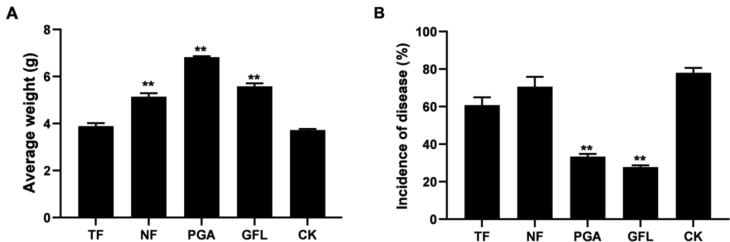
The results revealed that different MIs and GFL could increase the root dry weight of , PGA enhanced it by 83.24%, followed by GFL (49.93%), meanwhile, PGA and GFL were able to lessen root-knot nematode disease incidence by 57.25% and 64.35%. The treatment of PGA and GFL can also effectively reduce heavy metals in roots. The As content in GFL and PGA was decreased by 52.17% and 43.48% respectively, while the Cd and Pb contents of GFL and PGA was decreased somewhat. Additionally, the content of total ginsenosides was increased by 42.14% and 42.07%, in response to TF and NF, respectively. Our metagenomic analysis showed that the relative abundance of particular soil microbial community members related to the biocontrol of root-knot nematode disease and plant pathogen (i.e., in NF in GFL and in PGA), heavy metal bioremediation ( in PGA and in GFL), and nitrogen fixation ( and in TF) was significantly increased; notably, potential harmful microflora, such as and , were more abundant in the control group.
MI and GFL could improve the quality of by modifying its rhizosphere microbial community structure and composition, both of them are beneficial to the development of ecological cultivation of .
寻找一种合适的生态栽培措施,以解决(某植物,原文未明确写出)根结线虫病问题及其根部重金属积累问题。
对三年生(该植物)采用微生物菌剂(MI)和垃圾发酵液(GFL)的四种不同组合进行处理[“土秀”MI与五十钾MI联合施用(TF)、“一号”MI与五十钾MI组合使用(NF)、“谷乐丰”聚γ-谷氨酸MI(PGA)、GFL],以及未处理的对照组(CK)。在此,采用高通量测序、电感耦合等离子体质谱法(ICP-MS)和超高效液相色谱法(UPLC)系统地表征不同处理之间微生物多样性和结构组成、重金属(砷、镉和铅)含量以及人参皂苷含量的变化。
结果表明,不同的MI和GFL可增加(该植物)根干重,PGA使其增加了83.24%,其次是GFL(49.93%),同时,PGA和GFL能够使根结线虫病发病率分别降低57.25%和64.35%。PGA和GFL处理还可有效降低根部重金属含量。GFL和PGA中的砷含量分别降低了52.17%和43.48%,而GFL和PGA中的镉和铅含量有所降低。此外,总人参皂苷含量分别因TF和NF而增加了42.14%和42.07%。我们的宏基因组分析表明,与根结线虫病和植物病原菌生物防治相关的特定土壤微生物群落成员(即GFL中的NF和PGA中的)、重金属生物修复(PGA中的和GFL中的)以及固氮(TF中的和)的相对丰度显著增加;值得注意的是,对照组中潜在有害微生物群落,如和,更为丰富。
MI和GFL可通过改变其根际微生物群落结构和组成来提高(该植物)的品质,二者均有利于(该植物)生态栽培的发展。