Department of Civil and Environmental Engineering, Northwestern University, Evanston, IL, 60208, USA.
NPJ Biofilms Microbiomes. 2022 Sep 19;8(1):72. doi: 10.1038/s41522-022-00335-7.
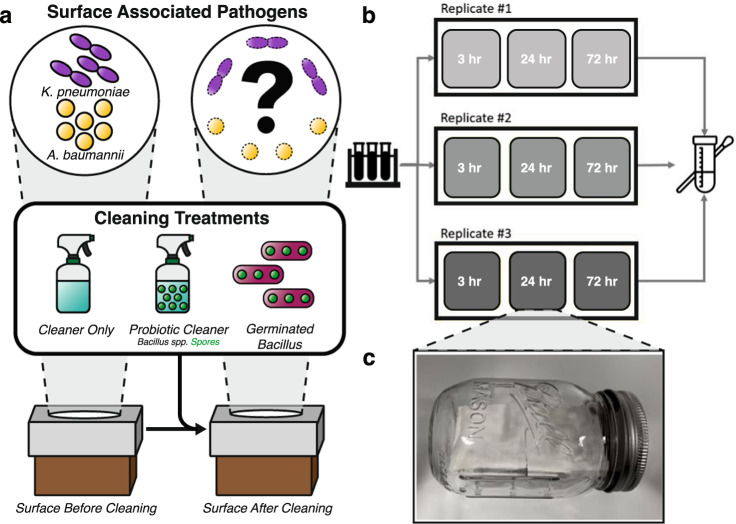
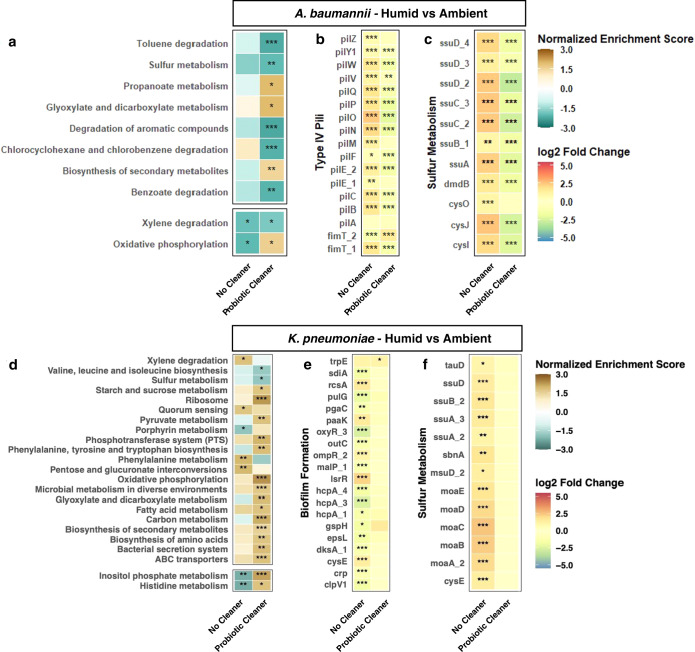
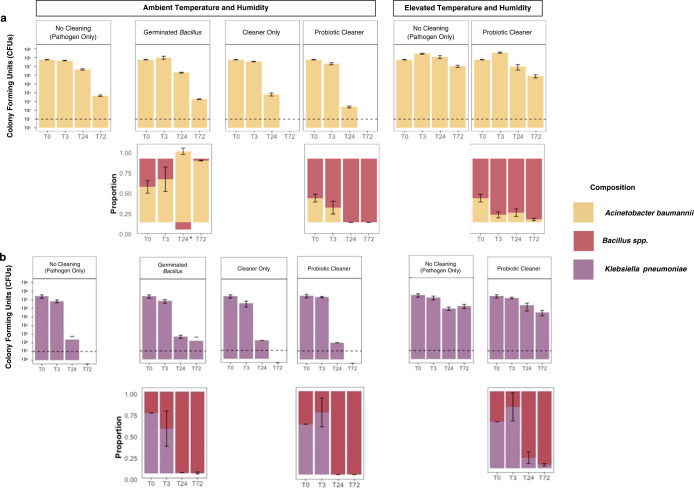
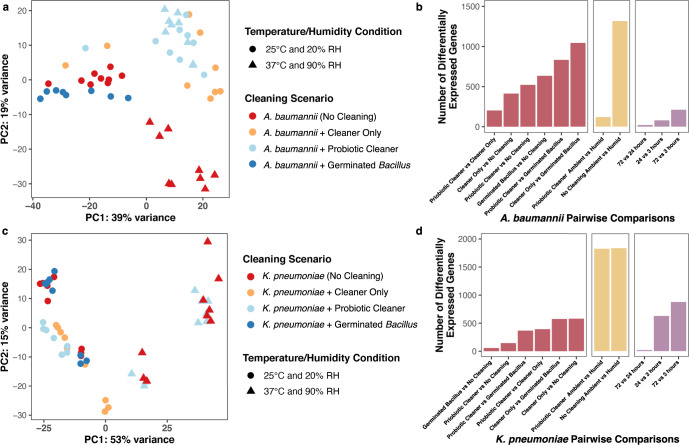
Indoor surfaces are paradoxically presumed to be both colonized by pathogens, necessitating disinfection, and "microbial wastelands." In these resource-poor, dry environments, competition and decay are thought to be important drivers of microbial community composition. However, the relative contributions of these two processes have not been specifically evaluated. To bridge this knowledge gap, we used microcosms to evaluate whether interspecies interactions occur on surfaces. We combined transcriptomics and traditional microbiology techniques to investigate whether competition occurred between two clinically important pathogens, Acinetobacter baumannii and Klebsiella pneumoniae, and a probiotic cleaner containing a consortium of Bacillus species. Probiotic cleaning seeks to take advantage of ecological principles such as competitive exclusion, thus using benign microorganisms to inhibit viable pathogens, but there is limited evidence that competitive exclusion in fact occurs in environments of interest (i.e., indoor surfaces). Our results indicate that competition in this setting has a negligible impact on community composition but may influence the functions expressed by active organisms. Although Bacillus spp. remained viable on surfaces for an extended period of time after application, viable colony forming units (CFUs) of A. baumannii recovered following exposure to a chemical-based detergent with and without Bacillus spp. showed no statistical difference. Similarly, for K. pneumoniae, there were small statistical differences in CFUs between cleaning scenarios with or without Bacillus spp. in the chemical-based detergent. The transcriptome of A. baumannii with and without Bacillus spp. exposure shared a high degree of similarity in overall gene expression, but the transcriptome of K. pneumoniae differed in overall gene expression, including reduced response in genes related to antimicrobial resistance. Together, these results highlight the need to fully understand the underlying biological and ecological mechanisms for community assembly and function on indoor surfaces, as well as having practical implications for cleaning and disinfection strategies for infection prevention.
室内表面被认为既是病原体的栖息地,需要进行消毒,又是“微生物荒地”。在这些资源匮乏、干燥的环境中,竞争和腐烂被认为是微生物群落组成的重要驱动因素。然而,这两个过程的相对贡献尚未得到具体评估。为了弥补这一知识空白,我们使用微宇宙来评估物种间的相互作用是否会在表面发生。我们结合转录组学和传统微生物学技术,研究两种临床重要病原体(鲍曼不动杆菌和肺炎克雷伯菌)与一种含有芽孢杆菌属联合体的益生菌清洁剂之间是否存在竞争。益生菌清洁试图利用竞争排除等生态原则,从而利用良性微生物抑制有活力的病原体,但实际上在室内表面等相关环境中,竞争排除是否发生的证据有限。我们的结果表明,在这种情况下,竞争对群落组成的影响微不足道,但可能会影响活性生物表达的功能。尽管芽孢杆菌属在应用后仍能在表面存活很长时间,但在暴露于含有或不含有芽孢杆菌属的化学清洁剂后,鲍曼不动杆菌的活菌形成单位(CFU)的恢复没有统计学差异。同样,对于肺炎克雷伯菌,在含有或不含有芽孢杆菌属的化学清洁剂的清洁方案中,CFU 之间存在统计学差异较小。有和没有芽孢杆菌属暴露的鲍曼不动杆菌的转录组在总体基因表达上具有高度相似性,但肺炎克雷伯菌的转录组在总体基因表达上存在差异,包括与抗菌药物耐药性相关的基因表达减少。这些结果共同强调了需要充分理解室内表面群落组装和功能的潜在生物学和生态学机制,这对感染预防的清洁和消毒策略具有实际意义。