Stone Wendy, Tolmay Janke, Tucker Keira, Wolfaardt Gideon M
Environmental Microbiology Laboratory, Water Institute, Department of Microbiology, Stellenbosch University, 7602 Stellenbosch, South Africa.
Environmental Microbiology Laboratory, Department of Chemistry and Biology, Ryerson University, Toronto, ON M5B 2K3, Canada.
Microorganisms. 2020 Nov 4;8(11):1726. doi: 10.3390/microorganisms8111726.
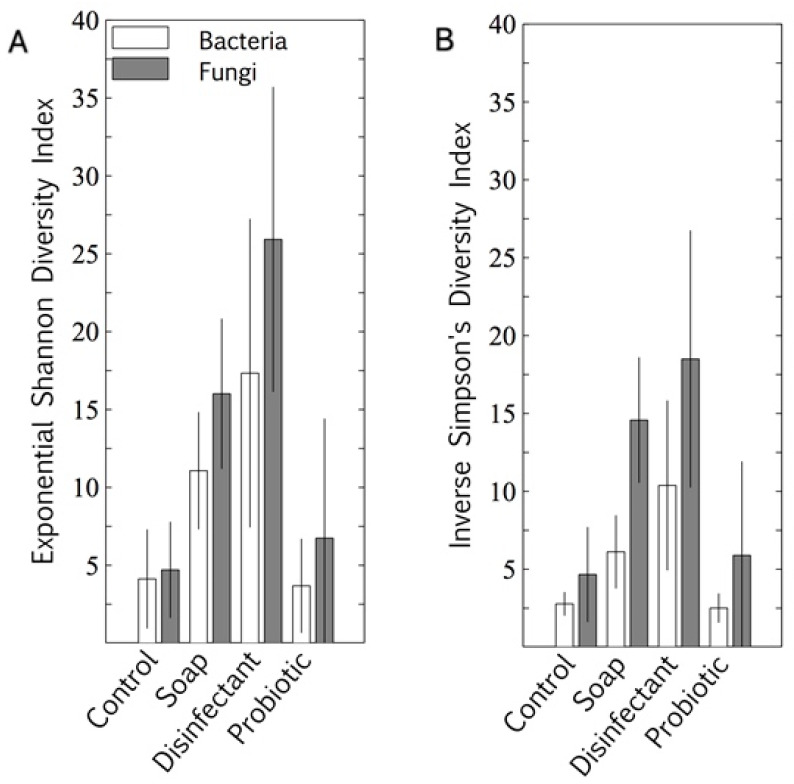
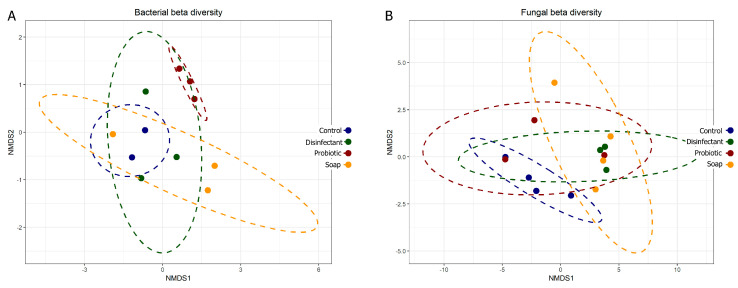
This study extends probiotic cleaning research to a built environment. Through an eight-month cleaning trial, we compared the effect of three cleaning products (disinfectant, plain soap, and a probiotic cleaner containing a patented spore consortium), and tap water as the control, on the resident microbiome of three common hospital surfaces (linoleum, ceramic, and stainless steel). Pathogens, and were deposited and desiccated, and competitive exclusion was assessed for each microbiome. Cell survival was shown to be an incomplete tool for measuring microbial competitive exclusion. Biofilm competition offered a fuller understanding of competitive dynamics. A test for culturable cell survival showed that both plain soap and probiotic cleaner regimes established a surface microbiome that outcompeted the two pathogens. A different picture emerged when observing biofilms with a deposited and desiccated GFP-labeled pathogen, . Competitive exclusion was again demonstrated. On surfaces cleaned with disinfectant the pathogen outcompeted the microbiomes. On surfaces cleaned with plain soap, the microbiomes outcompeted the pathogen. However, on surfaces cleaned with probiotic cleaner, despite the exponentially higher surface microbial loads, the microbiome did not completely outcompete the pathogen. Thus, the standard culturable cell test for survival on a surface confirmed the competitive advantage that is typically reported for probiotic cleaners. However, observation of competition in biofilms showed that the more diverse microbiome (according to alpha and beta indices) established on a surface cleaned with plain soap had a better competitive advantage than the monoculture established by the probiotic cleaner. Therefore, microbial diversity appears to be as critical to the competitive exclusion principle as cell numbers. The study showed that both plain soap and probiotic cleaner fostered competitive exclusion far more effectively than disinfectant. Probiotic cleaners with microbial diversity could be worth considering for hospital cleaning.
本研究将益生菌清洁研究扩展至建筑环境。通过为期八个月的清洁试验,我们比较了三种清洁产品(消毒剂、普通肥皂和含有专利芽孢菌群的益生菌清洁剂)以及作为对照的自来水,对医院三种常见表面(油毡、陶瓷和不锈钢)上的常驻微生物群落的影响。将病原体进行沉积和干燥处理,并评估每种微生物群落的竞争排斥情况。结果表明,细胞存活率是衡量微生物竞争排斥的不完整指标。生物膜竞争能更全面地理解竞争动态。可培养细胞存活率测试表明,普通肥皂和益生菌清洁剂处理方式都能建立起比两种病原体更具竞争力的表面微生物群落。在用沉积并干燥的绿色荧光蛋白标记病原体观察生物膜时,出现了不同的情况。再次证明了竞争排斥现象。在用消毒剂清洁的表面上,病原体比微生物群落更具竞争力。在用普通肥皂清洁的表面上,微生物群落比病原体更具竞争力。然而,在用益生菌清洁剂清洁的表面上,尽管表面微生物负荷呈指数级增加,但微生物群落并未完全胜过病原体。因此,表面存活的标准可培养细胞测试证实了益生菌清洁剂通常所具有的竞争优势。然而,对生物膜竞争的观察表明,在用普通肥皂清洁的表面上建立的更多样化的微生物群落(根据α和β指数)比益生菌清洁剂建立的单一培养物具有更好的竞争优势。因此,微生物多样性似乎与细胞数量一样,对竞争排斥原则至关重要。研究表明,普通肥皂和益生菌清洁剂促进竞争排斥的效果远比消毒剂有效。具有微生物多样性的益生菌清洁剂可能值得考虑用于医院清洁。