Ebrahimi-Zarandi Marzieh, Saberi Riseh Roohallah, Tarkka Mika T
Department of Plant Protection, Faculty of Agriculture, Shahid Bahonar University of Kerman, Kerman 7618411764, Iran.
Department of Plant Protection, Faculty of Agriculture, Vali-e-Asr University of Rafsanjan, Imam Khomeini Square, Rafsanjan 7718897111, Iran.
Microorganisms. 2022 Aug 29;10(9):1739. doi: 10.3390/microorganisms10091739.
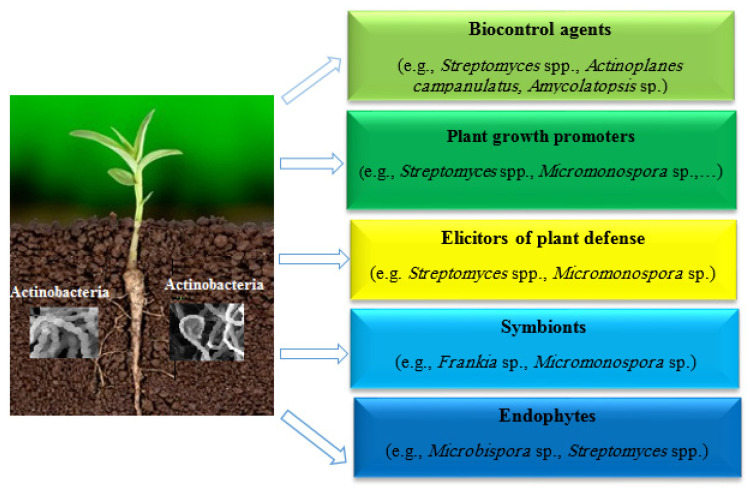
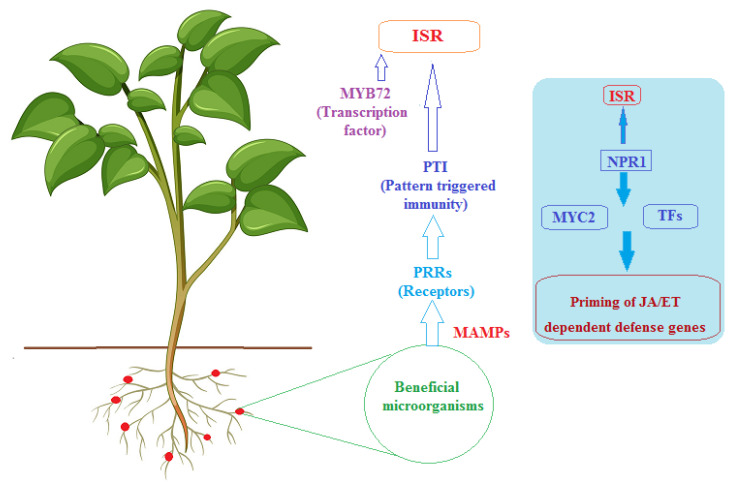
Pathogen suppression and induced systemic resistance are suitable alternative biocontrol strategies for integrated plant disease management and potentially comprise a sustainable alternative to agrochemicals. The use of Actinobacteria as biocontrol agents is accepted in practical sustainable agriculture, and a short overview on the plant-beneficial members of this phylum and recent updates on their biocontrol efficacies are the two topics of this review. Actinobacteria include a large portion of microbial rhizosphere communities and colonizers of plant tissues that not only produce pest-antagonistic secondary metabolites and enzymes but also stimulate plant growth. Non-pathogenic Actinobacteria can also induce systemic resistance against pathogens, but the mechanisms are still poorly described. In the absence of a pathogen, a mild defense response is elicited under jasmonic acid and salicylic acid signaling that involves pathogenesis-related proteins and secondary plant metabolites. Priming response partly includes the same compounds as the response to a sole actinobacterium, and the additional involvement of ethylene signaling has been suggested. Recent amplicon sequencing studies on bacterial communities suggest that future work may reveal how biocontrol active strains of Actinobacteria can be enriched in plant rhizosphere.
病原菌抑制和诱导系统抗性是植物病害综合管理中合适的替代生物防治策略,并且可能构成农用化学品的可持续替代品。在实际的可持续农业中,放线菌作为生物防治剂的使用已被接受,本综述的两个主题是该门植物有益成员的简要概述及其生物防治功效的最新进展。放线菌包括大部分微生物根际群落和植物组织定殖者,它们不仅产生害虫拮抗次生代谢物和酶,还刺激植物生长。非致病性放线菌也能诱导对病原体的系统抗性,但其机制仍知之甚少。在没有病原体的情况下,茉莉酸和水杨酸信号通路会引发轻度防御反应,涉及病程相关蛋白和植物次生代谢物。引发反应部分包括与对单一放线菌的反应相同的化合物,并且有人提出乙烯信号通路也会额外参与其中。最近关于细菌群落的扩增子测序研究表明,未来的工作可能会揭示如何在植物根际富集放线菌的生物防治活性菌株。