Wolfson Institute of Population Health, Barts and the London School of Medicine and Dentistry, Queen Mary University of London, London E1 2AB, UK.
Blizard Institute, Barts and the London School of Medicine and Dentistry, Queen Mary University of London, London E1 2AT, UK.
Nutrients. 2022 Sep 16;14(18):3821. doi: 10.3390/nu14183821.
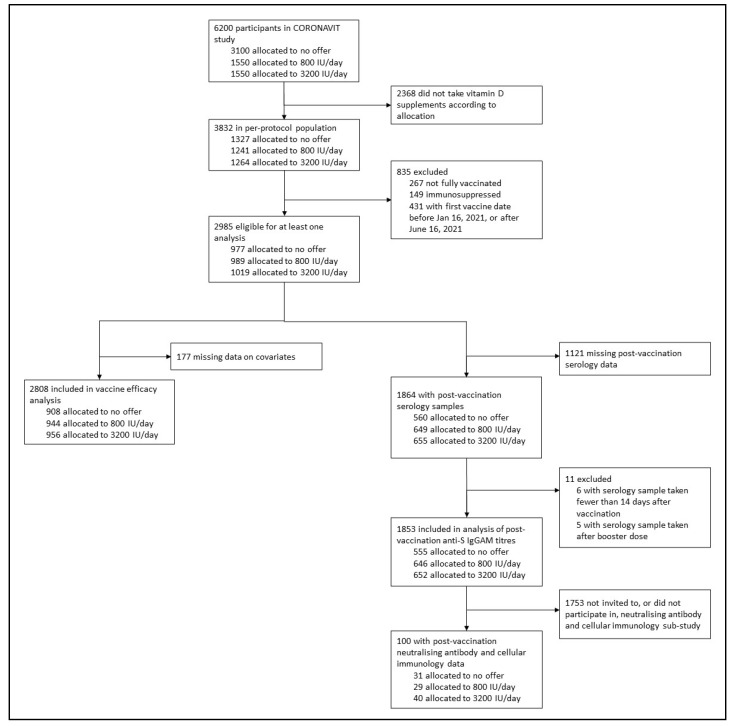
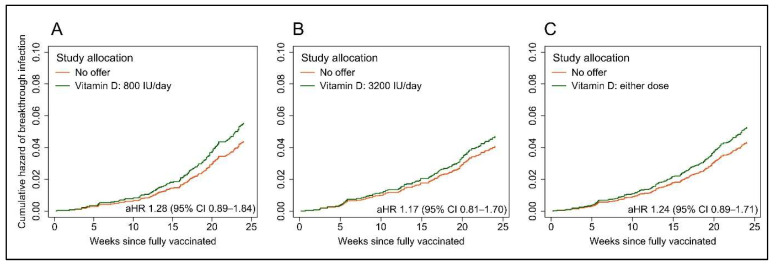
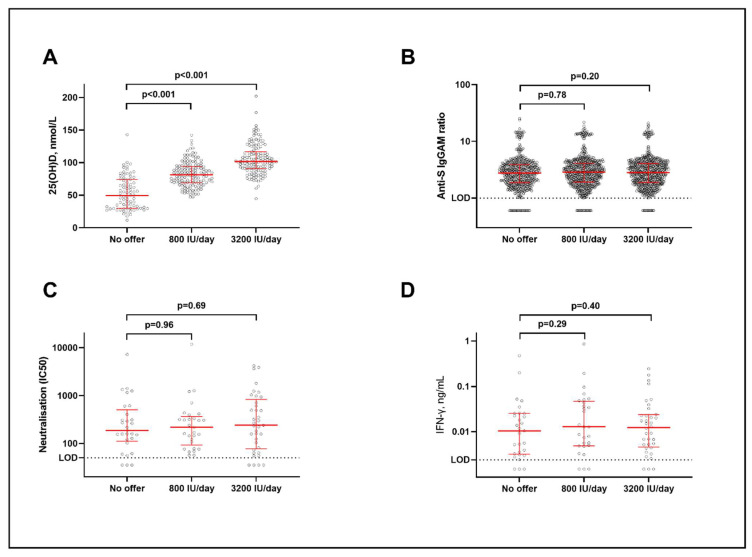
Vitamin D deficiency has been reported to associate with the impaired development of antigen-specific responses following vaccination. We aimed to determine whether vitamin D supplements might boost the immunogenicity and efficacy of SARS-CoV-2 vaccination by conducting three sub-studies nested within the CORONAVIT randomised controlled trial, which investigated the effects of offering vitamin D supplements at a dose of 800 IU/day or 3200 IU/day vs. no offer on risk of acute respiratory infections in UK adults with circulating 25-hydroxyvitamin D concentrations <75 nmol/L. Sub-study 1 (n = 2808) investigated the effects of vitamin D supplementation on the risk of breakthrough SARS-CoV-2 infection following two doses of SARS-CoV-2 vaccine. Sub-study 2 (n = 1853) investigated the effects of vitamin D supplementation on titres of combined IgG, IgA and IgM (IgGAM) anti-Spike antibodies in eluates of dried blood spots collected after SARS-CoV-2 vaccination. Sub-study 3 (n = 100) investigated the effects of vitamin D supplementation on neutralising antibody and cellular responses in venous blood samples collected after SARS-CoV-2 vaccination. In total, 1945/2808 (69.3%) sub-study 1 participants received two doses of ChAdOx1 nCoV-19 (Oxford−AstraZeneca); the remainder received two doses of BNT162b2 (Pfizer). Mean follow-up 25(OH)D concentrations were significantly elevated in the 800 IU/day vs. no-offer group (82.5 vs. 53.6 nmol/L; mean difference 28.8 nmol/L, 95% CI 22.8−34.8) and in the 3200 IU/day vs. no offer group (105.4 vs. 53.6 nmol/L; mean difference 51.7 nmol/L, 45.1−58.4). Vitamin D supplementation did not influence the risk of breakthrough SARS-CoV-2 infection in vaccinated participants (800 IU/day vs. no offer: adjusted hazard ratio 1.28, 95% CI 0.89 to 1.84; 3200 IU/day vs. no offer: 1.17, 0.81 to 1.70). Neither did it influence IgGAM anti-Spike titres, neutralising antibody titres or IFN-γ concentrations in the supernatants of S peptide-stimulated whole blood. In conclusion, vitamin D replacement at a dose of 800 or 3200 IU/day effectively elevated 25(OH)D concentrations, but it did not influence the protective efficacy or immunogenicity of SARS-CoV-2 vaccination when given to adults who had a sub-optimal vitamin D status at baseline.
维生素 D 缺乏与接种疫苗后抗原特异性反应的受损发展有关。我们旨在通过在 CORONAVIT 随机对照试验中嵌套三个子研究来确定维生素 D 补充剂是否可以通过提供 800 IU/天或 3200 IU/天的剂量来增强 SARS-CoV-2 疫苗的免疫原性和功效,以调查提供维生素 D 补充剂对英国成年人急性呼吸道感染风险的影响循环 25-羟维生素 D 浓度<75nmol/L。子研究 1(n=2808)调查了维生素 D 补充剂对两剂 SARS-CoV-2 疫苗接种后突破性 SARS-CoV-2 感染风险的影响。子研究 2(n=1853)调查了维生素 D 补充剂对 SARS-CoV-2 疫苗接种后干燥血斑洗脱液中 IgG、IgA 和 IgM(IgGAM)抗刺突抗体滴度的影响。子研究 3(n=100)调查了维生素 D 补充剂对 SARS-CoV-2 疫苗接种后静脉血样本中中和抗体和细胞反应的影响。共有 1945/2808(69.3%)子研究 1 参与者接受了两剂 ChAdOx1 nCoV-19(牛津-阿斯利康);其余接受了两剂 BNT162b2(辉瑞)。800 IU/天组与无补充组的平均随访 25(OH)D 浓度显著升高(82.5 与 53.6nmol/L;平均差异 28.8nmol/L,95%CI 22.8-34.8)和 3200 IU/天组与无补充组(105.4 与 53.6nmol/L;平均差异 51.7nmol/L,45.1-58.4)。维生素 D 补充剂并未影响接种疫苗参与者突破性 SARS-CoV-2 感染的风险(800 IU/天与无补充:调整后的危害比 1.28,95%CI 0.89-1.84;3200 IU/天与无补充:1.17,0.81-1.70)。它也没有影响 IgGAM 抗刺突抗体滴度、中和抗体滴度或 S 肽刺激全血上清液中的 IFN-γ浓度。总之,每天补充 800 或 3200IU 的维生素 D 可有效提高 25(OH)D 浓度,但在基线时维生素 D 状态不佳的成年人中给予时,并未影响 SARS-CoV-2 疫苗的保护效力或免疫原性。