Ao Di, Vega Marleny M, Shourijeh Mohammad S, Patten Carolynn, Fregly Benjamin J
Rice Computational Neuromechanics Lab, Department of Mechanical Engineering, Rice University, Houston, TX, United States.
Biomechanics, Rehabilitation, and Integrative Neuroscience (BRaIN) Lab, VA Northern California Health Care System, Martinez, CA, United States.
Front Bioeng Biotechnol. 2022 Sep 7;10:962959. doi: 10.3389/fbioe.2022.962959. eCollection 2022.
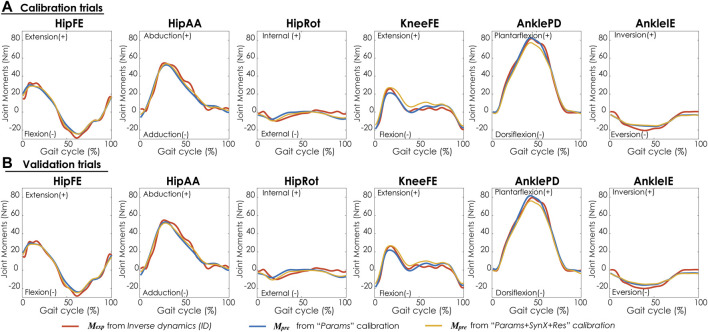
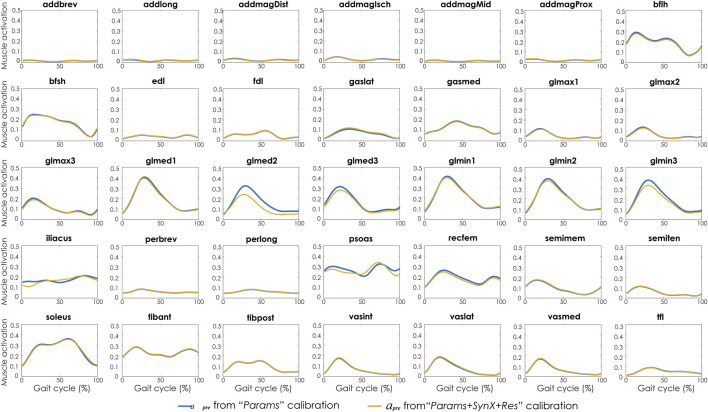
Subject-specific electromyography (EMG)-driven musculoskeletal models that predict muscle forces have the potential to enhance our knowledge of internal biomechanics and neural control of normal and pathological movements. However, technical gaps in experimental EMG measurement, such as inaccessibility of deep muscles using surface electrodes or an insufficient number of EMG channels, can cause difficulties in collecting EMG data from muscles that contribute substantially to joint moments, thereby hindering the ability of EMG-driven models to predict muscle forces and joint moments reliably. This study presents a novel computational approach to address the problem of a small number of missing EMG signals during EMG-driven model calibration. The approach (henceforth called "synergy extrapolation" or SynX) linearly combines time-varying synergy excitations extracted from measured muscle excitations to estimate 1) unmeasured muscle excitations and 2) residual muscle excitations added to measured muscle excitations. Time-invariant synergy vector weights defining the contribution of each measured synergy excitation to all unmeasured and residual muscle excitations were calibrated simultaneously with EMG-driven model parameters through a multi-objective optimization. The cost function was formulated as a trade-off between minimizing joint moment tracking errors and minimizing unmeasured and residual muscle activation magnitudes. We developed and evaluated the approach by treating a measured fine wire EMG signal (iliopsoas) as though it were "unmeasured" for walking datasets collected from two individuals post-stroke-one high functioning and one low functioning. How well unmeasured muscle excitations and activations could be predicted with SynX was assessed quantitatively for different combinations of SynX methodological choices, including the number of synergies and categories of variability in unmeasured and residual synergy vector weights across trials. The two best methodological combinations were identified, one for analyzing experimental walking trials used for calibration and another for analyzing experimental walking trials not used for calibration or for predicting new walking motions computationally. Both methodological combinations consistently provided reliable and efficient estimates of unmeasured muscle excitations and activations, muscle forces, and joint moments across both subjects. This approach broadens the possibilities for EMG-driven calibration of muscle-tendon properties in personalized neuromusculoskeletal models and may eventually contribute to the design of personalized treatments for mobility impairments.
特定受试者的肌电图(EMG)驱动的肌肉骨骼模型可预测肌肉力量,有潜力增进我们对正常和病理运动的内部生物力学及神经控制的了解。然而,实验性EMG测量中的技术差距,例如使用表面电极无法触及深层肌肉或EMG通道数量不足,可能导致难以从对关节力矩有重大贡献的肌肉收集EMG数据,从而阻碍EMG驱动模型可靠预测肌肉力量和关节力矩的能力。本研究提出一种新颖的计算方法,以解决EMG驱动模型校准期间少量缺失EMG信号的问题。该方法(以下称为“协同外推”或SynX)线性组合从测量的肌肉兴奋中提取的时变协同兴奋,以估计1)未测量的肌肉兴奋和2)添加到测量的肌肉兴奋中的残余肌肉兴奋。通过多目标优化,与EMG驱动模型参数同时校准定义每个测量的协同兴奋对所有未测量和残余肌肉兴奋贡献的时不变协同向量权重。成本函数被制定为在最小化关节力矩跟踪误差与最小化未测量和残余肌肉激活幅度之间的权衡。我们通过将测量的细丝EMG信号(髂腰肌)视为从两名中风后个体(一名功能良好,一名功能低下)收集的步行数据集中“未测量”的信号,来开发和评估该方法。针对SynX方法选择的不同组合,包括协同数量以及试验间未测量和残余协同向量权重的变异性类别,定量评估SynX预测未测量肌肉兴奋和激活的效果。确定了两种最佳方法组合,一种用于分析用于校准的实验性步行试验,另一种用于分析未用于校准或用于计算预测新步行运动的实验性步行试验。两种方法组合均始终如一地为两名受试者提供未测量肌肉兴奋和激活、肌肉力量及关节力矩的可靠且有效的估计。这种方法拓宽了个性化神经肌肉骨骼模型中EMG驱动的肌腱特性校准的可能性,并最终可能有助于设计针对运动障碍的个性化治疗方案。