• 文献检索
  • 文档翻译
  • 深度研究
  • 学术资讯
  • Suppr Zotero 插件Zotero 插件
  • 邀请有礼
  • 套餐&价格
  • 历史记录
应用&插件
Suppr Zotero 插件Zotero 插件浏览器插件Mac 客户端Windows 客户端微信小程序
定价
高级版会员购买积分包购买API积分包
服务
文献检索文档翻译深度研究API 文档MCP 服务
关于我们
关于 Suppr公司介绍联系我们用户协议隐私条款
关注我们

Suppr 超能文献

核心技术专利:CN118964589B侵权必究
粤ICP备2023148730 号-1Suppr @ 2026

文献检索

告别复杂PubMed语法,用中文像聊天一样搜索,搜遍4000万医学文献。AI智能推荐,让科研检索更轻松。

立即免费搜索

文件翻译

保留排版,准确专业,支持PDF/Word/PPT等文件格式,支持 12+语言互译。

免费翻译文档

深度研究

AI帮你快速写综述,25分钟生成高质量综述,智能提取关键信息,辅助科研写作。

立即免费体验

寻常性炎性痤疮粉刺内容物中的微生物群由Spp.及其他皮肤微生物过度生长组成。

The Microbiome in Comedonal Contents of Inflammatory Acne Vulgaris is Composed of an Overgrowth of Spp. and Other Cutaneous Microorganisms.

作者信息

Akaza Narifumi, Takasaki Kazuto, Nishiyama Eri, Usui Atsuko, Miura Shiori, Yokoi Aya, Futamura Kyoko, Suzuki Kayoko, Yashiro Youichi, Yagami Akiko

机构信息

Research Laboratories, Nippon Menard Cosmetic Co., Ltd., Nagoya, Japan.

Fasmac Co., Ltd., Kanagawa, Japan.

出版信息

Clin Cosmet Investig Dermatol. 2022 Sep 21;15:2003-2012. doi: 10.2147/CCID.S379609. eCollection 2022.

DOI:10.2147/CCID.S379609
PMID:36172249
原文链接:https://pmc.ncbi.nlm.nih.gov/articles/PMC9510696/
Abstract

BACKGROUND

Acne vulgaris (acne) and cutaneous resident microorganisms are considered to be closely related. However, the bacterial and fungal microbiota in the comedonal contents of inflammatory acne lesions have not yet been investigated in detail.

PURPOSE

To clarify the relationship between cutaneous microorganisms and acne, we examined the microbiome in the comedonal contents of inflammatory acne and on the facial skin of patients with acne using 16s rRNA and ITS gene sequencing with a next-generation sequencer (NGS).

PATIENTS AND METHODS

Twenty-two untreated Japanese acne outpatients were examined. The comedonal contents of inflammatory acne lesions on the face were collected using a comedo extractor. Skin surface samples from facial skin were collected using the swab method.

RESULTS

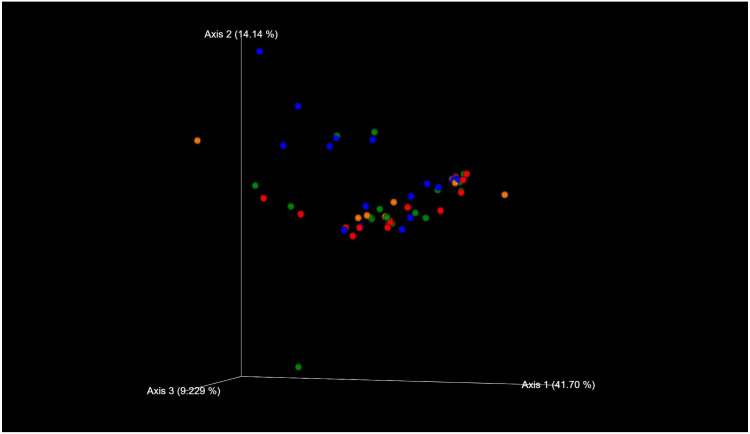
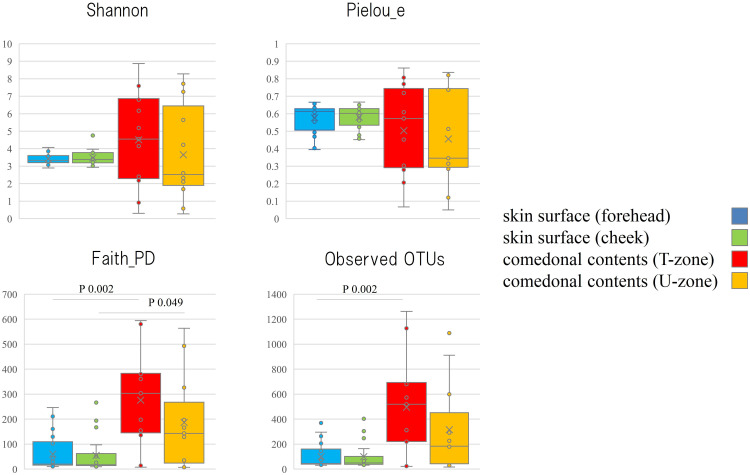
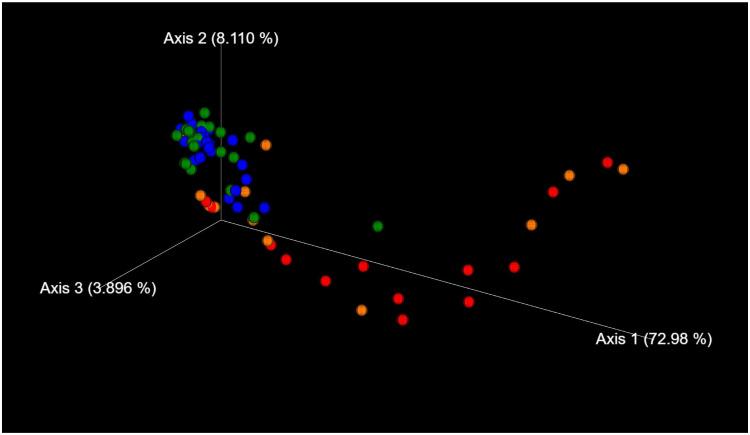
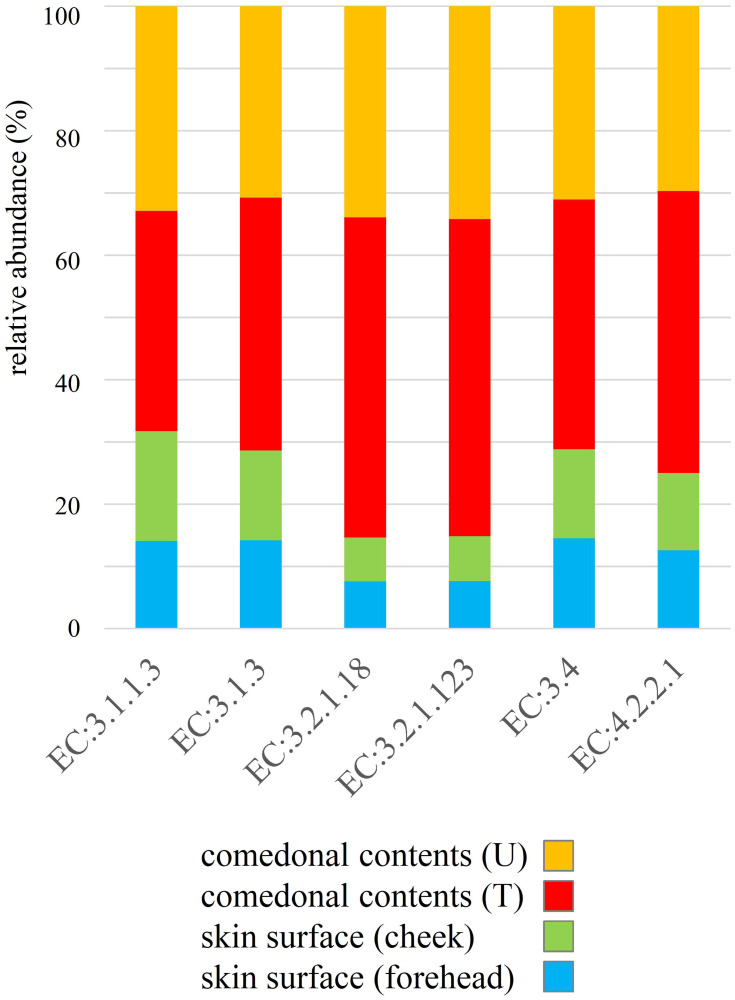
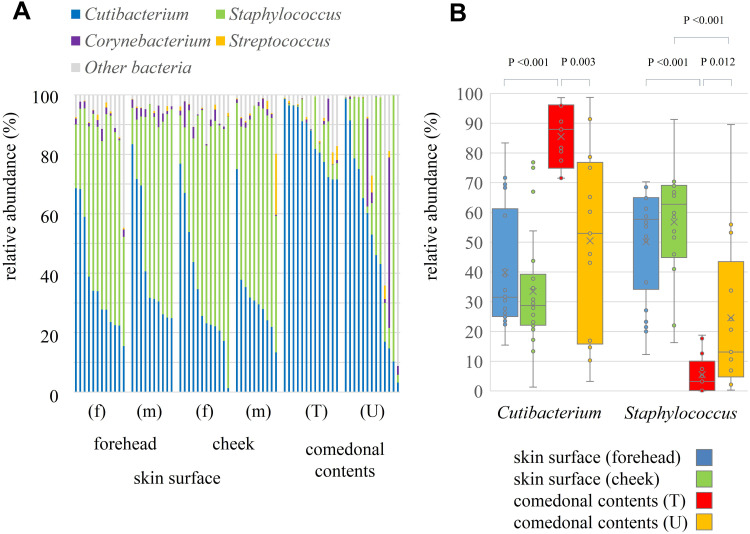
The results obtained revealed that the predominant bacteria in the comedonal contents of inflammatory acne were spp. (more prominent in areas with large amounts of sebum), while those on the skin surface were spp. spp., particularly , were the predominant fungi in both the comedonal contents of inflammatory acne and on the skin surface. The bacterial microbiome in comedonal contents exhibited stronger metabolic activity, including the production of enzymes related to acne, than that on the skin surface.

CONCLUSION

These results indicate that acne is an inflammatory disease involving the overgrowth of and other cutaneous resident microorganisms, including spp.

摘要

背景

寻常痤疮(痤疮)与皮肤常驻微生物被认为密切相关。然而,炎性痤疮皮损粉刺内容物中的细菌和真菌微生物群尚未得到详细研究。

目的

为阐明皮肤微生物与痤疮之间的关系,我们使用下一代测序仪(NGS)通过16s rRNA和ITS基因测序,检测了炎性痤疮粉刺内容物及痤疮患者面部皮肤的微生物组。

患者与方法

对22名未经治疗的日本痤疮门诊患者进行检查。使用粉刺挤压器收集面部炎性痤疮皮损的粉刺内容物。采用拭子法收集面部皮肤表面样本。

结果

所得结果显示,炎性痤疮粉刺内容物中的主要细菌为 菌属(在皮脂分泌量大的区域更为突出),而皮肤表面的主要细菌为 菌属。 菌属,尤其是 菌属,是炎性痤疮粉刺内容物和皮肤表面的主要真菌。粉刺内容物中的细菌微生物组表现出比皮肤表面更强的代谢活性,包括与痤疮相关酶的产生。

结论

这些结果表明,痤疮是一种涉及 菌属和其他皮肤常驻微生物(包括 菌属)过度生长的炎症性疾病。
https://cdn.ncbi.nlm.nih.gov/pmc/blobs/b314/9510696/0033e58493de/CCID-15-2003-g0007.jpg
https://cdn.ncbi.nlm.nih.gov/pmc/blobs/b314/9510696/635d1e6f6926/CCID-15-2003-g0001.jpg
https://cdn.ncbi.nlm.nih.gov/pmc/blobs/b314/9510696/cb34836aea80/CCID-15-2003-g0002.jpg
https://cdn.ncbi.nlm.nih.gov/pmc/blobs/b314/9510696/761245eeed50/CCID-15-2003-g0003.jpg
https://cdn.ncbi.nlm.nih.gov/pmc/blobs/b314/9510696/6a9ac2a02eaa/CCID-15-2003-g0004.jpg
https://cdn.ncbi.nlm.nih.gov/pmc/blobs/b314/9510696/eb4ecb54cbcc/CCID-15-2003-g0005.jpg
https://cdn.ncbi.nlm.nih.gov/pmc/blobs/b314/9510696/69c2b98a1563/CCID-15-2003-g0006.jpg
https://cdn.ncbi.nlm.nih.gov/pmc/blobs/b314/9510696/0033e58493de/CCID-15-2003-g0007.jpg
https://cdn.ncbi.nlm.nih.gov/pmc/blobs/b314/9510696/635d1e6f6926/CCID-15-2003-g0001.jpg
https://cdn.ncbi.nlm.nih.gov/pmc/blobs/b314/9510696/cb34836aea80/CCID-15-2003-g0002.jpg
https://cdn.ncbi.nlm.nih.gov/pmc/blobs/b314/9510696/761245eeed50/CCID-15-2003-g0003.jpg
https://cdn.ncbi.nlm.nih.gov/pmc/blobs/b314/9510696/6a9ac2a02eaa/CCID-15-2003-g0004.jpg
https://cdn.ncbi.nlm.nih.gov/pmc/blobs/b314/9510696/eb4ecb54cbcc/CCID-15-2003-g0005.jpg
https://cdn.ncbi.nlm.nih.gov/pmc/blobs/b314/9510696/69c2b98a1563/CCID-15-2003-g0006.jpg
https://cdn.ncbi.nlm.nih.gov/pmc/blobs/b314/9510696/0033e58493de/CCID-15-2003-g0007.jpg

相似文献

1
The Microbiome in Comedonal Contents of Inflammatory Acne Vulgaris is Composed of an Overgrowth of Spp. and Other Cutaneous Microorganisms.寻常性炎性痤疮粉刺内容物中的微生物群由Spp.及其他皮肤微生物过度生长组成。
Clin Cosmet Investig Dermatol. 2022 Sep 21;15:2003-2012. doi: 10.2147/CCID.S379609. eCollection 2022.
2
Microorganisms inhabiting follicular contents of facial acne are not only Propionibacterium but also Malassezia spp.寄居于面部痤疮毛囊内容物中的微生物不仅有丙酸杆菌,还有马拉色菌属。
J Dermatol. 2016 Aug;43(8):906-11. doi: 10.1111/1346-8138.13245. Epub 2015 Dec 24.
3
Skin Microbiota in Non-inflammatory and Inflammatory Lesions of Acne Vulgaris: The Underlying Changes within the Pilosebaceous Unit.痤疮非炎性和炎性皮损中的皮肤微生物群:毛囊皮脂腺单位内的潜在变化。
Mycopathologia. 2021 Dec;186(6):863-869. doi: 10.1007/s11046-021-00586-6. Epub 2021 Sep 8.
4
Inferences in microbial structural signatures of acne microbiome and mycobiome.痤疮微生物组和真菌组的微生物结构特征的推论。
J Microbiol. 2021 Apr;59(4):369-375. doi: 10.1007/s12275-021-0647-1. Epub 2021 Feb 10.
5
The increasing importance of the gut microbiome in acne vulgaris.肠道微生物组在寻常痤疮中的重要性日益增加。
Folia Microbiol (Praha). 2022 Dec;67(6):825-835. doi: 10.1007/s12223-022-00982-5. Epub 2022 Jun 16.
6
The microbiome in preadolescent acne: Assessment and prospective analysis of the influence of benzoyl peroxide.青春期前痤疮中的微生物群:过氧化苯甲酰影响的评估与前瞻性分析
Pediatr Dermatol. 2019 Mar;36(2):200-206. doi: 10.1111/pde.13741. Epub 2019 Jan 18.
7
Analysis of facial skin-resident microbiota in Japanese acne patients.日本痤疮患者面部皮肤常驻微生物群分析。
Dermatology. 2014;228(1):86-92. doi: 10.1159/000356777. Epub 2013 Dec 20.
8
Association of Systemic Antibiotic Treatment of Acne With Skin Microbiota Characteristics.痤疮的系统性抗生素治疗与皮肤微生物组特征的关联。
JAMA Dermatol. 2019 Apr 1;155(4):425-434. doi: 10.1001/jamadermatol.2018.5221.
9
The Skin Microbiome: A New Actor in Inflammatory Acne.皮肤微生物组:炎症性痤疮的新角色。
Am J Clin Dermatol. 2020 Sep;21(Suppl 1):18-24. doi: 10.1007/s40257-020-00531-1.
10
Skin microbiome and acne vulgaris: Staphylococcus, a new actor in acne.皮肤微生物组与寻常痤疮:葡萄球菌,痤疮发病新的“主角”。
Exp Dermatol. 2017 Sep;26(9):798-803. doi: 10.1111/exd.13296. Epub 2017 Apr 10.

引用本文的文献

1
Beyond the Skin: Exploring the Gut-Skin Axis in Chronic Spontaneous Urticaria and Other Inflammatory Skin Diseases.皮肤之外:探索慢性自发性荨麻疹及其他炎症性皮肤病中的肠-皮肤轴
Biomedicines. 2025 Aug 19;13(8):2014. doi: 10.3390/biomedicines13082014.
2
Skin-associated commensal microorganisms and their metabolites.皮肤共生微生物及其代谢产物。
J Appl Microbiol. 2025 May 2;136(5). doi: 10.1093/jambio/lxaf111.
3
Microecology in vitro model replicates the human skin microbiome interactions.体外微生态模型可复制人类皮肤微生物群的相互作用。

本文引用的文献

1
PICRUSt2 for prediction of metagenome functions.用于宏基因组功能预测的PICRUSt2
Nat Biotechnol. 2020 Jun;38(6):685-688. doi: 10.1038/s41587-020-0548-6.
2
Reproducible, interactive, scalable and extensible microbiome data science using QIIME 2.使用QIIME 2进行可重复、交互式、可扩展和可延伸的微生物组数据科学研究。
Nat Biotechnol. 2019 Aug;37(8):852-857. doi: 10.1038/s41587-019-0209-9.
3
Skin microbiome differences relate to the grade of acne vulgaris.皮肤微生物组的差异与寻常痤疮的严重程度有关。
Nat Commun. 2025 Mar 31;16(1):3085. doi: 10.1038/s41467-025-58377-2.
4
Modulations of the skin microbiome in skin disorders: A narrative review from a wound care perspective.皮肤疾病中皮肤微生物组的调节:从伤口护理角度的叙述性综述。
Int Wound J. 2024 Oct;21(10):e70087. doi: 10.1111/iwj.70087.
5
Proteomic and transcriptomic analyses of biofilms and planktonic cultures in presence of epinephrine.在肾上腺素存在的情况下对生物膜和浮游培养物进行蛋白质组学和转录组学分析。
AIMS Microbiol. 2024 May 27;10(2):363-390. doi: 10.3934/microbiol.2024019. eCollection 2024.
6
An optimal method for quantifying the facial sebum level and characterizing facial sebum features.一种量化面部皮脂水平和描述面部皮脂特征的最佳方法。
Skin Res Technol. 2023 Sep;29(9):e13454. doi: 10.1111/srt.13454.
7
New insights into the characteristic skin microorganisms in different grades of acne and different acne sites.不同痤疮分级及不同痤疮部位特征性皮肤微生物的新见解。
Front Microbiol. 2023 Apr 27;14:1167923. doi: 10.3389/fmicb.2023.1167923. eCollection 2023.
8
Microbiomes in Acne Vulgaris and Their Susceptibility to Antibiotics in Indonesia: A Systematic Review and Meta-Analysis.印度尼西亚寻常痤疮中的微生物群及其对抗生素的敏感性:系统评价与荟萃分析
Antibiotics (Basel). 2023 Jan 11;12(1):145. doi: 10.3390/antibiotics12010145.
9
The Prevalence, Associated Factors, and Clinical Characterization of folliculitis in Patients Clinically Diagnosed with Acne Vulgaris.临床诊断为寻常痤疮患者中毛囊炎的患病率、相关因素及临床特征
Clin Cosmet Investig Dermatol. 2022 Dec 10;15:2647-2654. doi: 10.2147/CCID.S395654. eCollection 2022.
J Dermatol. 2019 Sep;46(9):787-790. doi: 10.1111/1346-8138.14952. Epub 2019 Jul 10.
4
Potential Role of the Microbiome in Acne: A Comprehensive Review.微生物群落在痤疮中的潜在作用:综述
J Clin Med. 2019 Jul 7;8(7):987. doi: 10.3390/jcm8070987.
5
Staphylococcus epidermidis: A Potential New Player in the Physiopathology of Acne?表皮葡萄球菌:痤疮病理生理学的新潜在因素?
Dermatology. 2019;235(4):287-294. doi: 10.1159/000499858. Epub 2019 May 21.
6
Acne, the Skin Microbiome, and Antibiotic Treatment.痤疮、皮肤微生物组与抗生素治疗。
Am J Clin Dermatol. 2019 Jun;20(3):335-344. doi: 10.1007/s40257-018-00417-3.
7
Skin microbiome and acne vulgaris: Staphylococcus, a new actor in acne.皮肤微生物组与寻常痤疮:葡萄球菌,痤疮发病新的“主角”。
Exp Dermatol. 2017 Sep;26(9):798-803. doi: 10.1111/exd.13296. Epub 2017 Apr 10.
8
The balance of metagenomic elements shapes the skin microbiome in acne and health.宏基因组元素的平衡塑造了痤疮和健康皮肤中的微生物组。
Sci Rep. 2016 Dec 21;6:39491. doi: 10.1038/srep39491.
9
Staphylococcal LTA-Induced miR-143 Inhibits Propionibacterium acnes-Mediated Inflammatory Response in Skin.葡萄球菌脂磷壁酸诱导的miR-143抑制痤疮丙酸杆菌介导的皮肤炎症反应。
J Invest Dermatol. 2016 Mar;136(3):621-630. doi: 10.1016/j.jid.2015.12.024. Epub 2015 Dec 29.
10
Microorganisms inhabiting follicular contents of facial acne are not only Propionibacterium but also Malassezia spp.寄居于面部痤疮毛囊内容物中的微生物不仅有丙酸杆菌,还有马拉色菌属。
J Dermatol. 2016 Aug;43(8):906-11. doi: 10.1111/1346-8138.13245. Epub 2015 Dec 24.